We always keep our cryptocurrency nodes up to date to provide our users with the best mining experience. This is the list of the most important node updates of August.
Ergo Protocol Reference Client 4.0.41
Beam Node Groovy Gluon 7.1.13105
Zcash v5.2.0-gd6d2093beb6
Monero v0.18.0.0-release
Monero Hard Fork
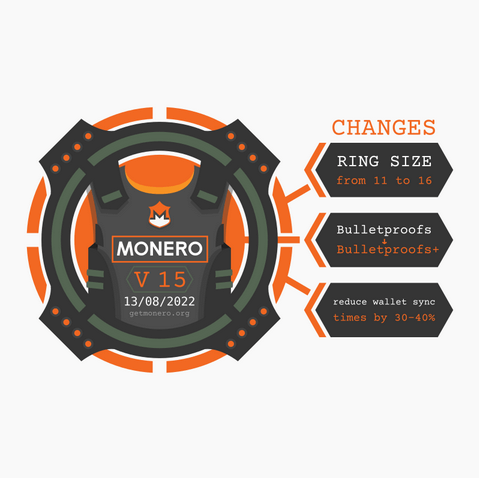
An important Monero (XMR) upgrade v15 took place on August 13th at block 2 688 888. The hard fork was initially scheduled for July but it was manually postponed because of the extra time required for the hardware wallet and multi-sig audit.
The transactions issued by old XMR nodes are not accepted by the network anymore. Make sure to upgrade your wallets to continue using Monero.
This upgrade increased the network anonymity, reduced the transaction size by 5-7%, and improved the transaction propagation speed. Wallet synchronization became almost 50% faster. You could find the complete upgrade list on Monero’s official blog.
Ethereum DAG File Reached 5GB. ASIC Issues
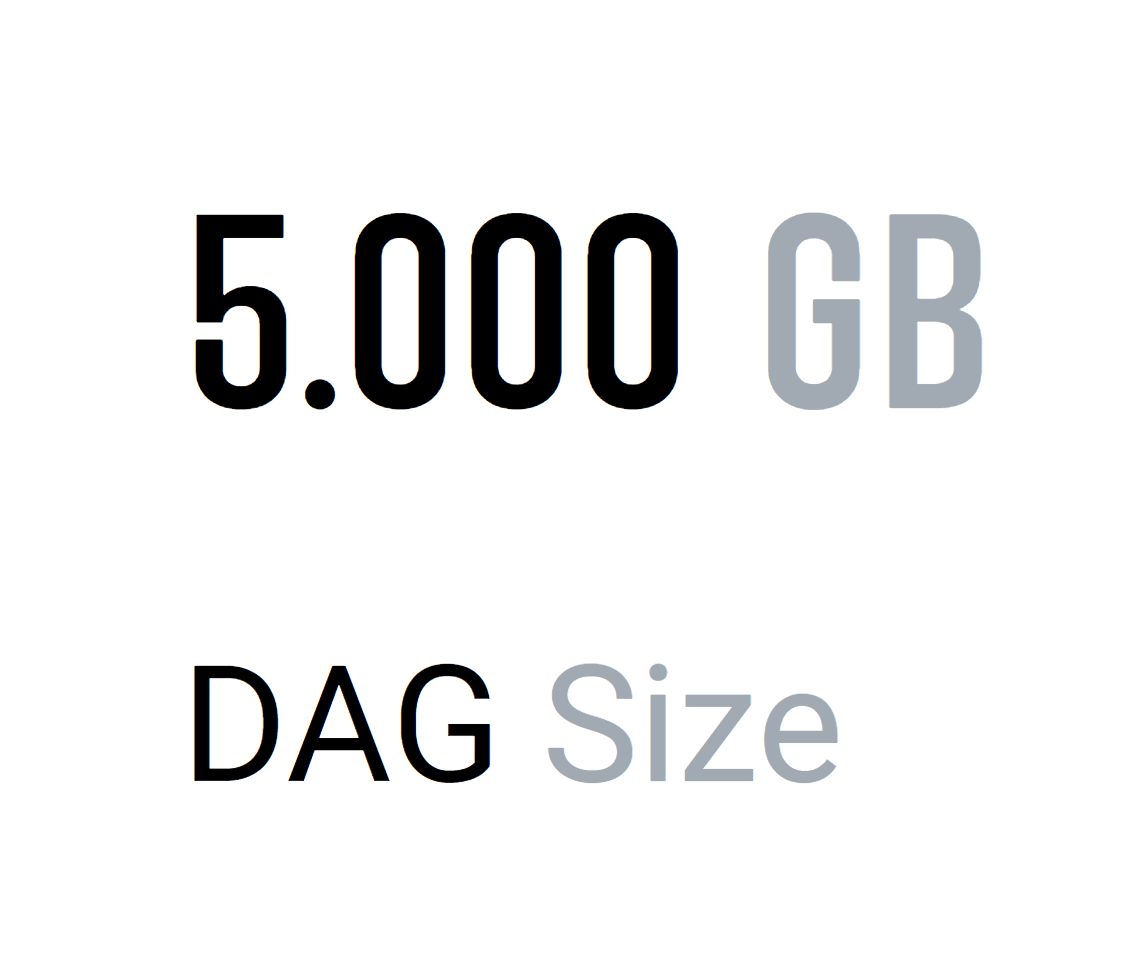
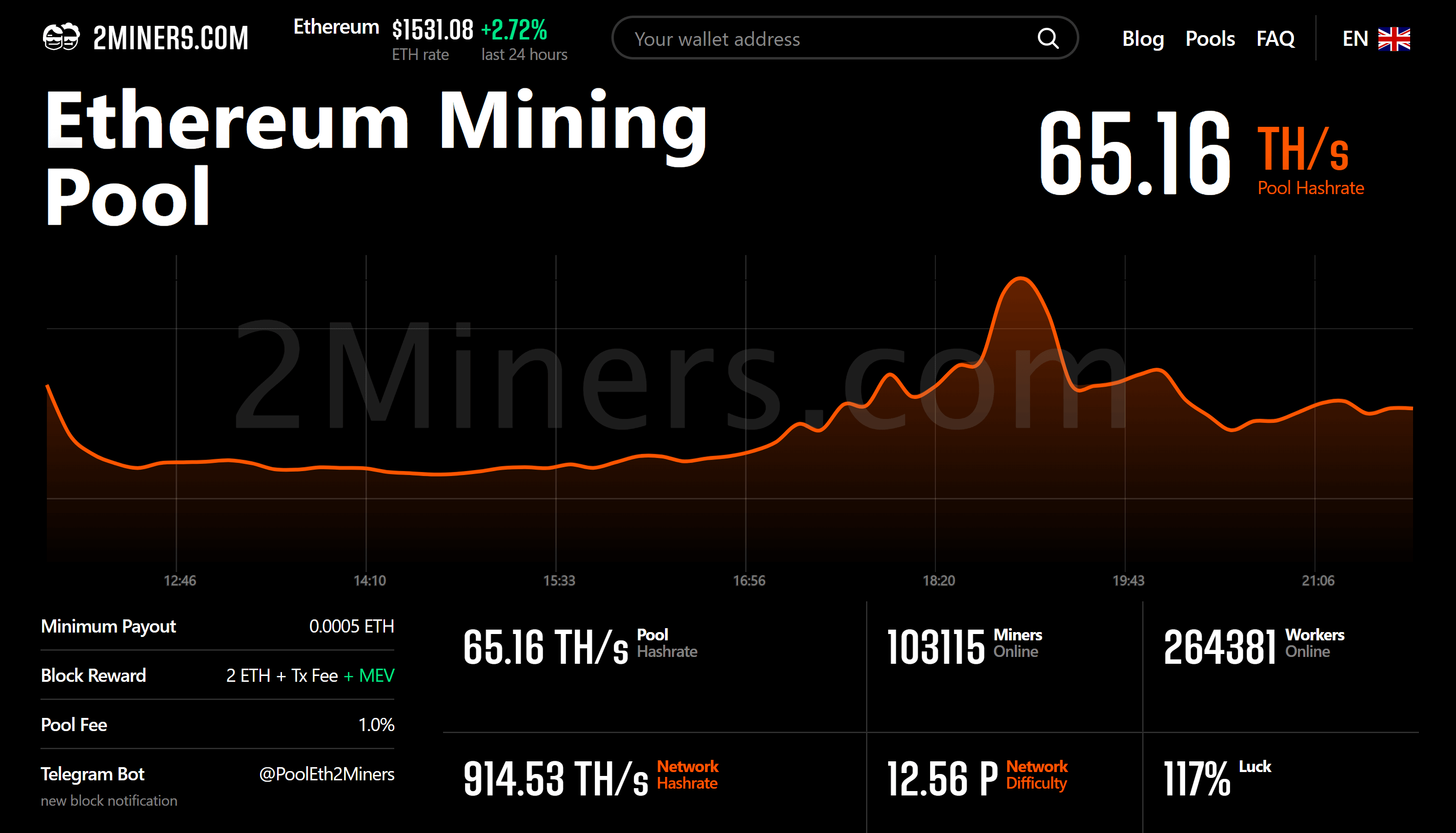
This month Ethereum DAG file size reached 5 GB. Unfortunately, all Innosilicon A10 devices do not mine Ethereum since that event. This is caused by an unknown hardware/software issue. It seems that developers could not (or don’t want to) solve this issue in the nearest time. The Ethereum mining era should end in the middle of September so it seems these devices won’t be able to mine ETH anymore. Please note that Innosilicon A11 machines were not affected by this problem.
Ethereum cryptocurrency switches from POW to POS in the middle of September. This event is called the Merge and it should take place approximately on September 14th. Since the Merge event, no Ethereum mining would be possible.
We suggest all our miners switch to ETC, RVN, or ERGO coins. It is still hard to say which of them would be the most profitable coin when such a huge hashpower which was occupied by ETH mining is released. 2CryptoCalc.com always helps you find the most profitable coin for your hardware.
After the Merge, we will process one last payout to all the Ethereum pool users. The last BTC and NANO payout may be delayed because of crypto exchange maintenance caused by the Merge. You don’t need to request the final payout or claim it anyhow. We will pay all the unpaid balances that are over the minimum Ethereum pool payout threshold.
Ethereum Classic (ETC) is the closest cryptocurrency to Ethereum (ETH). The main difference is the minor change in the mining algorithm. It is quite easy to set up ETC mining. Below you could find the settings for popular mining software Gminer, T-Rex, lolMiner. If you mine with an ASIC device the firmware update is most likely required.
Settings for Gminer miner.exe --algo etchash --server etc.2miners.com:1010 --user YOUR_WALLET_ADDRESS.RIG_ID
Settings for lolMiner lolMiner.exe --algo ETCHASH --pool etc.2miners.com:1010 --user YOUR_WALLET_ADDRESS.RIG_ID
Settings for T-Rex t-rex.exe -a etchash -o stratum+tcp://etc.2miners.com:1010 -u YOUR_WALLET_ADDRESS -w RIG_ID -p x
The wallet address for ETH and ETC is absolutely the same. Sometimes (especially if you use the local wallet) it is possible to use the same address for both ETH and ETC just by switching the different networks in the wallet settings. However, that is not always possible and we highly recommend you generate the new ETC address before you start mining to avoid any inconveniences.
The 2Miners pool co-founder, businessman, miner. In 2017 started mining cryptocurrencies and built many rigs on his own. As a result, he gained lots of practical knowledge and became interested in sharing it with others.
In his articles on 2Miners, he shares useful tips that he tried and tested himself. For example, Darek gives advice on how to buy hardware components for the basic mining rig and how to connect them to each other correctly. He also explained lots of complicated terms in simple words, such as shares, mining luck, block types, and cryptocurrency wallets. After the pool was launched, he published a series of articles ‘Crypto Mythbusters’ where he explained how to protect the network against 51% attack, talked about cryptocurrency mining difficulty and difficulties of launching your own node.
Fin de la minería de Ethereum: ¿Cuándo? ¿Qué minar a continuación con GPU? Explicación de la transición a POS
August 31, 2022
Se espera el cambio del mecanismo de consenso de Ethereum de Prueba de Trabajo (POW) a Prueba de Participación (POS) a mediados de Septiembre. Este evento también se conoce como Merge (fusión). Cuando esto suceda, la minería de Ethereum finalizará y no se podrá extraer más ETH con GPU o ASIC. Demos un vistazo detallado al Merge y cómo funcionará el grupo Ethereum de 2Miners en Septiembre.
Cuando termina la minería de Ethereum
Los desarrolladores de Ethereum han definido la condición para el cambio de POW a POS. Operan con el parámetro conocido como Dificultad Terminal Total (TTD) de la red Ethereum. El cálculo de TTD es bastante complicado. En palabras simples, es un contador (una variable) que crece con cada nuevo bloque que se encuentra en la red Ethereum.
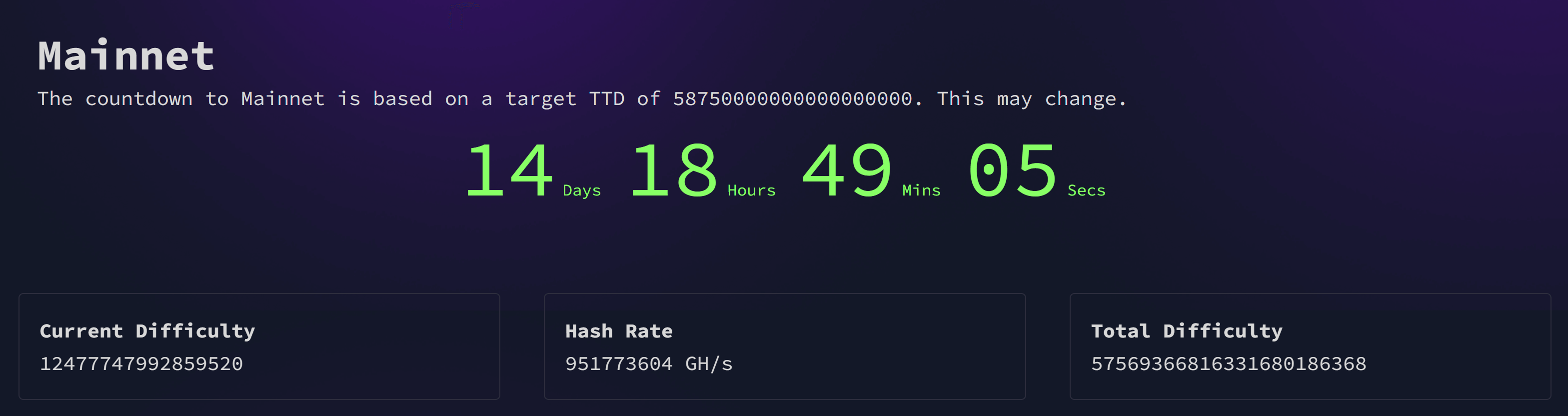
Wen Merge? (Cuando la fusión?) es un sitio web impresionante con el contador de la fusión. Siempre puede verificar la dificultad total (TTD) actual allí.
El TTD actual es 57 569 366 816 331 680 186 368
La fusión ocurre cuando el TTD alcanza los 58 750 000 000 000 000 000 000 Esto
sucede aproximadamente el 14 de septiembre.
¿Es exacta esta fecha?
Sí, esta fecha es bastante precisa. Se podrían ver algunos cambios menores si el hashrate de Ethereum cambia severamente. No creemos que esto pueda suceder en las próximas dos semanas.
¿Hay algún factor que pueda alterar la transición a la fecha del PoS?
Sí, los desarrolladores de Ethereum podrían posponer la fusión a un TTD más alto. Sin embargo, este es un evento extremadamente improbable.
Como sucederá el merge
Hemos escuchado muchos rumores de que la minería ETH aún sería posible después de la fusión, solo que la dificultad de minado aumentaría debido a la bomba de dificultad, etc. Eso no es cierto. Cuando ocurra la fusión, la red Ethereum ya no aceptará bloques minados por POW. Así que la minería simplemente muere.
La minería de Ethereum (ETH) se detiene a mediados de septiembre (aproximadamente el 14 de septiembre). No será posible minar más ETH.
Como operará el pool ETH de 2Miners
En ese momento en particular, cuando el TTD de Ethereum alcanza el valor preestablecido de 58 750 000 000 000 000 000 000, el grupo ya no puede encontrar un nuevo bloque ETH y ser recompensado. La fecha y hora del evento no es precisa, por lo tanto, operaremos hasta que ocurra la fusión.
Estamos agradecidos de tener un grupo minero ETH tan impresionante y la comunidad minera que tenemos. Más de 100K mineros están minando Ethereum en 2Miners. ¡Nos gustaría decir MUCHAS GRACIAS! a todos nuestros mineros. No es por halagar, siempre defendemos a nuestros mineros, ¡ustedes molan! En este triste momento, lucharemos hasta el último bloque minado.
Cuando se produzca la fusión, el grupo seguirá aceptando shares durante un corto período de tiempo. Obviamente, no se podrán acreditar recompensas después del Merge. Nos gustaría cambiarlos automáticamente al grupo de minería ETC (Ethereum Classic). Sin embargo, eso es imposible porque ETC utiliza una versión modificada del algoritmo de minería Ethash llamado Etchash. Deberá reconfigurar su software para hacerlo.
Pagos del grupo Ethereum de 2Miners
Los pagos se procesarán de la manera estándar hasta la fusión.
Los pagos a las direcciones ETH se procesan cada 2 horas (generalmente mucho más rápido si no hay una larga cola). Los pagos a las direcciones BTC y NANO se procesan una vez al día a las 12:00 UTC.
Después de la fusión, procesaremos un último pago a todos los usuarios del grupo Ethereum. Debería suceder en un par de horas después de Merge. Podría retrasarse ligeramente debido a posibles problemas de red. ETH nunca antes operó utilizando el consenso de POS. Cualquier cosa podía pasar. Muchos Exchange de criptomonedas pueden suspender los depósitos y retiros de ETH durante el tiempo de la fusión. Utilizamos Kraken y Binance para procesar los pagos en BTC o NANO. Tenga en cuenta que el último pago de BTC / NANO puede retrasarse hasta que uno de estos Exchange reanude sus operaciones con Ethereum.
No necesita solicitar el pago final ni reclamarlo de todos modos. No necesita cambiar su umbral de pago tampoco si es demasiado alto. Pagaremos todos los saldos impagos que superen el umbral mínimo de pago del grupo Ethereum.
Para direcciones ETH, 0.01 ETH;
Para direcciones BTC, 0.005 ETH;
Para direcciones NANO, 0.0005 ETH.
Que minar cuando finalice la minería de Ethereum
Hay muchas monedas que podrías minar luego de que termine la minería de Ethereum. Tenemos una publicación donde todas ellas se enumeran Qué minar cuando Ethereum se vuelve POS (En inglés).
Obviamente, cuando la minería ETH termina, se liberaría un enorme poder de hash. Los cálculos de rentabilidad pueden ser inexactos durante un corto período de tiempo, mientras que los mineros cambiarían constantemente de una moneda a otra. 2Miners.com le brinda la mejor experiencia posible al ofrecer todos los grupos de minería de altcoin en un solo lugar. Simplemente abra 2Miners.com, elija la moneda que sea más rentable para su hardware y comience a minar.
Algunas monedas tienen un hashrate enorme y otras son bastante pequeñas. Ninguna moneda podría compararse con Ethereum en términos de poder de hash, pero Ethereum Classic, Ravencoin y Ergo son los perseguidores más cercanos. Elegir uno de ellos es la estrategia post-merge más segura. Al menos durante los primeros días.
Cambio a la minería ETC
Cambiar el host del grupo en su software de minería de eth.2miners.com:2020 a etc.2miners.com:1010
Cambiar el algoritmo de minería de ethash a etchash.
ETH y ETC tienen el mismo formato de billetera. A veces es posible mantener la dirección de su billetera ETH. Todo lo que necesita es simplemente cambiar la red de ETH a ETC en su billetera. A veces, el proceso es más difícil, especialmente si utiliza un Exchange de criptomonedas. También admitimos los pagos de BTC para el grupo Ethereum Classic.
Si utiliza un dispositivo ASIC, es posible que se requiera un nuevo firmware. Aquí está la publicación detallada sobre las máquinas de Innosilicon.
URL: stratum+tcp://etc.2miners.com:1010

Worker: YOUR_ADDRESS.ASIC_ID

Password: x
Nicehash es compatible. Custom pool name: 2Miners ERG Algorithm: Autolykos Stratum hostname or IP: erg.2miners.com Port: 8888 Username: YOUR_WALLET_ADDRESS Password: x
Minería EthereumPoW
El nuevo proyecto llamado EthereumPoW (ETHW) apareció recientemente. El equipo de desarrolladores quiere mantenerse en la blockchain original de Ethereum sin cambiar a POS. No creemos que sea posible cambiar los mineros de la minería ETH a ETHW sin problemas. La red ETHW se iniciará en algún momento después del evento Merge en sí.
Actualmente, estamos discutiendo la posibilidad de agregar ETHW a 2Miners y estamos en contacto con los desarrolladores del proyecto. Los mantendremos informados sobre este asunto. También agregaremos EthereumPoW a 2CryptoCalc cuando comience la minería ETHW.
Qué minar con GPU en 2023
El cambio de Ethereum a Proof-of-Stake es, sin lugar a dudas, uno de los eventos más importantes en la historia de la minería de criptomonedas de todos los tiempos. Los desarrolladores de ETH planearon esto desde el principio, pero no mucha gente esperaba que esto sucediera en 2022. Ethereum siempre fue el impulsor más importante de la industria minera de tarjetas gráficas. El próximo año, el proceso de minería de GPU no será tan fácil como antes. En 2023 debes elegir las monedas que extraes sabiamente. Los tiempos en los que podías simplemente configurar la minería ETH en tu plataforma y olvidarte de ella durante un par de años han pasado. Ahora siempre necesita calcular la rentabilidad teniendo en cuenta sus costos operativos, especialmente el consumo de energía.
Qué minar con las tarjetas de video Nvidia en 2023
Las GPU Nvidia siempre proporcionan la mejor flexibilidad en términos de minería. Nvidia puede procesar bien todos los algoritmos de GPU que existen. Incluso si no has notado antes, podríamos asegurarte que es una ventaja de esta marca en comparación con AMD.
Hay muchas tarjetas antiguas de bajo nivel como Nvidia GeForce GTX 1050 Ti que aún podrían minar con una rentabilidad de hasta $0.3 / día.
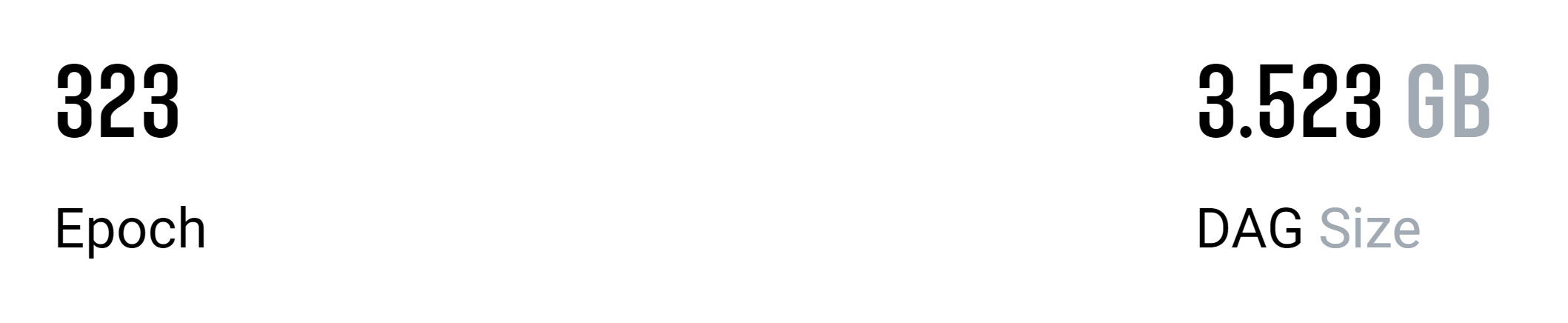
4 GB de memoria es suficiente para casi todas las monedas, incluido Ravencoin. El archivo DAG de RVN es actualmente de 3.523 GB. Eso significa que aún puede extraer RVN con una tarjeta de 4 GB, pero solo si opera con el sistema operativo Linux. Sería bastante imposible ejecutar la minería de Ravencoin con una GTX 1050 Ti en Windows.
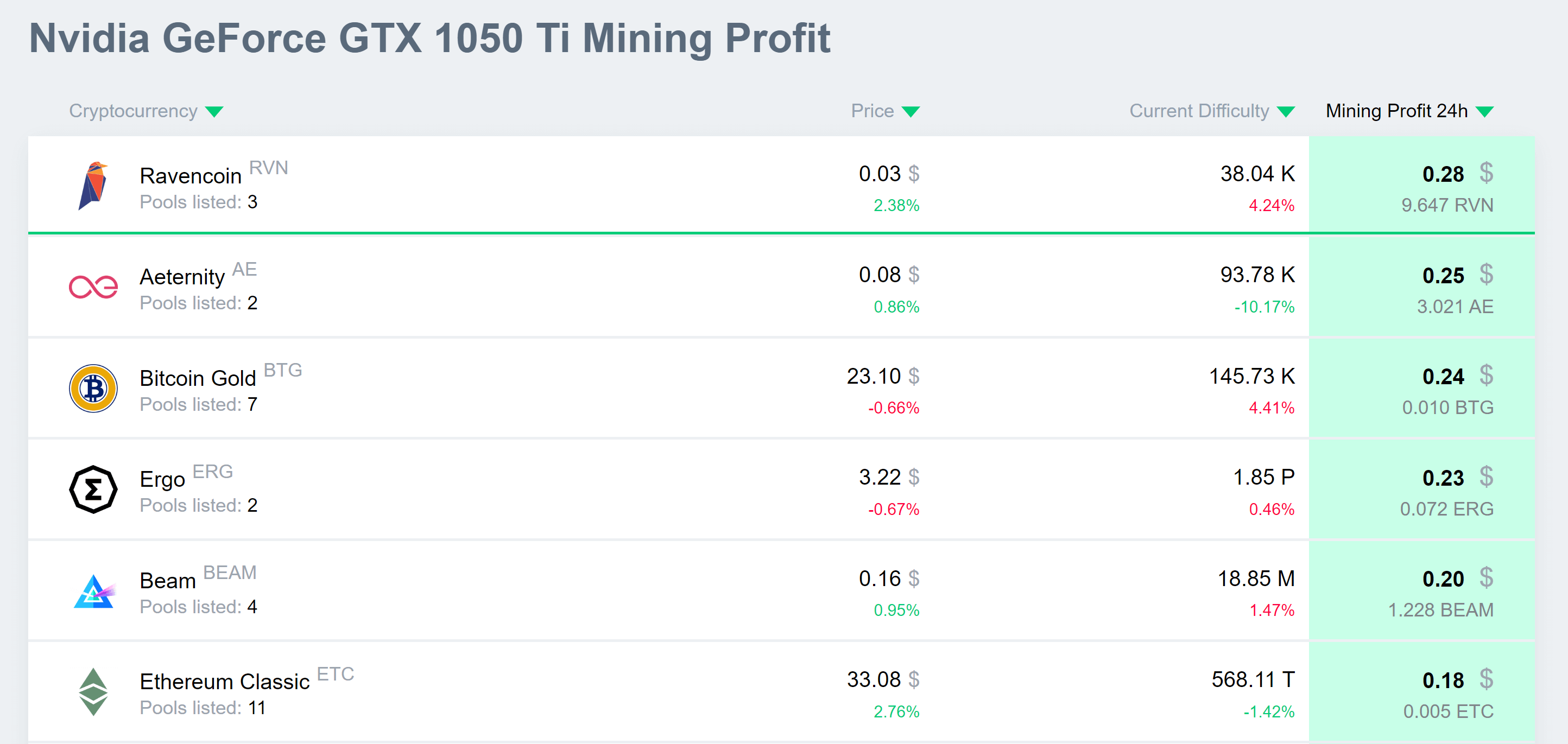
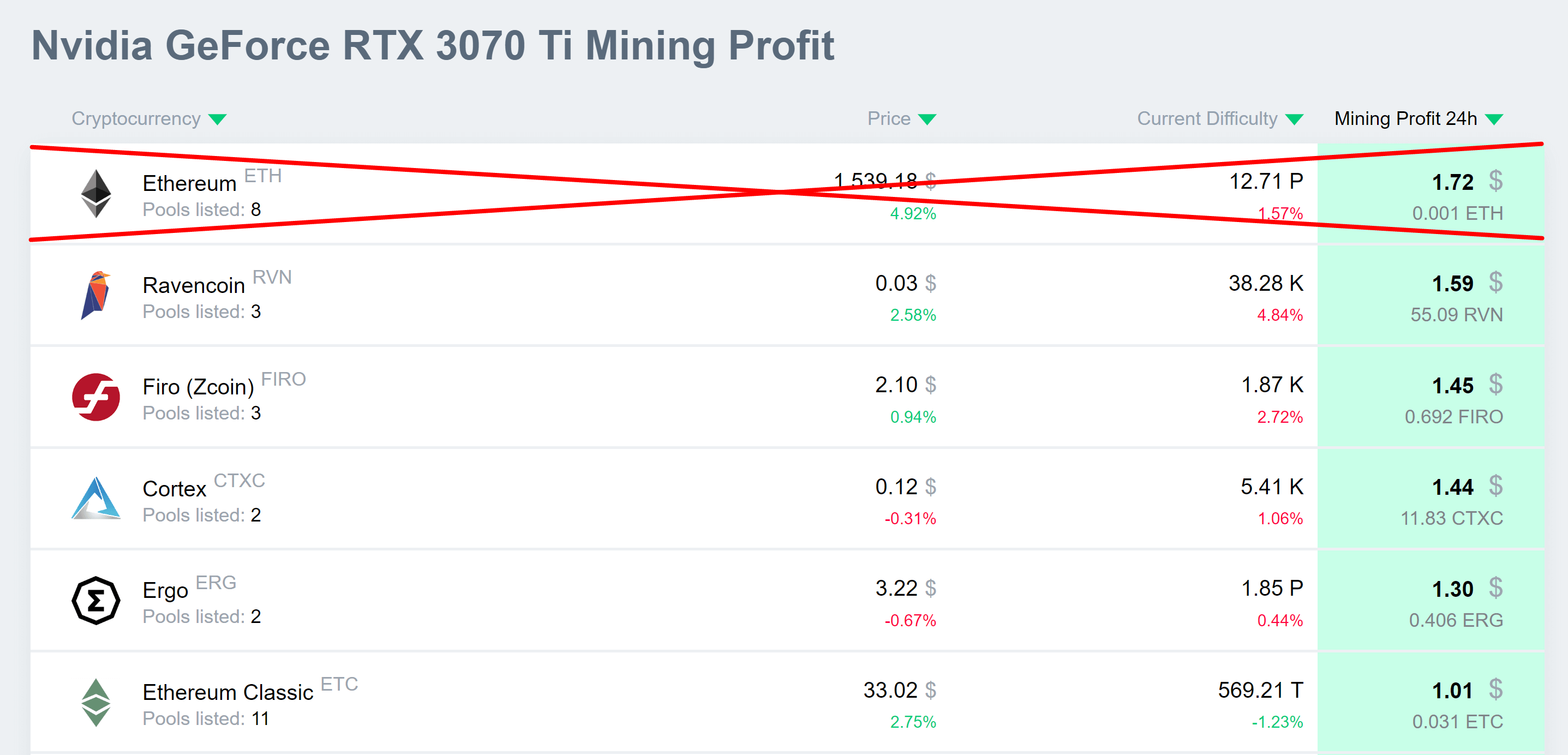
Vaya a https://2cryptocalc.com/ y haga clic en su tarjeta. Aparecerá la tabla de rentabilidad de minado.
Sin ETH todavía hay monedas que le traen más de $1/día con la tarjeta. Esta tabla de rentabilidad cambiará cuando ETH se convierta en POS y la rentabilidad de RVN, ETC y otras monedas podría disminuir. Sin embargo, si eres un afortunado propietario de una 3070 Ti, podrías extraer monedas de alta exigencia como Cortex. Esto puede ser un refugio seguro para ti.
Qué minar con las tarjetas de video AMD en 2023
Las tarjetas AMD son a menudo más baratas que las análogas de Nvidia. Por lo general, consumen más energía y admiten menos algoritmos de minería. Estos factores podrían ser cruciales cuando Ethereum cambie a POS. Gracias a lolMiner y otros desarrolladores de software de minería, las tarjetas AMD podrían extraer más y más monedas.
Tarjetas de 5 años de antigüedad como AMD Radeon RX 480 o AMD Radeon RX 580, incluso sin moneda Ethereum, aún podrían minar con una rentabilidad de $0.5 / día.
Si tienes los modelos de tarjetas gráficas de 4 GB podrías seguir minando en 2023. ERGO, RVN, ETC– todas estas monedas parecen ser muy prometedoras para su hardware.
La minería de Ravencoin (RVN) en tarjetas gráficas de 4 GB sería posible hasta mediados de 2023.
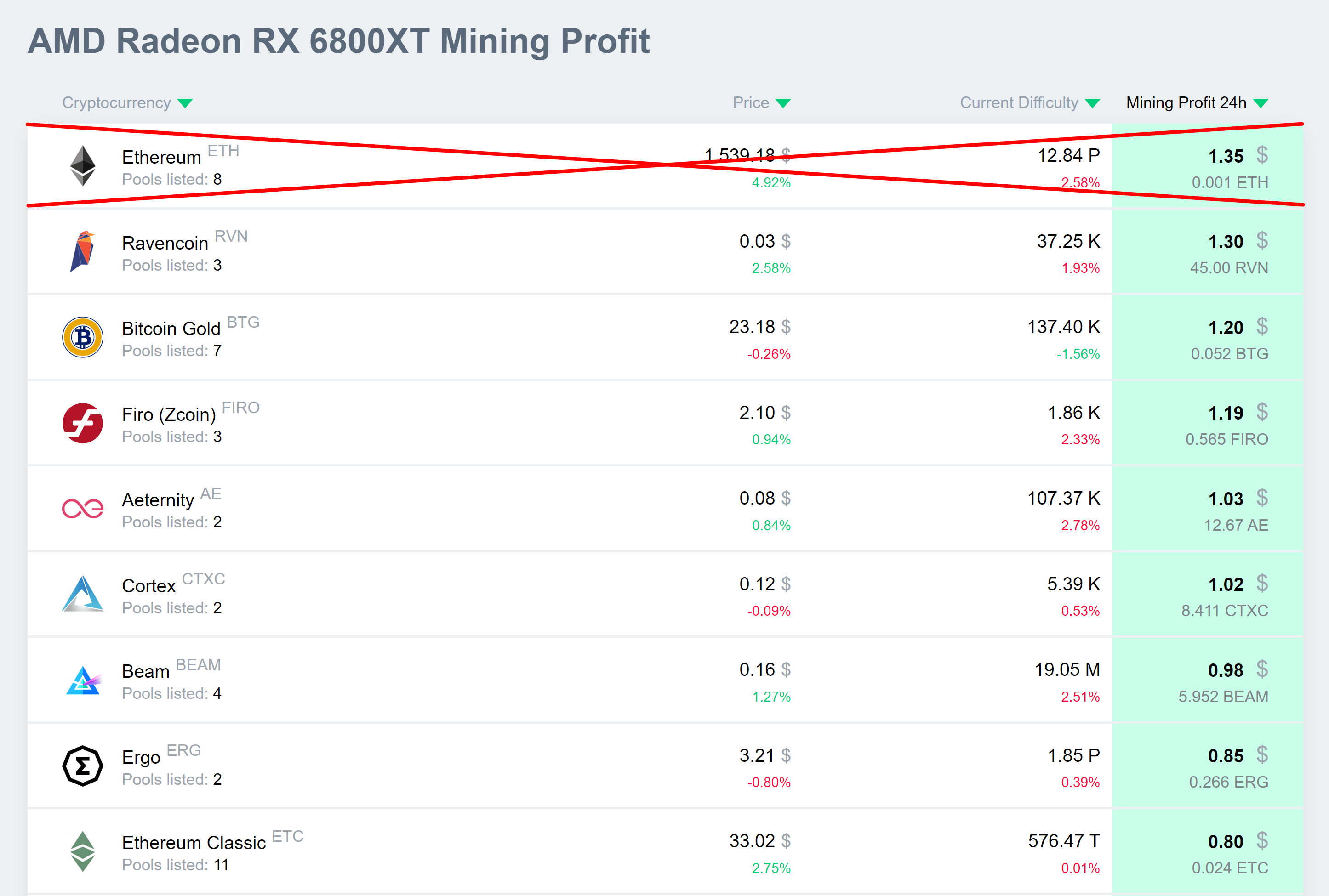
Entonces, ¿qué pasa con las tarjetas AMD avanzadas? ¿Qué extraer si tienes AMD Radeon RX 6800XT?
El procedimiento es similar al de Nvidia. Vaya a https://2cryptocalc.com/ y haga clic en el nombre de su tarjeta. Aparecerá la tabla de rentabilidad minera.
Las cosas no se ven tan mal en ausencia de ETH. Todavía no está claro cómo cambiará. De todos modos, no tomará mucho tiempo y a fines de septiembre, veremos el nuevo mundo de la minería de criptomonedas GPU. Te mantendremos informado en nuestro blog y Twitter.
Miner since 2017, the 2Miners pool co-founder. Became interested in cryptocurrencies at the dawn of the latest bull run and bought his first graphics cards. After having built and set up a few mining rigs, he realized that existing mining pools didn’t satisfy him – that’s how the idea of creating the 2Miners pool was born.
John published a series of articles about the basics of cryptocurrency mining. He gave valuable tips on how to buy ASICs and GPUs from abroad and then shared their mining performance. On the website, you can find early articles about cryptocurrency mining, blockchain in general and mining pool operation principles. The readers gave positive feedback on John’s practical guides, such as building an Ethereum mining rig and Nvidia 1080ti overclocking.
End of the Ethereum Mining: When? What to Mine Next with GPU? Transition to POS Explained
August 30, 2022
Ethereum consensus switch from Proof-of-Work (POW) to Proof-of-Stake (POS) is expected in the middle of September. This event is also known as Merge. When this happens Ethereum mining ends and you could not mine any ETH with GPU or ASIC. Let’s have a detailed look at Merge and how the 2Miners Ethereum pool will operate in September.
When Ethereum Mining Ends
Ethereum developers have defined the condition for the POW to POS switch. They operate with the parameter known as Total Terminal Difficulty (TTD) of the Ethereum network. TTD calculation is quite complicated. In simple words, it is a counter (a variable) that grows with every new block found in the Ethereum network.
Wen Merge? is an awesome website with the Merge counter. You could always check the current Total Difficulty (TTD) there.
Current TTD is 57 569 366 816 331 680 186 368
Merge happens when TTD reaches 58 750 000 000 000 000 000 000
This happens roughly on September 14th.
Is this date accurate?
Yes, this date is quite accurate. Some minor changes could be seen if the Ethereum hashrate changes severely. We don’t think this could happen in the nearest two weeks.
Are there any factors that may alter the transition to the POS date?
Yes, Ethereum developers could postpone the Merge to a higher TTD. This is an extremely unlikely event though.
How the Merge Happens
We’ve heard a lot of rumors that ETH mining would be still possible after the Merge just the mining difficulty would increase because of the difficulty bomb etc. That is not true. When Merge happens the Ethereum network will no longer accept POW-mined blocks. So the mining just dies.
Ethereum (ETH) mining stops in the middle of September (approximately on September 14th). No more ETH mining would be possible.
How Will 2Miners ETH Pool Operate
At that particular moment when the Ethereum TTD reaches the preset value of 58 750 000 000 000 000 000 000 the pool can no longer find a new ETH block and get rewarded. The date and time of the Merge event is not precise therefore we will operate until the Merge happens.
We are grateful to have such an awesome ETH mining pool and mining community that we have. More than 100K miners are mining Ethereum in 2Miners. We would like to say BIG THANKS! to all our miners. No flattering, we always stand for our miners, you guys rock! In this sad moment, we would fight to the last mined block.
When the Merge happens the pool will still accept shares for a short period of time. Obviously, no rewards after the Merge event could be credited. We would like to switch you automatically to ETC (Ethereum Classic) mining pool. However, that is impossible because ETC uses a modified version of the Ethash mining algorithm called Etchash. You will need to reconfigure your software in order to do that.
2Miners Ethereum Pool Payouts
The payouts would be processed in the standard way until the Merge.
The payouts to the ETH addresses are processed every 2 hours (usually much faster if there is no long queue). The payouts to the BTC and NANO addresses are processed once a day at 12:00 UTC.
After the Merge, we will process one last payout to all the Ethereum pool users. It should happen in a couple of hours after Merge. It could be slightly delayed due to possible network issues. ETH was never operated using the POS consensus before. Anything could happen. A lot of cryptocurrency exchanges may suspend ETH deposits and withdrawals for the time of Merge. We use Kraken and Binance to process the payouts in BTC or NANO. Please note that the last BTC/NANO payout may be delayed until one of these crypto exchanges resumes operations with Ethereum.
You don’t need to request the final payout or claim it anyhow. You don’t need to change your payout threshold too if it was too high. We will pay all the unpaid balances that are over the minimum Ethereum pool payout threshold.
For ETH addresses 0.01 ETH;
For BTC addresses 0.005 ETH;
For NANO addresses 0.0005 ETH.
What to Mine when Ethereum Mining Stops
There is a whole bunch of coins that you could mine after Ethereum mining ends. We got a post where all of them are listed What to Mine when Ethereum Goes POS.
Obviously, when the ETH mining ends a huge hashpower would be set free. The profitability calculations may be inaccurate for a short period of time while the miners would be constantly switching from one coin to another. 2Miners provides you with the best possible experience by offering all the altcoin mining pools in one place. Just open 2Miners.com, choose the coin that is the most profitable for your hardware and start mining.
Some coins have a huge hashrate and others are quite small. No coin could be compared to Ethereum in terms of hashpower but Ethereum Classic, Ravencoin, and Ergo are the closest pursuers. Choosing one of them is the safest post-Merge strategy. At least for the first days.
Switching to ETC Mining
Change pool host in your mining software from eth.2miners.com:2020 to etc.2miners.com:1010
Change mining algorithm from ethash to etchash.
ETH and ETC have the same wallet format. Sometimes it is possible to keep your ETH wallet address. All you need is to simply switch the network from ETH to ETC in your wallet. Sometimes the process is harder especially if you mine to a crypto exchange. We also do support the BTC payouts for the Ethereum Classic pool.
If you use an ASIC device, new firmware might be required. Here is the detailed post regarding Innosilicon machines.
URL: stratum+tcp://etc.2miners.com:1010

Worker: YOUR_ADDRESS.ASIC_ID

Password: x
Nicehash is supported. Custom pool name: 2Miners ERG Algorithm: Autolykos Stratum hostname or IP: erg.2miners.com Port: 8888 Username: YOUR_WALLET_ADDRESS Password: x
EthereumPoW Mining
The new project called EthereumPoW (ETHW) appeared recently. The developer team wants to keep on the original Ethereum chain without switching to POS. We don’t think it would be possible to switch the miners from ETH to ETHW mining smoothly. The ETHW network will start sometime after the Merge event itself.
Currently, we are discussing the possibility to add the ETHW to 2Miners and we are in contact with the project developers. We will keep you updated on this matter. We will also add EthereumPoW to 2CryptoCalc when the ETHW mining starts.
What to Mine with GPU in 2023
Ethereum’s switch to Proof-of-Stake is, without a doubt, one of the most important events in the cryptocurrency mining history of all time. ETH devs planned this from the beginning but not so many people expected this to happen in 2022. Ethereum was always the most important driver of the graphics card mining industry. The following year the GPU mining process would not be as easy as before. In 2023 you should choose the coins you mine wisely. The times when you could just set the ETH mining on your rig and forget about it for a couple of years have passed. Now you always need to calculate the profitability bearing in mind your operational costs, especially the energy consumption.
What to Mine with Nvidia Video Cards in 2023
Nvidia GPUs always provide the best flexibility in terms of mining. Nvidia could mine well all the GPU algorithms that exist. Even if you have not noticed that before we could assure you that is an advantage of this brand compared to AMD.
There are a lot of low-tier old cards like Nvidia GeForce GTX 1050 Ti that could still mine with the profitability of up to $0.3/day.
4 GB memory is enough for almost all the coins including Ravencoin. RVN DAG file is currently 3.523 GB. That means you could still mine RVN with a 4 GB card but only if you operate with Linux OS. It would be quite impossible to run Ravencoin mining with a GTX 1050 Ti on Windows.
Of course, you couldn’t mine such demanding algorithms like CuckooCortex with a 4 GB card. This algorithm is used by Cortex (CTXC) and it requires at least 8 GB graphics cards.
Go to https://2cryptocalc.com/ and click on your card. The mining profitability table will appear.
Without ETH there are still coins that bring you more than $1/day from the card. This profitability table will change when ETH goes POS and the profitability of RVN, ETC and other coins could go down. However, if you are a lucky owner of 3070 Ti you could mine high-demanding coins like Cortex. This may be a safe haven for you.
What to Mine with AMD Video Cards in 2023
AMD cards are often cheaper than Nvidia analogs. They usually consume more energy and support fewer mining algorithms. These factors could be crucial when Ethereum switches to POS. Thanks to lolMiner and other mining software developers the AMD cards could mine more and more coins.
Such 5 year-old cards like AMD Radeon RX 480 or AMD Radeon RX 580 even without Ethereum coin could still mine with a profitability of $0.5/day.
If you have the 4 GB graphics cards models you could continue mining in 2023. ERGO, RVN, ETC – all these coins seem to be very promising for your hardware.
Ravencoin (RVN) mining on 4 GB graphics cards would be possible until the middle of 2023.
So what about advanced AMD cards? What to mine if you have AMD Radeon RX 6800XT?
The procedure is similar to Nvidia. Go to https://2cryptocalc.com/ and click on your card name. The mining profitability table will appear.
Things don’t look that bad in the absence of ETH. It is still unclear how will it change. Anyway, it will not take long and at the end of September, we’ll see the new World of GPU cryptocurrency mining. We will keep you updated in our blog and Twitter.
Miner since 2017, the 2Miners pool co-founder. Became interested in cryptocurrencies at the dawn of the latest bull run and bought his first graphics cards. After having built and set up a few mining rigs, he realized that existing mining pools didn’t satisfy him – that’s how the idea of creating the 2Miners pool was born.
John published a series of articles about the basics of cryptocurrency mining. He gave valuable tips on how to buy ASICs and GPUs from abroad and then shared their mining performance. On the website, you can find early articles about cryptocurrency mining, blockchain in general and mining pool operation principles. The readers gave positive feedback on John’s practical guides, such as building an Ethereum mining rig and Nvidia 1080ti overclocking.
Innosilicon A10 Stopped Mining Ethereum. Possible Solutions.
August 18, 2022
Recently all Innosilicon A10 ASIC owners reported problems with the Ethereum (ETH) mining. This happened when the Ethereum DAG file size reached 5 GB. No matter how much memory the ASIC has 5 GB, 6 GB, 7 GB, or 8 GB. All of them fail to work right now. In this post, we talk about the causes of this incident and possible solutions.
Ethereum DAG File Problem
Ethash (Ethereum mining algorithm) has a special DAG file that is loaded to the GPU/ASIC memory before the mining process starts. We described in detail how it works in our post When Will My Graphics Card Stop Mining Ether?
DAG file size is always growing. You could always find the current DAG size on 2Miners Ethereum pool main page. On August 17th DAG file for ETH reached 5 GB.
Most likely this was the last important milestone for the Ethereum DAG file and it will never reach the next one (6GB). Ethereum devs plan to change the consensus mechanism from PoW to PoS in September which will end the ETH mining in general.
Innosilicon A10 Affected by the DAG File Size
A10 is a popular Ethereum ASIC miner produced by Innosilicon. Originally it was mining only Ethereum (ETH) and other Ethash coins. Recently the manufacturer released the firmware that allows also Ethereum Classic (ETC) mining bearing in mind the future end of the ETH mining. ETC is slightly different from ETH as it uses its own Etchash algorithm (Ethash algorithm modification). More information on the new firmware could be found in our post Innosilicon Released New Mining Firmware to Mine Ethereum Classic on ASIC.
The new ETC firmware can not be used to mine ETH and vice versa, it is not possible to mine ETC with the old ETH firmware. Ethereum mining is currently more profitable than Ethereum Classic mining so many ASIC owners prefered to mine ETH and not to update to the new firmware to mine ETC.
As soon as the Ethereum DAG file reached 5 GB all the Innosilicon A10 stopped working. No matter how much memory they had. It looks like a firmware bug. However, it could be related to the hardware configuration as well. Unfortunately, Innosilicon has not released any information about this matter. Their twitter account is almost dead.
Lucky owners of Innosilicon A11 could still continue Ethereum mining. It seems this device uses different firmware.
How to Mine With Innosilicon A10 and A10 Pro
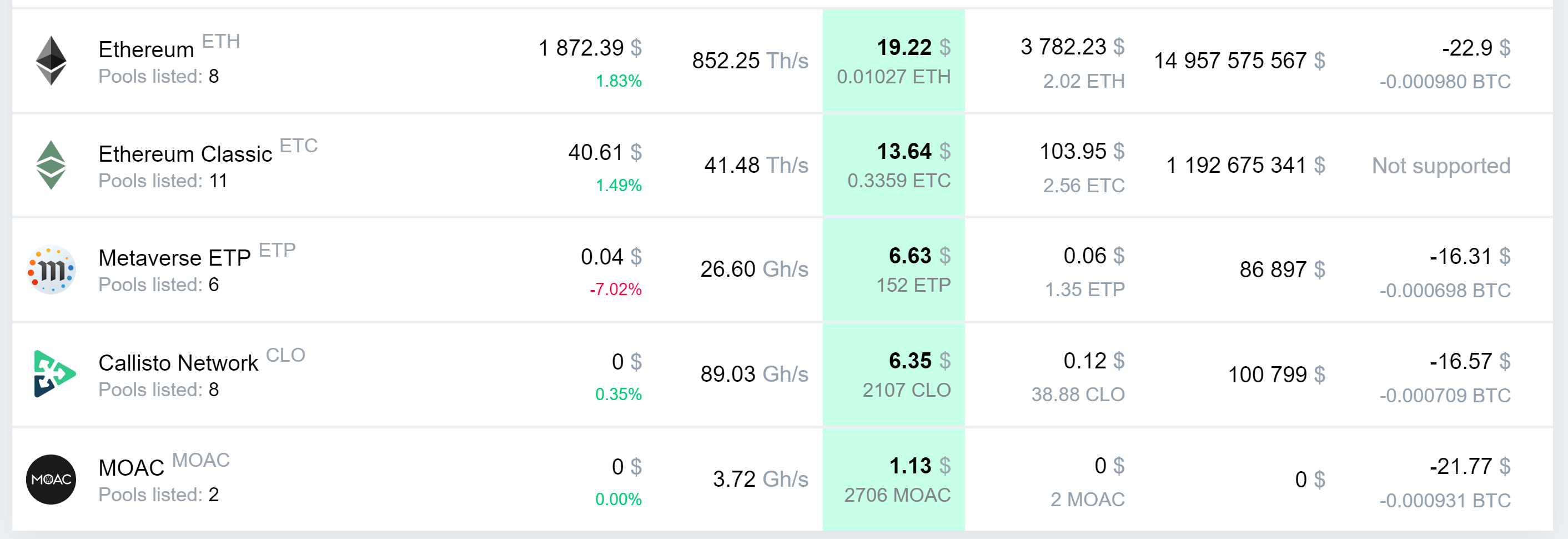
Hopefully, there are solutions you could use to still generate some profit with Innosilicon A10 ASICs. There are other coins that use Ethash algo that have the smaller DAG file. There is also the ETC firmware available. Let’s have a look at the 2CryptoCalc.com mining calculator and enter the 700 MH/s hashrate for both Ethash and Etchash algorithms.
Ethereum is the most profitable coin $19.22/day followed by Ethereum Classic $13.64/day. You could not mine ETP with Innosilicon A10, so the next option is Callisto $6.35/day. You should not take into account Expanse (EXP) as this coin trading volume is very little.
The Worst Option. Just Wait
We all hope that Innosilicon developers release the new firmware that fixes the Ethereum mining issue soon. If you are afraid of firmware updates and if you hope that the A10 issue is software-related and if you hope that Innosilicon devs could fix that then you could just turn off your devices for a couple of days. So many “ifs” but who knows?
The Best Option. Ethereum Classic Mining
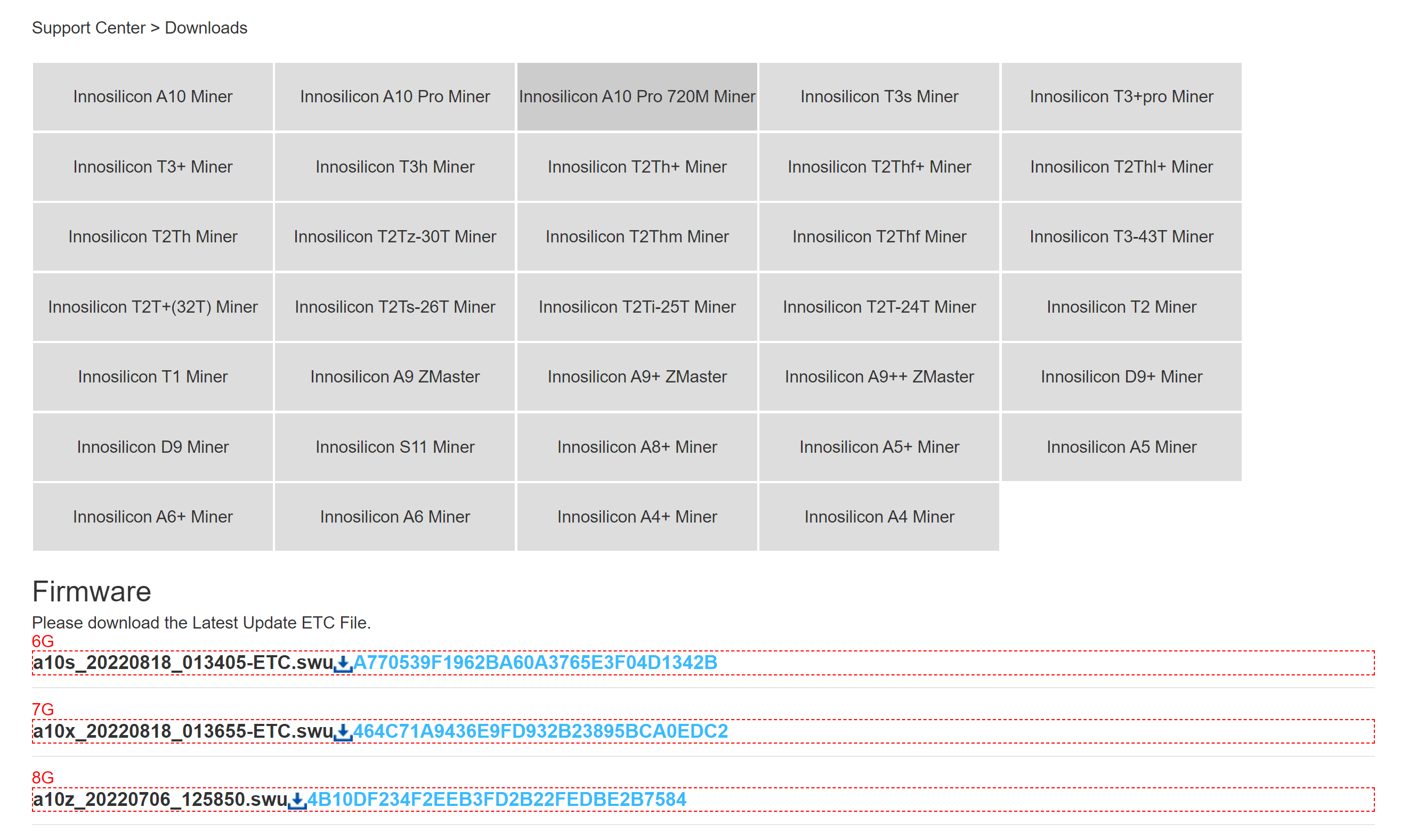
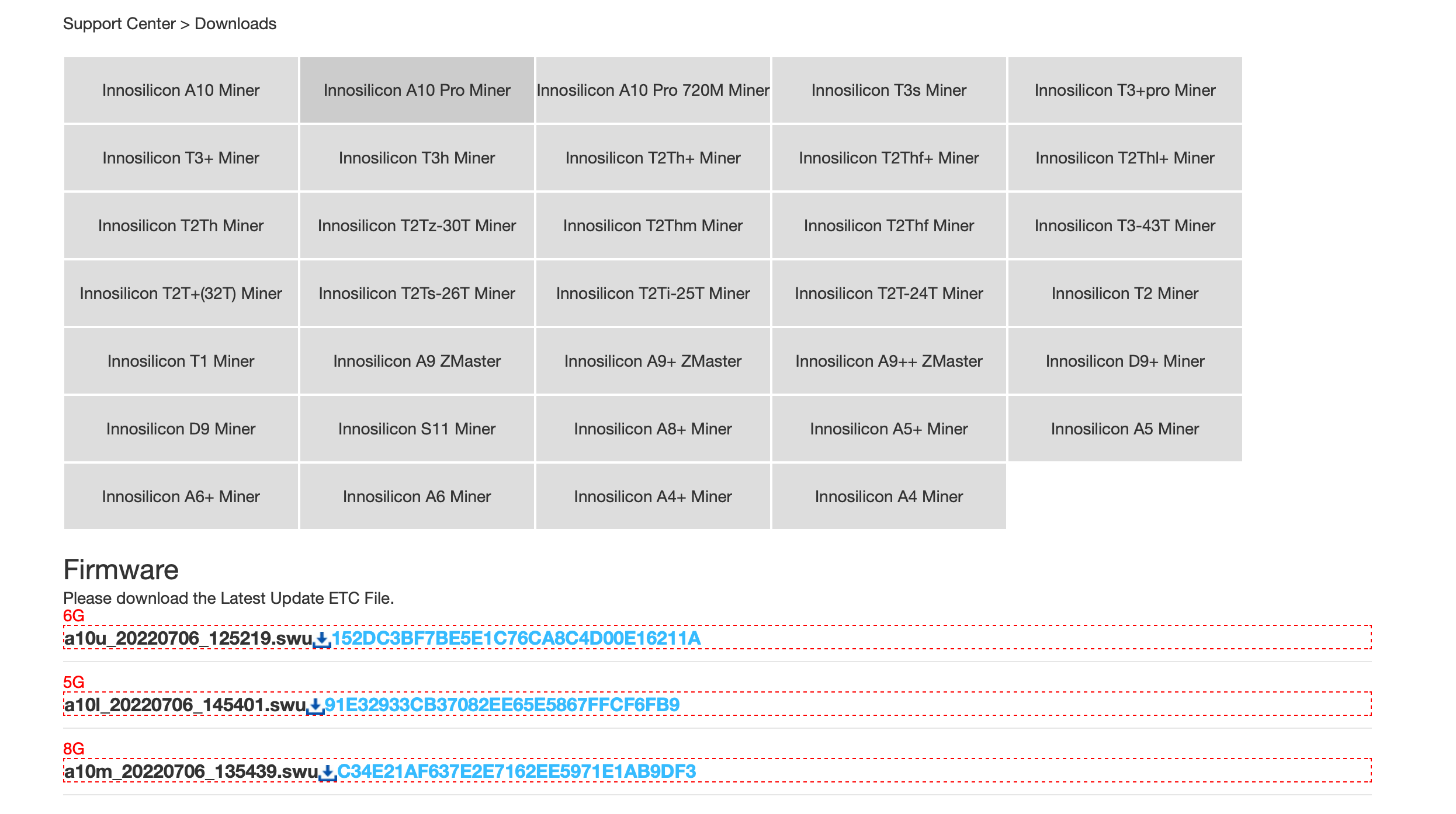
The new Innosilicon ETC firmware works just great. Flash it to your A10 device and start mining Ethereum Classic right now. You can download the firmware on the official project support website.
Here are ETC’s mining settings.
URL: stratum+tcp://etc.2miners.com:1010

Worker: YOUR_ADDRESS.ASIC_ID

Password: x
The Second Best Option. Callisto Mining
You could switch your A10 to CLO mining pool. You would earn much less but you would still earn something. Then you could wait some time and again hope that Innosilicon developers could fix the problem and release the updated firmware in the nearest time.
You could find the settings below.
URL: stratum+tcp://clo.2miners.com:3030

Worker: YOUR_ADDRESS.ASIC_ID

Password: x
Bonus Part. How Many Innosilicon A10 Devices Are There?
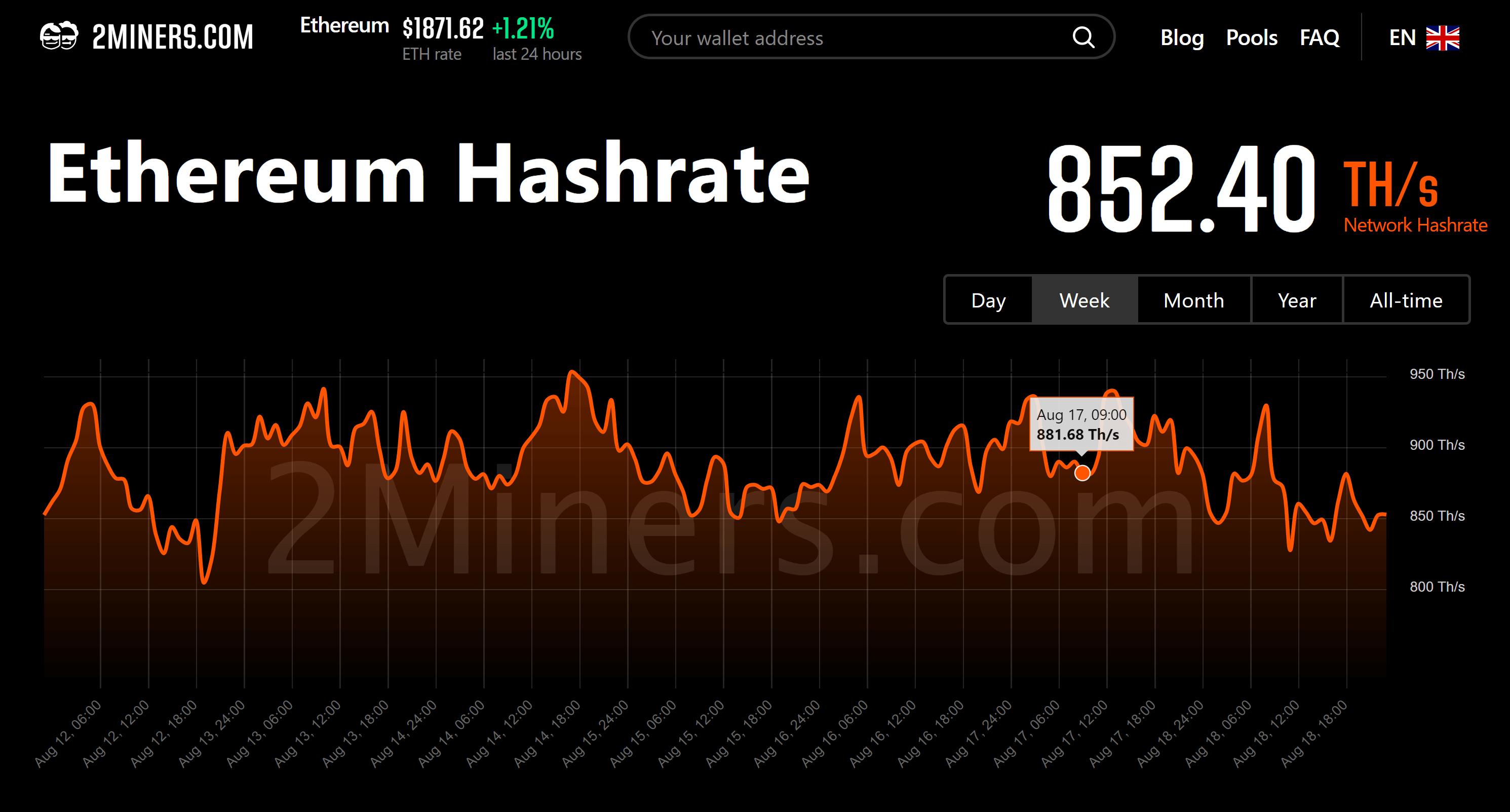
Let’s have a look at the Ethereum Hashrate Chart. As you see the ETH network hashrate fluctuations are quite high. It’s hard to say how much the hashrate dropped when DAG file reached 5 GB. We could say that it was at least 30 TH/s. There are 500 MH/s and 720 MH/s versions so we could assume there were at least 55 000 – 60 000 Innosilicon A10 miners in the network.
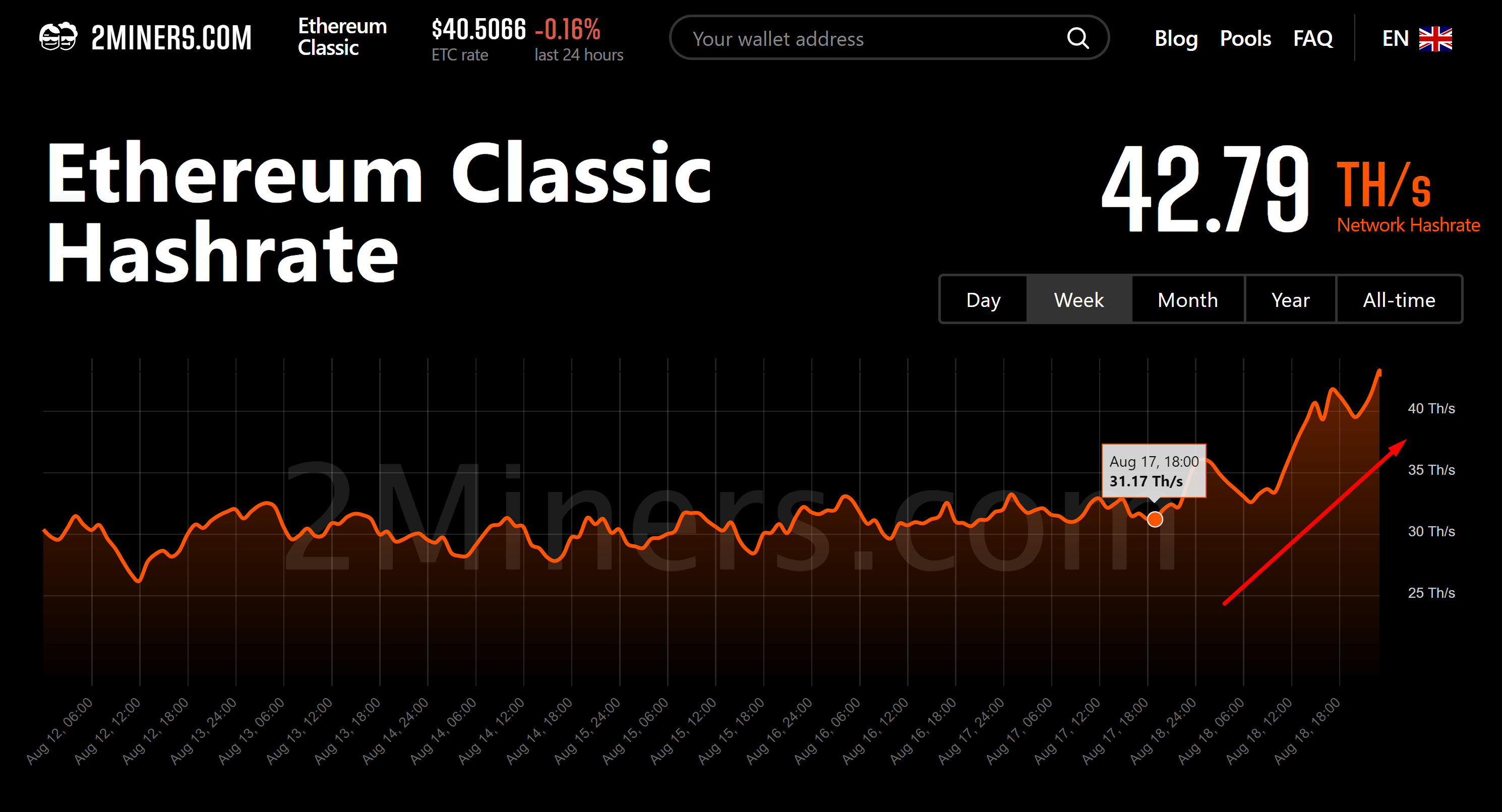
Let’s now check the network hashrates of Ethereum Classic and Callisto.
Miner since 2017, the 2Miners pool co-founder. Became interested in cryptocurrencies at the dawn of the latest bull run and bought his first graphics cards. After having built and set up a few mining rigs, he realized that existing mining pools didn’t satisfy him – that’s how the idea of creating the 2Miners pool was born.
John published a series of articles about the basics of cryptocurrency mining. He gave valuable tips on how to buy ASICs and GPUs from abroad and then shared their mining performance. On the website, you can find early articles about cryptocurrency mining, blockchain in general and mining pool operation principles. The readers gave positive feedback on John’s practical guides, such as building an Ethereum mining rig and Nvidia 1080ti overclocking.
July 2022 Work Progress Report: New ASIC Miners and ASIC Firmware for ETC
August 1, 2022
New ASIC miners and ASIC firmware for the Ethereum Classic mining, suggested Ethereum merge date announced, ZEC, FIRO, ERGO, XMR node updates, and new mining software.
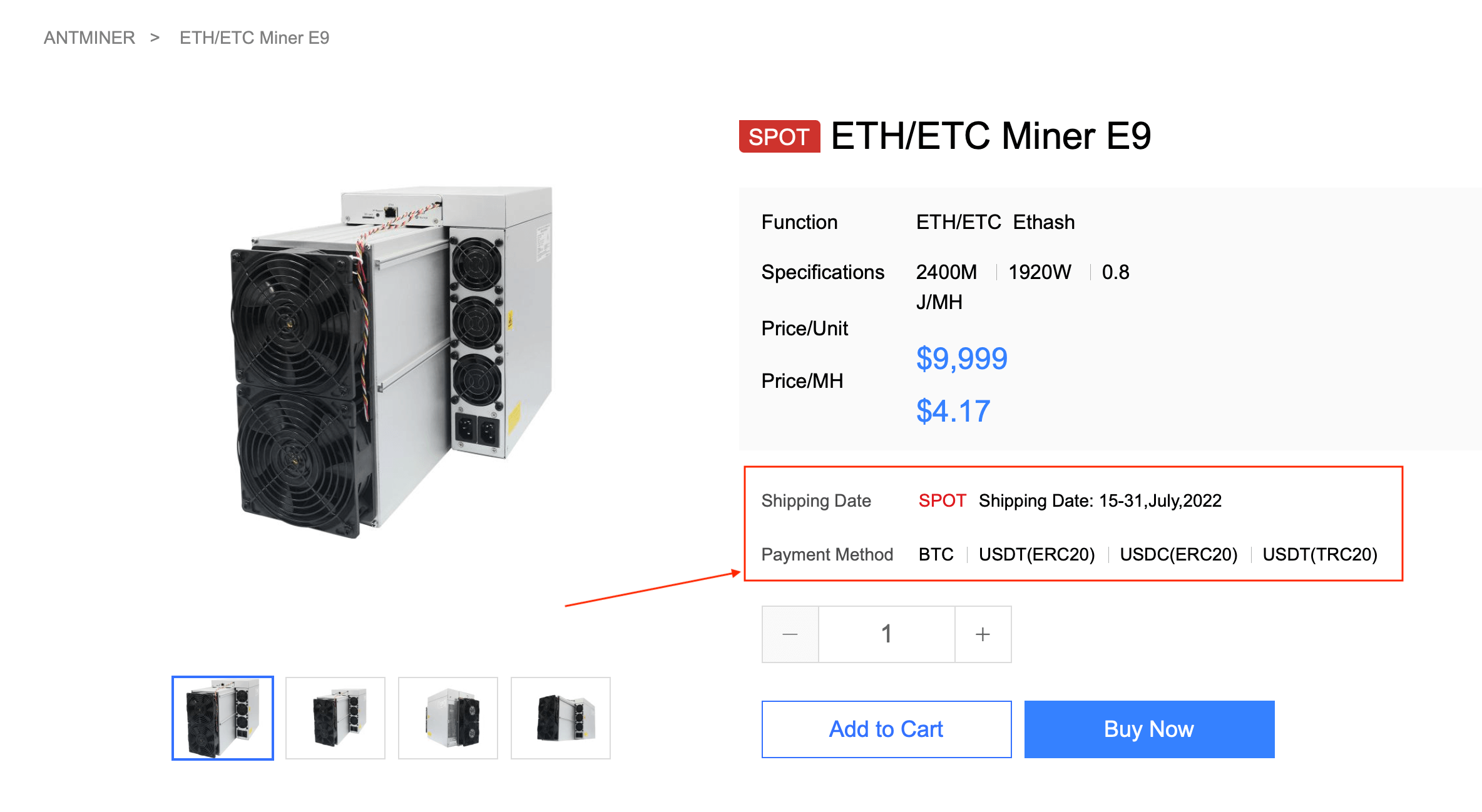
This month Bitmain released Antminer E9, its new ASIC mining device. It is designed for Ethash-based cryptocurrencies, like Ethereum and Ethereum Classic. The company says that the performance of the new miner is equivalent to 25 Nvidia’s high-end RTX 3080 graphics cards.
The pay-off period for this mining device is approximately 1 year taking into account the electricity costs. Many miners don’t really understand this Bitmain release as ETH merge (transition from POW to POS) is scheduled for this year.
iPollo released a new ASIC device for the Ethereum Classic mining called Ipollo V1 Mini Classic Plus. This ASIC has 3.6 GB memory onboard and only the ETCHASH mining algorithm is supported. This means you could mine ETC for about a year/a year and a half depending on the ASIC firmware.
Innosilicon A10 Firmware for ETC Mining
Another ASIC manufacturer Innosilicon officially released the new firmware that enables ETC mining for Innosilicon A10 and A10 Pro.
At the moment the firmware is available for A10 Pro only, but it should also work with A10. The upgrade for Innosilicon A11 to mine ETC is currently in development. The release is yet to be announced. The new firmware could be downloaded on the Innosilicon website. Please find below the ETC mining settings.
URL: stratum+tcp://etc.2miners.com:1010

Worker: YOUR_ADDRESS.ASIC_ID

Password: x
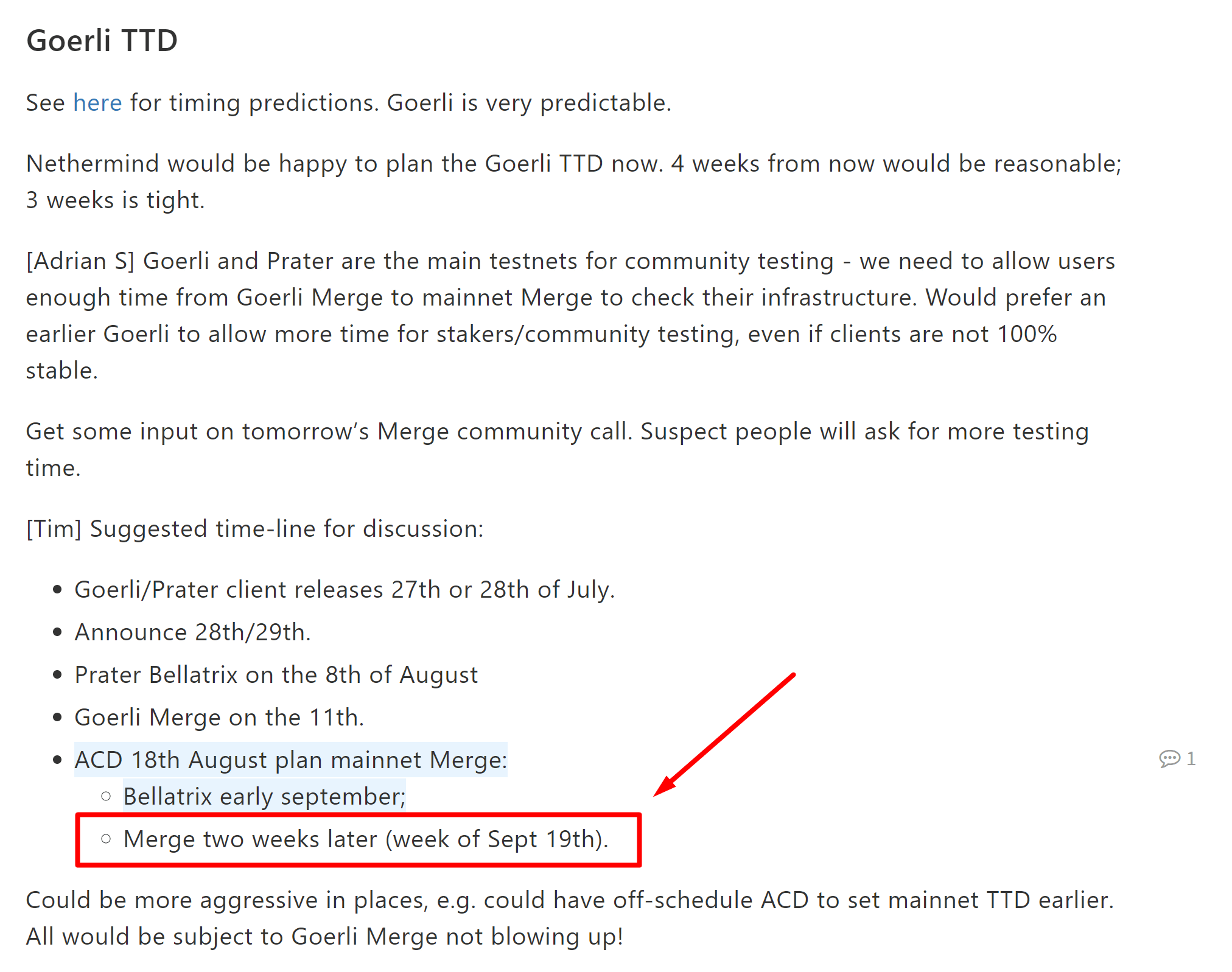
Ethereum developers plan to switch from POW to POS in the nearest time. This will be the end of the ETH mining era. During the so-called Consensus Layer Call, #91 held on July 14th the merge date has been suggested. According to ETH devs if all goes well for the Goerli testnet the merge could happen on week 38 (starting September 19th).
These are the call notes by Ben Edgington. You could also watch the complete call record on Youtube.
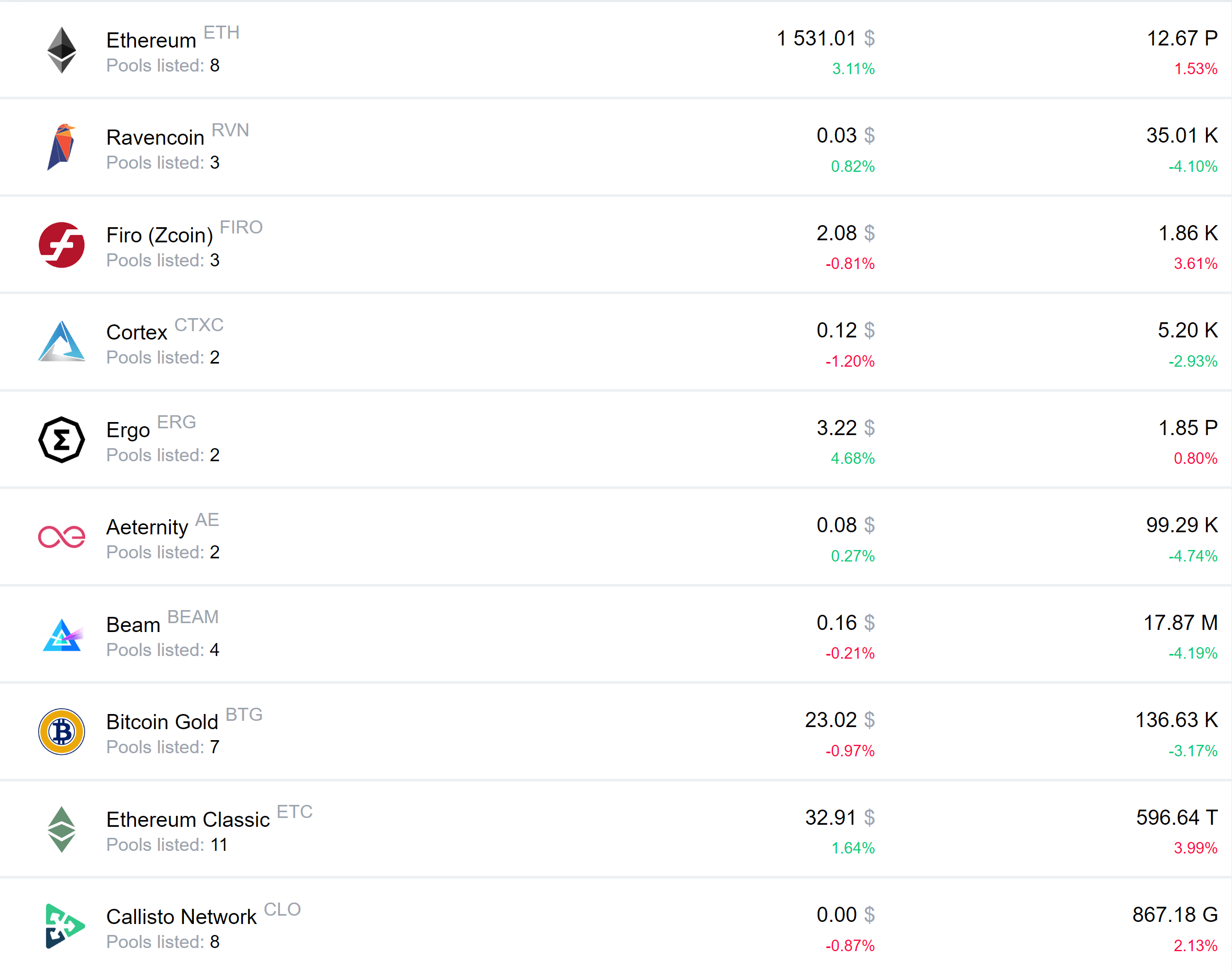
After Ethereum mining ends other coins could still be mined with your GPUs. The most popular coins are Ravencoin (RVN), Ethereum Classic (ETC), and ERGO (ERG). What to Mine when Ethereum Goes POS?
For example, while the Ethereum merge date rapidly approaches Ethereum Classic price surges. Some days ETC mining profitability was even higher than ETH mining profitability. Currently, these values are still very close. You could always check the most profitable coin for your mining hardware using the 2CryptoCalc mining profitability calculator.
Node Updates
We updated many cryptocurrency nodes on 2Miners.com this July.
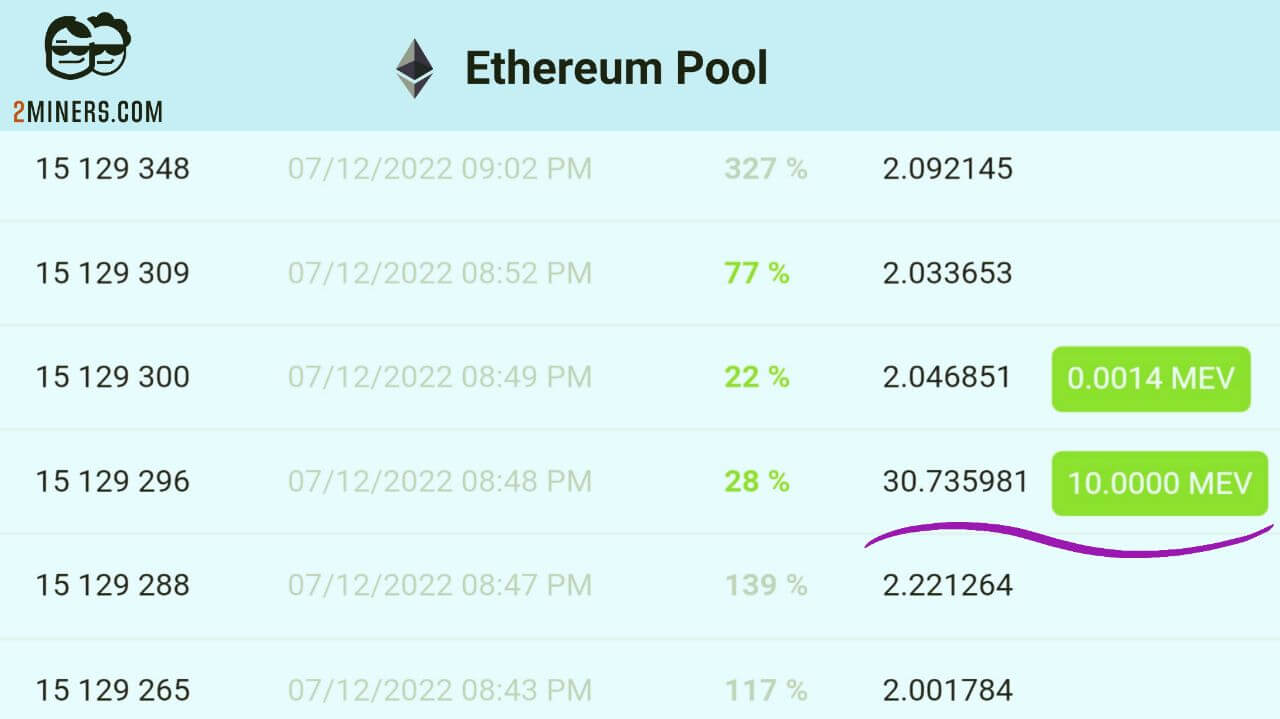
We noticed some nice blocks in 2Miners Ethereum Pool in July. The biggest block was number 15129296. It brought 30.73 ETH to the pool miners with 10 ETH MEV included.
You could always find the recent blocks on the blocks page of the Ethereum pool.
The 2Miners pool co-founder, businessman, miner. In 2017 started mining cryptocurrencies and built many rigs on his own. As a result, he gained lots of practical knowledge and became interested in sharing it with others.
In his articles on 2Miners, he shares useful tips that he tried and tested himself. For example, Darek gives advice on how to buy hardware components for the basic mining rig and how to connect them to each other correctly. He also explained lots of complicated terms in simple words, such as shares, mining luck, block types, and cryptocurrency wallets. After the pool was launched, he published a series of articles ‘Crypto Mythbusters’ where he explained how to protect the network against 51% attack, talked about cryptocurrency mining difficulty and difficulties of launching your own node.
Innosilicon Released New Mining Firmware to Mine Ethereum Classic on ASIC
July 29, 2022
July 2022 is definitely a good month for Ethereum Classic. While the cryptocurrency market keeps falling, ETC goes in the opposite direction. In the last 24 hours, the exchange rate increased by 20%, and in the last two weeks it leaped by 169%. With more and more hype around the coin, it doesn’t remain unnoticed in the cryptocurrency community. Mining devices manufacturers are no exception. Now you can officially mine ETC with Innosilicon A10 and A10 Pro. Keep reading for more details and mining settings.
A10 is a popular mining device by Innosilicon. It's worth noting that you could have mined Ethereum Classic quite successfully with A10 even before as the ETC network at that time used to work on the Ethash algorithm like the regular Ethereum (ETH).
In November 2020, Ethereum Classic switched to the new algorithm called Etchash as a result of the Thanos hardfork. The main reason for the hardfork was to reduce the size of the DAG file, essential for cryptocurrency mining. The hardfork enabled 3GB and 4GB GPUs to continue mining ETC and prevented ASICs from mining ETC.
As we already mentioned above, the hardfork was supposed to leave out ASIC miners, considered to be a threat to blockchain decentralization. However, that issue has lost its relevance, so ASIC miners manufacturers started enabling ETC mining on their devices.
Before we dive into mining settings for Innosilicon A10, it’s important to understand the reasons behind Ethereum Classic’s popularity.
What’s Behind Ethereum Classic’s Growth?
First, the regular Ethereum (ETH) will shift to the Proof-of-Stake consensus algorithm. It will happen on September 19, 2022. After the update, it will become impossible to mine ETH on GPUs.
Ethereum Classic, although originally coming from Ethereum’s chain, is not going to shift to PoS, so miners will keep mining ETC as usual.
Vitalik Buterin has also contributed to Ethereum Classic's growing popularity. Not so long ago, he announced that Ethereum will shift to PoS, but PoW fans will be able to mine Ethereum Classic. Buterin also called the ETC network "a totally fine chain."
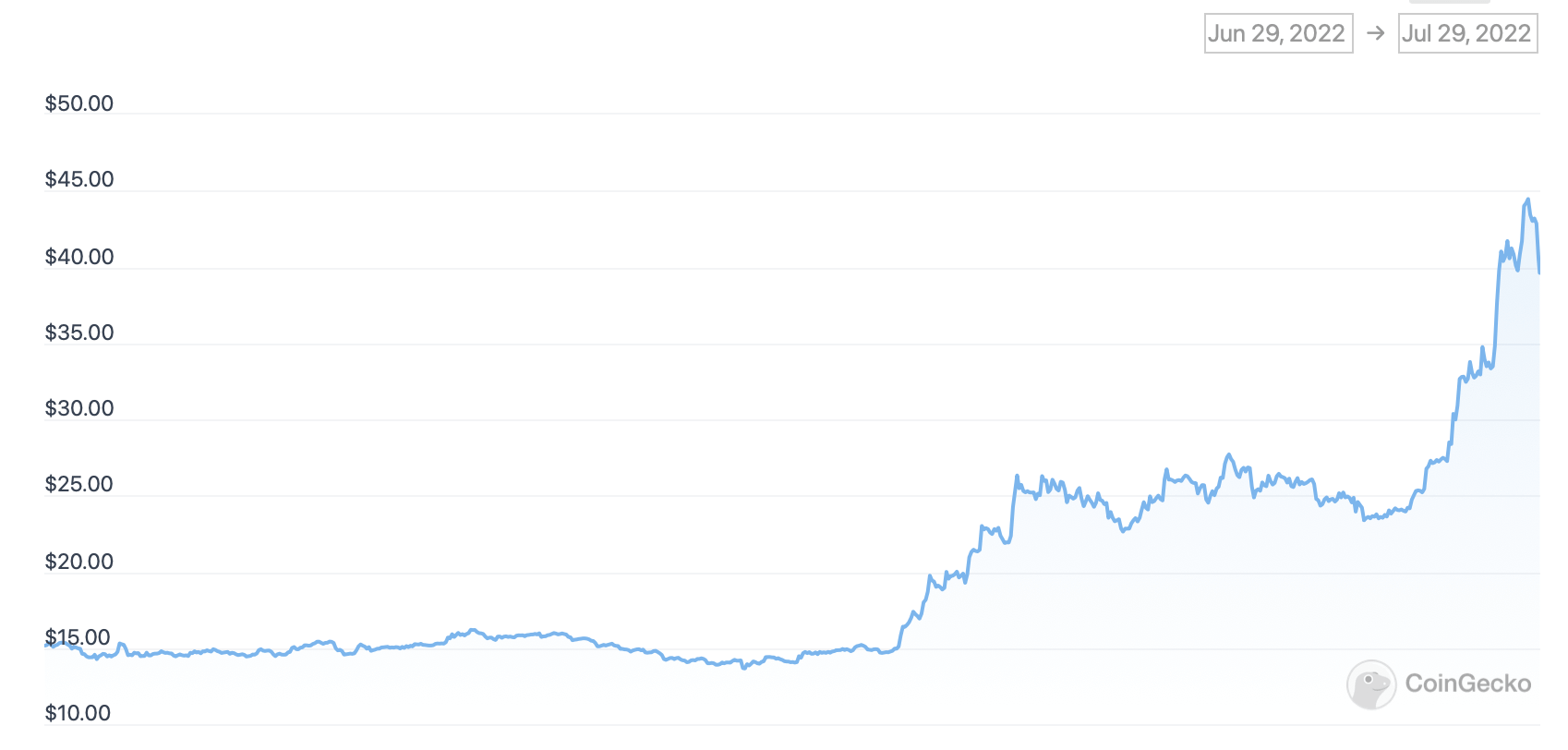
The second factor that boosted ETC’s popularity is a $10 million investment in the project ecosystem development made by AntPool this week. How did it all affect the cryptocurrency exchange rate? It has more than doubled in a month. Here is ETC’s chart for the last month.
How to Mine Ethereum Classic on Innosilicon A10 and A10 Pro
Yesterday Innosilicon announced the release of mining firmware for Innosilicon A10 and A10 Pro to mine ETC. According to the developers, A10 Pro has become 10% more efficient compared to Ethereum mining. At the same time, A10’s hash rate remained the same.
Note that at the moment the firmware is available only for A10 Pro, but it should also work with A10. The upgrade for Innosilicon A11 to mine ETC is currently in development. The release is yet to be announced.
You can download the firmware on the official project support website. According to the 2Miners pool users, the miner with the new firmware launches a bit more slowly, but overall it works.
To start mining you should download the update. In case you need them, here are ETC’s mining settings.
URL: stratum+tcp://etc.2miners.com:1010

Worker: YOUR_ADDRESS.ASIC_ID

Password: x
Ethereum's shift to Proof-of-Stake is likely to be one of the main reasons for Ethereum Classic's growing popularity. Most miners will probably continue mining ETC, thus making major pools and device manufacturers happy. In the long term, we should probably expect even more hype around Ethereum Classic.
Check the ASIC profitability ranking on 2CryptoCalc.
The 2Miners pool co-founder, businessman, miner. In 2017 started mining cryptocurrencies and built many rigs on his own. As a result, he gained lots of practical knowledge and became interested in sharing it with others.
In his articles on 2Miners, he shares useful tips that he tried and tested himself. For example, Darek gives advice on how to buy hardware components for the basic mining rig and how to connect them to each other correctly. He also explained lots of complicated terms in simple words, such as shares, mining luck, block types, and cryptocurrency wallets. After the pool was launched, he published a series of articles ‘Crypto Mythbusters’ where he explained how to protect the network against 51% attack, talked about cryptocurrency mining difficulty and difficulties of launching your own node.
Yesterday Bitmain has released Antminer E9, its new flagship mining device. It is designed for Ethash-based cryptocurrencies, like Ethereum with its PoW algorithm and Ethereum Classic. The company says that the performance of the new miner is equivalent to 25 Nvidia’s high-end RTX 3080 graphics cards. Let’s talk about this miner and its profitability.
Releasing a mining device for Ethereum is a surprising decision. Ethereum is shifting to the Proof-of-Stake consensus mechanism in 2022, which will disable mining on GPUs and ASICs. However, there is more to it.
First of all, PoW mining will continue for at least a few months. It is confirmed by the fact that on June 30, 2022, Ethereum has delayed the difficulty bomb in the network by 700 thousand blocks or about 100 days. This way the developers made sure that the blockchain would function properly until the merge of PoW and PoS.
Plus, 100 days is just an estimate. Ethereum will shift to PoS after 100 days only if there are no issues and small bugs during testing.
There are two testing stages left to be held before the merge of the two different networks. The first is the update of the Sepolia test network that will be held today at about midnight. The second stage will be held in Goerli, the last public testnet of this blockchain. In other words, the end is not so close, so there is a good chance that the upgrade will be delayed. For now, Ethereum's developers plan to shift to PoS in the second half of September 2022.
And yet, despite all the uncertainties, Bitmain has released Antminer E9. The company is clearly quite sure that the new miner will pay off.
Antminer E9: Specs and Profitability
Antminer E9 will give out 2,400 MH/s which is indeed equivalent to 25 Nvidia RTX 3080 graphics cards. To give you a better idea, it is also equivalent to 54 Nvidia GTX 1080Ti graphics cards.
It consumes 1920 W, while its energy efficiency is 0.8 J/MH.
Antminer E9 lists at $9,999. Shipping is expected to start in the middle of June. Bitmain accepts payments in BTC, USDT, and USDC.
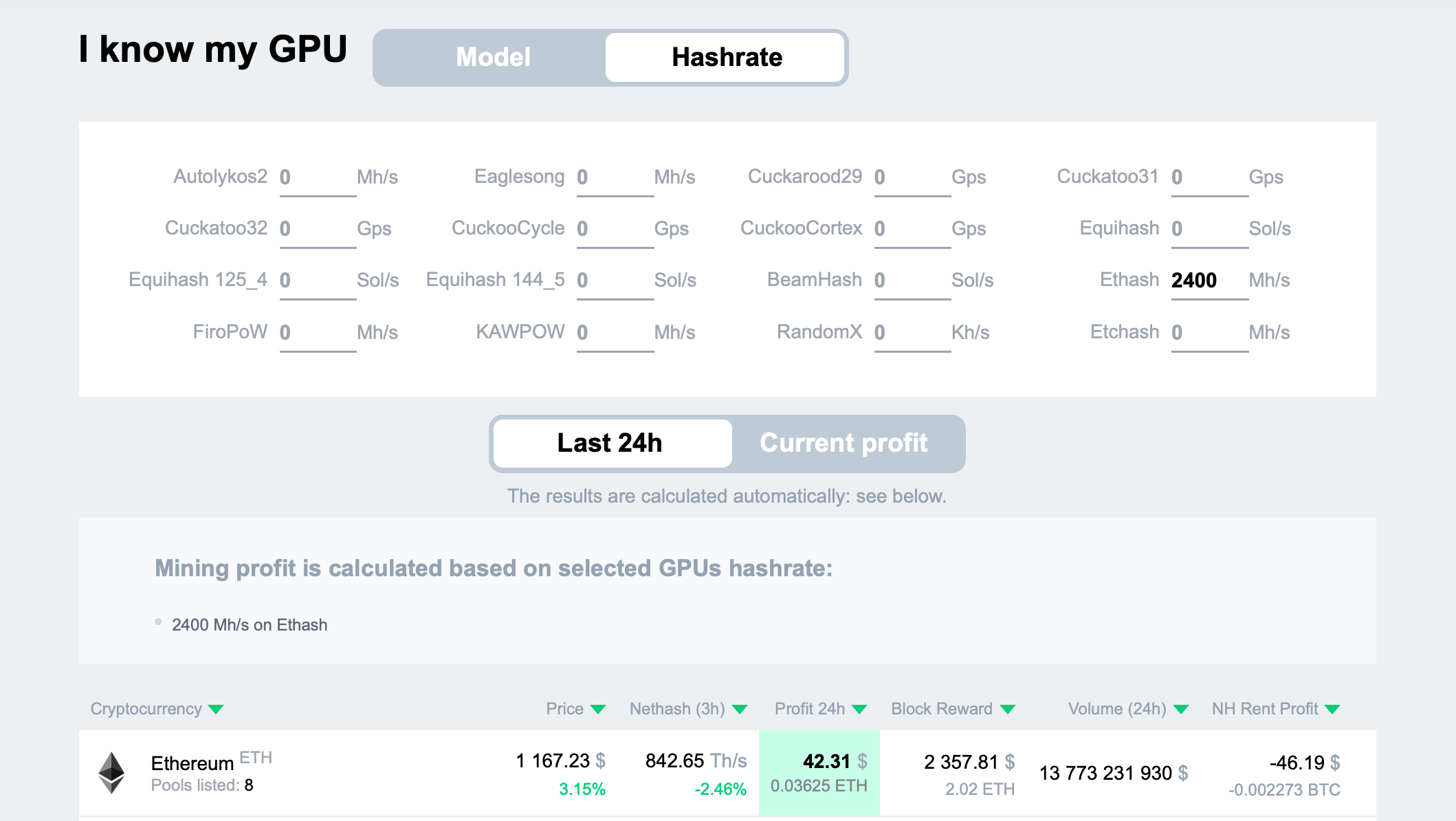
How profitable is the miner with such a hash rate? According to 2CryptoCalc, ETH is the most profitable coin for mining. At the current exchange rate and network difficulty, you can expect to get an equivalent of almost $42.
Keep in mind that it’s a gross profit, as you should subtract the cost of electricity consumed by the device, which will differ for everybody.
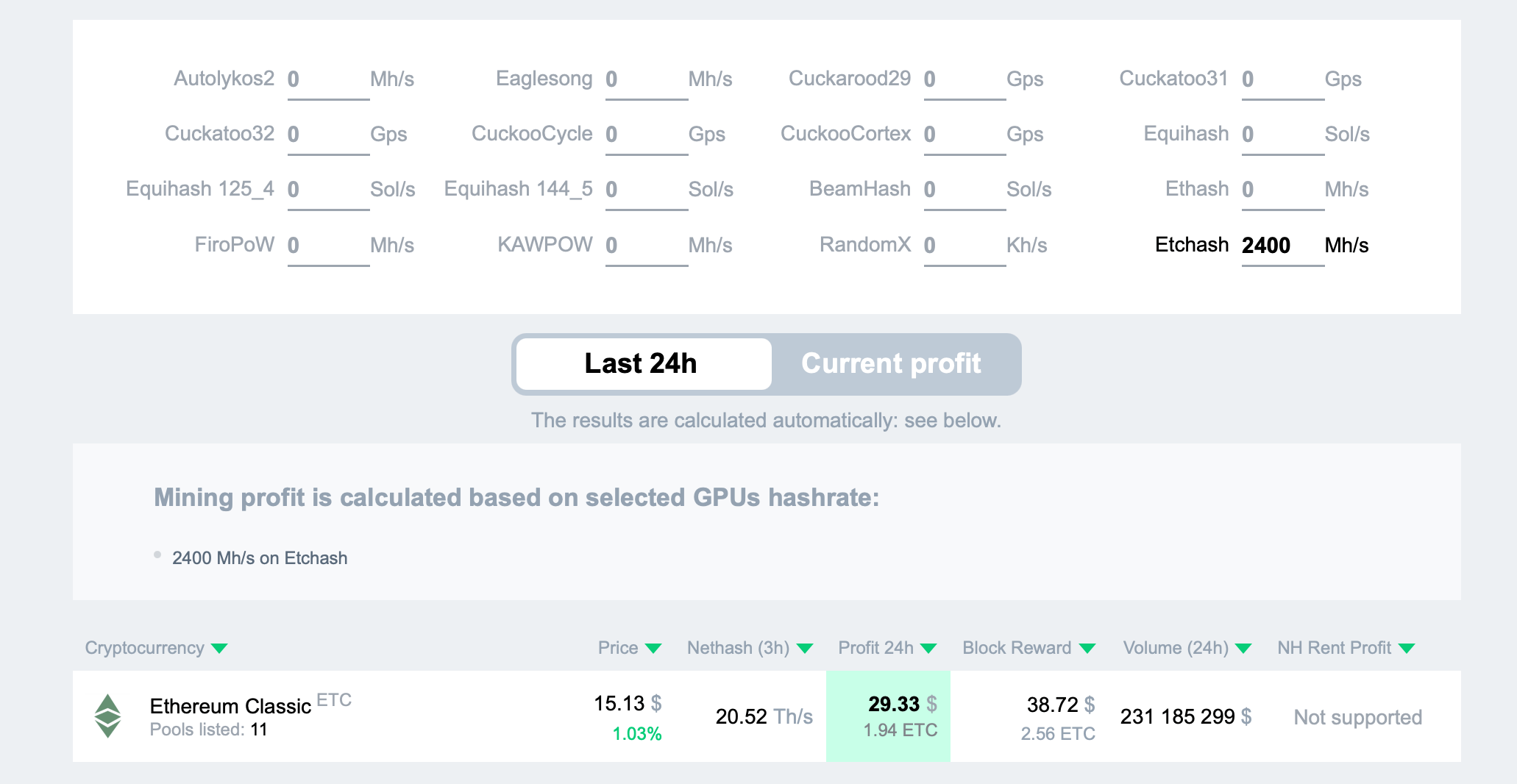
With the same hash rate, you will get $29 from mining Ethereum Classic.
If the ETH exchange rate and Ethereum network difficulty remain stable, the miner will start bringing a profit after $9,999/$42 = 238 days. In reality, the pay-off period may be longer if you also consider electricity costs.
So we can conclude that if you get Antminer E9, you will have to mine Ethereum Classic as well, because ETH network is likely to shift to PoS within 240 days.
Where and How to Mine with Antminer E9
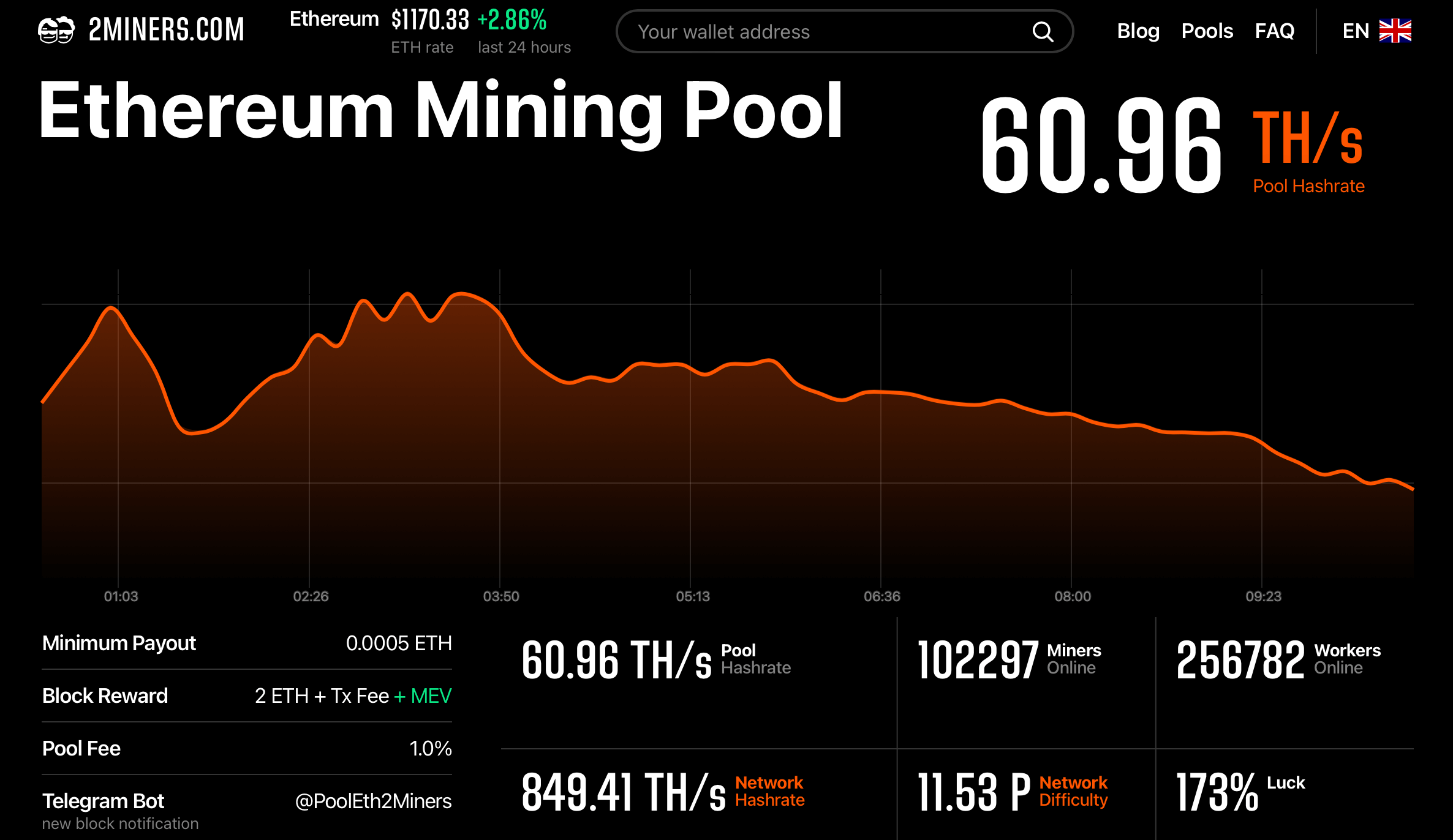
Antminer E9 settings are already available. We recommend mining Ethereum with this ASIC miner and graphics cards on the 2Miners pool that already boasts 102 thousand miners.
You can use the following settings for the new device:
URL: stratum+tcp://eth.2miners.com:2020

Worker: YOUR_WALLET_ADDRESS.ASIC_ID

Password: x
If you need to set up other devices, you will find all the info on the Ethereum pool page.
Antminer E9 is a powerful mining machine that will surely be popular among the right customers. Sure, sooner or later Ethereum will shift to PoS, but the device owners will still be able to mine Ethereum Classic. If the cryptocurrency market continues to grow, its profitability is likely to be more than satisfactory.
Remember to follow us on Twitter to get all the news as soon as possible.
Miner since 2017, the 2Miners pool co-founder. Became interested in cryptocurrencies at the dawn of the latest bull run and bought his first graphics cards. After having built and set up a few mining rigs, he realized that existing mining pools didn’t satisfy him – that’s how the idea of creating the 2Miners pool was born.
John published a series of articles about the basics of cryptocurrency mining. He gave valuable tips on how to buy ASICs and GPUs from abroad and then shared their mining performance. On the website, you can find early articles about cryptocurrency mining, blockchain in general and mining pool operation principles. The readers gave positive feedback on John’s practical guides, such as building an Ethereum mining rig and Nvidia 1080ti overclocking.
June 2022 Work Progress Report: Ethereum Difficulty Bomb Delayed, Ergo Reward Reduction
July 1, 2022
Ethereum difficulty bomb delayed, zero fees in Firo pool after the halving, Ergo block reward reduction, cryptocurrency node updates.
Ethereum Difficulty Bomb Delayed
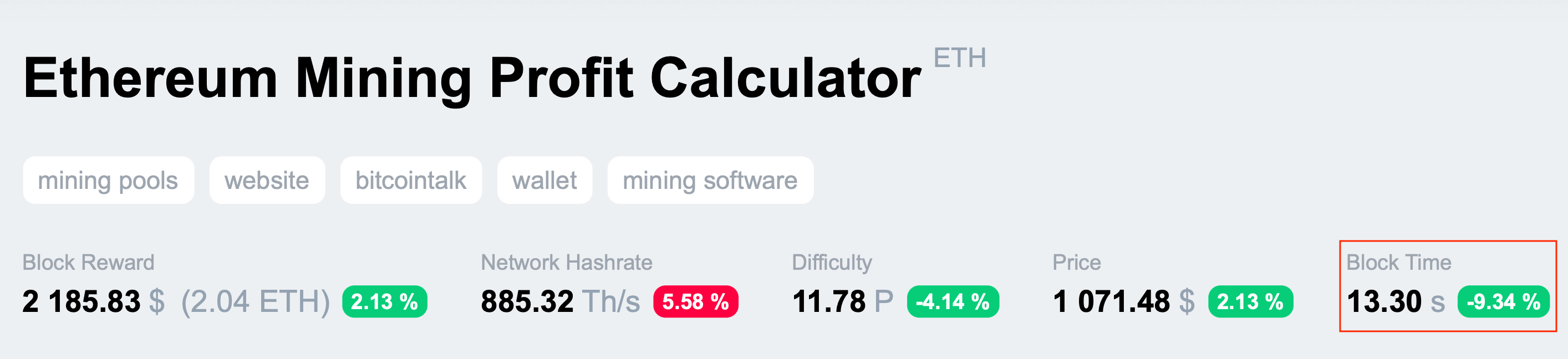
Ethereum Grey Glacier hardfork activated at Block 15 050 000. The difficulty bomb has been postponed to mid-September. ETH block time has dropped back from 16 sec to 13 sec.
More blocks in the network -> More rewards for the miners!
You could always check the current block time of the Ethereum Network in 2CryptoCalc.
If you have no time to read our latest post on the ETH future, Son of a Tech is reading it for you on YouTube.
No Fees for FIRO
FIRO halving happened on June 16.
The block reward was reduced from 6.25 FIRO to 1.5625 FIRO. The block time was reduced from 5 minutes to 2.5 minutes. That means all the miners now get two times fewer rewards than before.
2CryptoCalc was updated. You could read all the FIRO release details on GitHub.
To further support the miners who have their block rewards reduced due to the change in the monetary policy of FIRO devs, 2Miners pool is completely removing its commission, making it 0%.
From now on all the mined FIRO coins are paid to our miners. No matter if they mine in the Pool or Solo.
The change is immediately in effect and will last until further notice.
ERGO Block Reward Drops
Please pay attention that the ERGO block reward dropped from 63 ERG to 51 ERG at block 777 217 on June 22. 2CryptoCalc was updated.
Unfortunately, another block reward reduction happens at the beginning of July.
Block rewards are reduced every three months by 3 ERG/block. Based on the emission schedule, the next reduction in rewards will take place around July 2, 2022. The block rewards will be reduced by 3 ERG, therefore the total reward for each block will be 48 ERG. Three months from that date, the block rewards will be 45 ERG/block, and so on. This reduction schedule will continue until block rewards are 3 ERG/block. Block rewards will remain steady at 3 ERG/block until the remission contract has been depleted.
These cryptocurrency nodes were updated in June by 2Miners.
Beam Node Groovy Gluon 7.0.13064
Ergo Protocol Reference Client 4.0.31
ETC CoreGeth/v1.12.7-stable-a374c2e8
ETH Geth for Grey Glacier hardfork
ETH High MEV Blocks
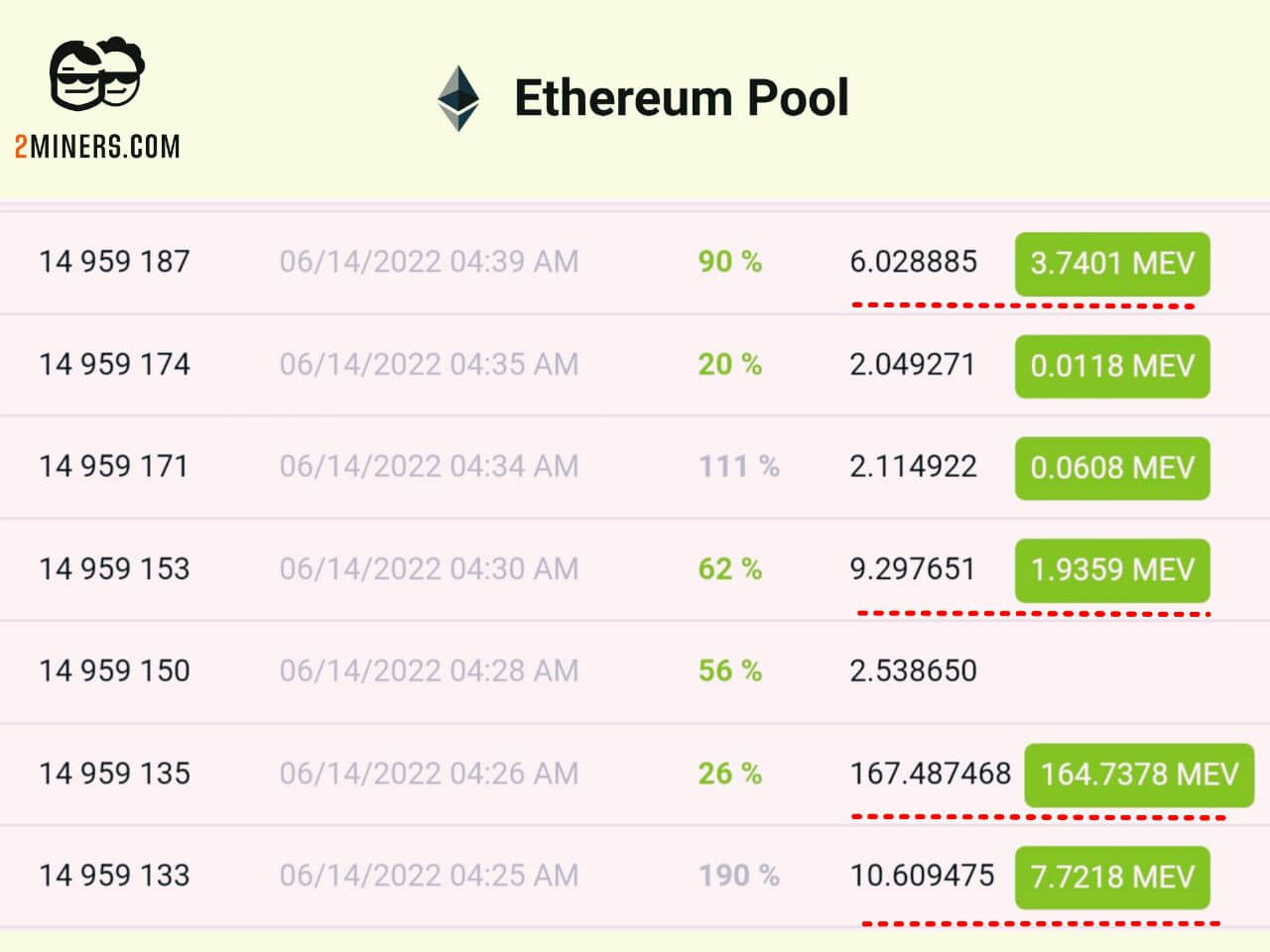
We’ve seen a couple of nice blocks series in 2Miners Ethereum Pool in June. For example block number 14 959 135 brought almost 165 ETH of MEV to the miners of the Ethereum pool.
You could always find the recent blocks on the blocks page of the Ethereum pool.
The 2Miners pool co-founder, businessman, miner. In 2017 started mining cryptocurrencies and built many rigs on his own. As a result, he gained lots of practical knowledge and became interested in sharing it with others.
In his articles on 2Miners, he shares useful tips that he tried and tested himself. For example, Darek gives advice on how to buy hardware components for the basic mining rig and how to connect them to each other correctly. He also explained lots of complicated terms in simple words, such as shares, mining luck, block types, and cryptocurrency wallets. After the pool was launched, he published a series of articles ‘Crypto Mythbusters’ where he explained how to protect the network against 51% attack, talked about cryptocurrency mining difficulty and difficulties of launching your own node.
Choosing Proof-of-Stake Over Mining Is Ethereum’s Biggest Mistake and Here Is Why
June 6, 2022
Years ago, Ethereum developers decided to quit cryptocurrency mining. And now, on June 8th, Ethereum’s test network called Ropsten will host the merge to shift to staking and abandon mining completely. On that day, only the test network will get an update, while the main cryptocurrency network will get it sometime in the near future. It means that staking is coming. In this article we are going to explain why quitting GPU mining is Ethereum’s biggest mistake.
Bitcoin vs Ethereum. Decentralization
Cryptocurrencies come and go, rise and fall, but there are two cryptocurrencies that have always stayed at the top for many years: Bitcoin (BTC) and Ethereum (ETH). Everyone compares these cryptocurrencies all the time.
Bitcoin
Bitcoin is the world’s first cryptocurrency, the father and mother of all other coins. Without BTC, other coins wouldn’t have existed. Bitcoin is the “digital gold”, the most secure coin, the keystone of all. It’s spread all over the globe. Bitcoin’s old software versions work great with its new versions.
The Bitcoin network has had only a few updates lately, but the truth is, it doesn’t need many. It’s good the way it is. Anyone in the world can become a Bitcoin user and launch a fully functional Bitcoin node. You only need a computer connected to the Internet and 400 GB of free space on the hard drive.
Of course you can also download a light wallet on your smartphone, but in this case, it's going to use the wallet's developer node.
Ethereum is a unique project developed on the base of Bitcoin. It’s not just a digital currency, but also a platform for the creation of blockchain-based applications. The Ethereum network allows you to transfer ETH coins that have value, but you can also launch programs called smart contracts inside the network.
Ethereum is like a botnet that allows you to launch a program on all computers within the network. Unlike a botnet though, Ethereum programs can’t access the external Internet and can’t harm anyone. In recent years, we’ve seen some unique projects developed on the Ethereum platform, like decentralized exchanges and other DeFi projects. They are trading platforms operating based on the preset algorithm without any human control or participation.
Ethereum is regularly updated. According to Electric Capital, over 4,000 developers are working on the project. One of the updates is the introduction of a smart contract for Ethereum staking that already stores over 10% of all ETH. Another important update is mining fee burning in the ETH network.
There is a lot going on with the project, and probably that is why users don't criticize the developers for the lack of an official and user-friendly wallet. There are a lot of wallets for Ethereum, but they are all third-party wallets.
Are Cryptocurrencies Decentralized?
You probably already know that cryptocurrencies are decentralized. No one runs them, there is no system in place to override, return transactions or direct them to a different address, you can’t delete your address, etc.
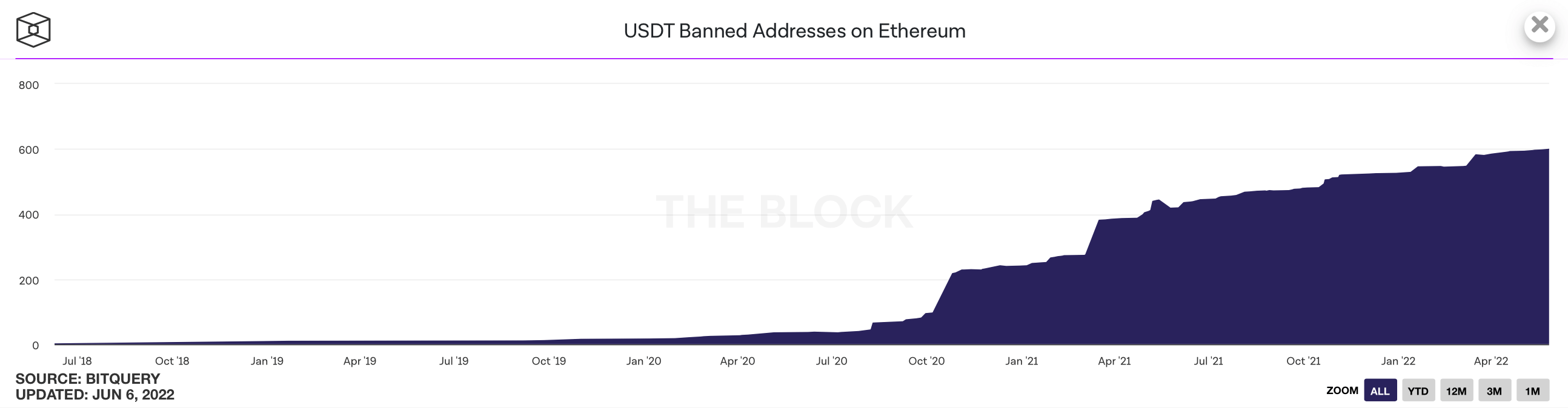
You can freeze your address, but not fully. For example, the Tether company that created the most popular stablecoin called USDT can prevent certain addresses in the Ethereum network from interacting with it. As of now, there are 597 addresses on the blacklist. But you can easily create a new address thus bypassing the ban.
Say, if you send the cryptocurrency to someone’s address, there is no way to get it back. At the same time, if you store the cryptocurrency on your personal wallet, tax or other authorities don’t have access to your funds. Everything is in your hands.
However, not all people understand what makes decentralization possible.
If you install a Bitcoin wallet on your computer with a full blockchain copy keeping it connected to the network, will you contribute to decentralization? Yes and no. But mostly you won’t. All network nodes are interconnected and transmit information about new blocks to each other. Your node also validates new blocks in the network. So your node helps to spread information faster among other network nodes, but it doesn’t help with anything else.
Decentralization is mostly made possible by miners, or by those nodes in the network that not only transmit and receive information but also find new blocks. Miners are the ones responsible for filling blocks with new transactions. We wrote about it in the article: What Is Mining?
Decentralization is Ethereum’s key advantage over Bitcoin and all other cryptocurrencies. Vitalik Buterin has created a unique solution that no one has been able to replicate yet. Why is it so unique?
If you want to mine most cryptocurrencies, you need special equipment. Bitcoin and many other coins are mined using the so-called ASIC devices. They are metal boxes with electronic circuit boards and extremely noisy fans that are actively blowing out the air. They are impossible to use at home and require a dedicated space.
There are no ASIC miners for Ethereum mining. That is, there are devices called in such a way, but in reality, they are just multiple GPU chips placed in the same case. Such ASICs are not superior to normal GPUs in any way. Their performance is at the same level, while the price is often higher. Plus, GPUs are multifunctional: you can use them to mine, render objects in 3ds Max, and play GTA5. ASICs for ETH are designed exclusively for mining, and their repairability is close to zero.
Ethereum Is the Most Decentralized Currency. Yet
Unlike Bitcoin, Ethereum can be mined only with GPUs. Thanks to its mining algorithm security, no one has been able to develop ASICs.
GPUs are available everywhere, so there are ETH miners all over the world. Some mine with one GPU, others mine with two, and there are those who have a garage full of GPUs. The point is, that everyone can start mining. And you don’t need much to do so. With a computer at home and $200–$300 to spend, you can already start mining.
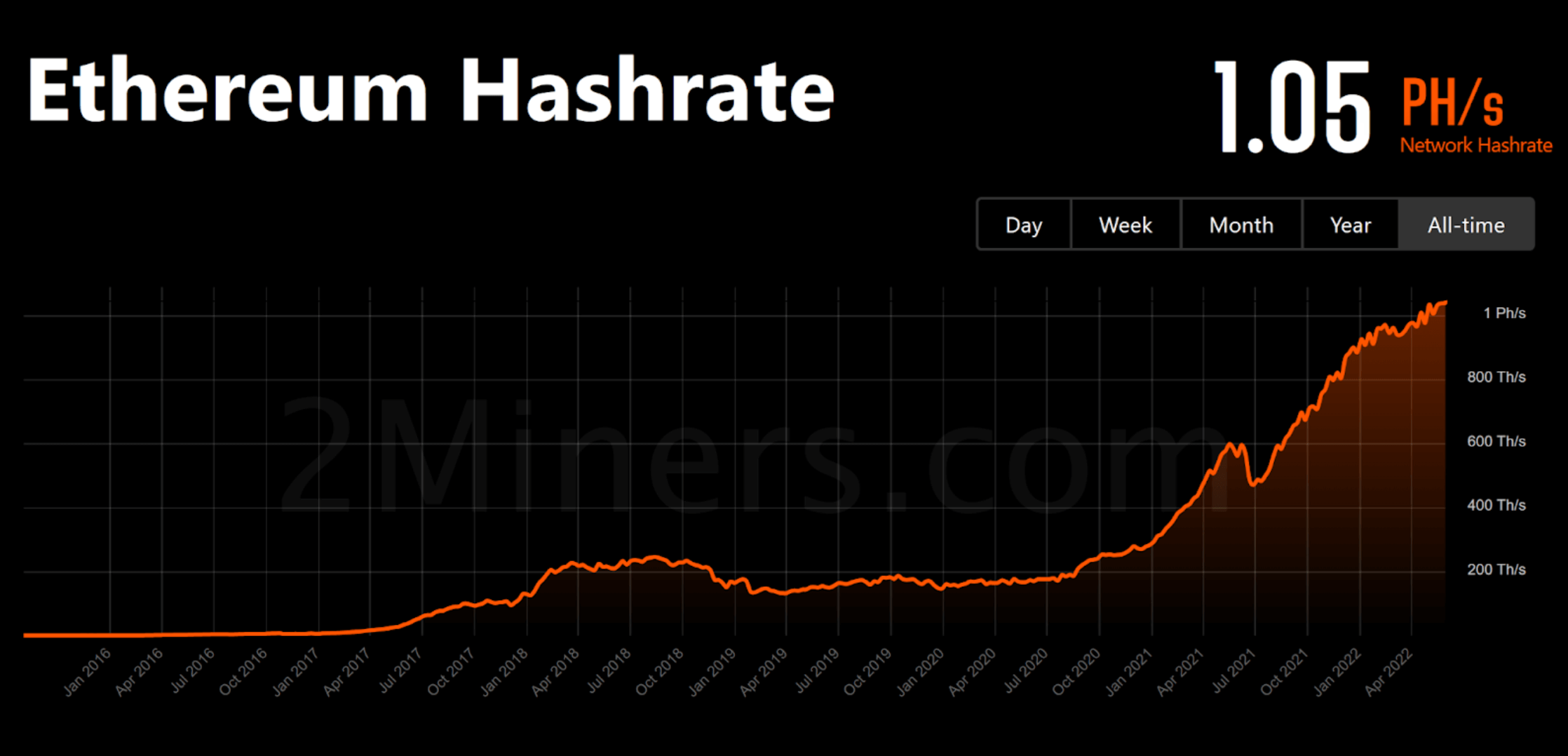
How many GPUs are mining Ethereum? At a current network hash rate of 1.05 PH/s and an average GPU hash rate of 40 MH/s, over 25 million GPUs mine Ethereum across the globe. Some other cryptocurrencies are also mined with GPUs, but even the most popular ones are mined by less than a million graphics cards. The difference is huge.
Bitcoin mining is only possible in special locations, like factories, industrial sites, etc. One up-to-date ASIC mining device costs a few thousand dollars. Plus, you need low electricity rates to be able to afford to mine. It’s hard to say how many people mine Bitcoin in specific countries, but it’s no secret that the leading countries are the USA, Russia, Kazakhstan, and China, despite the official ban on mining. A common person can’t mine Bitcoin. There is a workaround, but even in this case you actually mine ETH and then get paid in BTC.
Ethereum is much more decentralized than Bitcoin. Ethereum truly belongs to people. This is mind-blowing.
Ethereum developers though want to “centralize” the coin. They want to give control over Ethereum to rich users, those who have a lot of ETH. It means that a group of rich people will define the consensus in the network. You may think that they wouldn’t have any interest in harming the coin in any way because they invested a considerable amount of funds in it. The truth is, by working together they can alter the network operation to increase their profit.
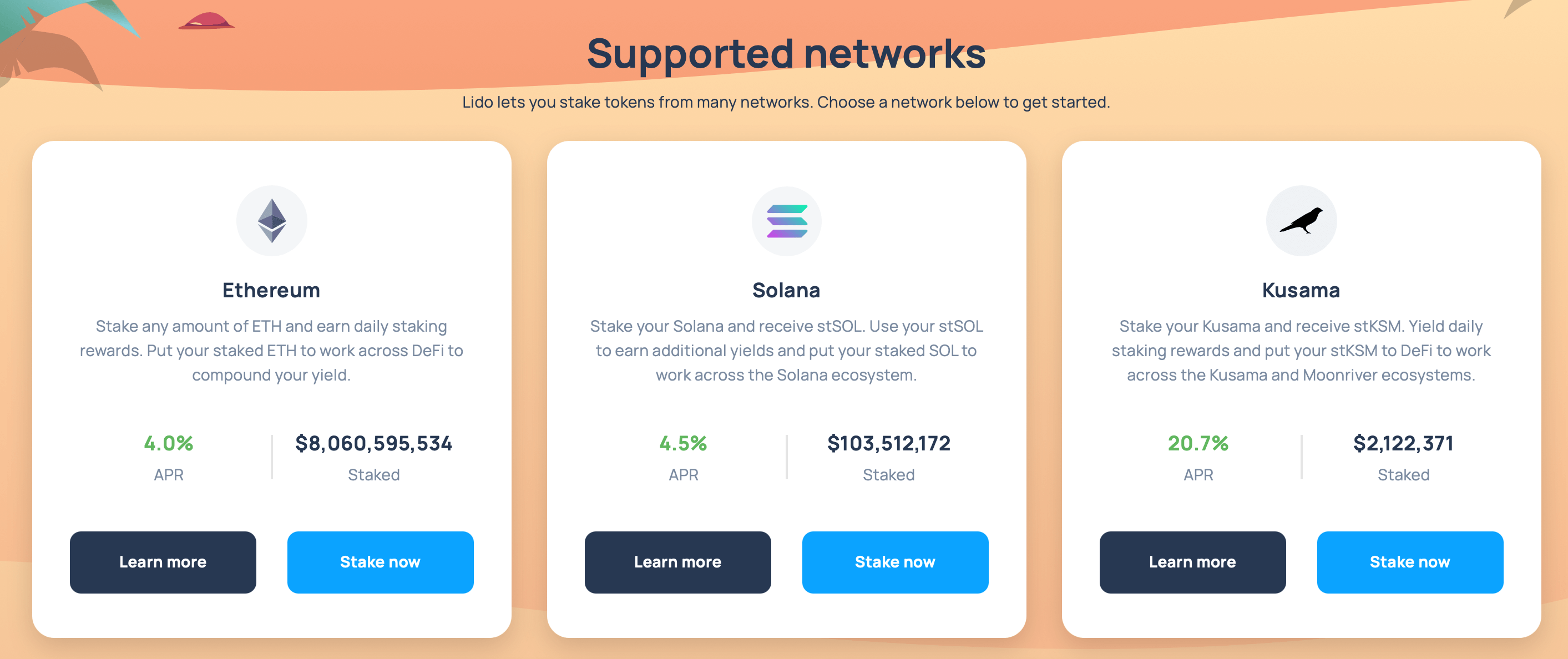
Ethereum Staking. What Will Change after the Shift to POS?
Simply put, POW is mining, while POS is staking. Mining means using your computing powers to get rewarded. Staking means locking a certain amount of money on your account and keeping your wallet online to get rewarded.
To become a true validator of the Ethereum network after it shifts to POS, you need to lock 32 ETH, which is sixty-five thousand dollars at the current exchange rate. What are the consequences of quitting mining and shifting to staking? Let’s talk about the key ones.
Lack of Decentralization
As we mentioned above, Ethereum is the most decentralized cryptocurrency of our time. GPUs are widely spread all over the world. Plus, you need only $200–$300 to start mining. After the shift to POS, you’ll need much more investments to start staking: in order to get a reward, you’ll have to lock the equivalent of $65 000 on your account, not to mention the expenses of powering your computer and renting a server for your validator node.
If Ethereum shifts to POS, it will no longer be the most decentralized currency in the world. It will become just an ordinary coin with a network security level comparable to many other coins.
Colossal Risks of Stakers
Some might argue that you don’t necessarily need 32 ETH to start staking: you can stake in pools, plus many exchanges will launch their own validators, etc.
Sure, you can stake in pools, as well as give your money to exchanges, but keep in mind the key rule of cryptocurrencies: Not Your Keys, Not Your Coins. You could pool 32 ETH with 31 more people by sending 1 ETH each to some platform that would launch a validator for you.
But how can you make sure that such a platform won’t rip you off? Someone could also hack the platform and steal your money. It’s even worse with exchanges: almost all of them have been hacked at least once, and the rest could be hacked at some point. Plus, exchanges tend to change KYC policies quite often. If you fail to comply one day, you won’t get your money back.
Exchanges can also ban user accounts due to "suspicious activity" without any further explanation.
Even if you have 32 ETH and you managed to launch your own validator node, it doesn’t mean that you will now get generously rewarded. There are a lot of penalties that your validator can get. You will be charged for all of them, as well as for inactivity.
Imagine that your validator gets under a DDOS attack. In this case, you will be charged a penalty. If someone launches a virus and your validator gets affected, it will be sending the wrong data to the network. The base penalty for such an error is 0.25 ETH, or $500.
In mining, these types of problems don’t exist. You get a reward without running any risks. No one can confiscate your GPUs if they don’t operate properly. Plus, you need $200–$300 to start mining, not $65 000. Mining is mostly done through mining pools. If something happens to a pool, you can switch to another pool in no time. In the case of staking, you can’t do that, especially if you stake through a third-party platform. Moreover, the servers of such a platform may catch fire, get seized, and your coins may disappear or get locked at any moment.
The ETH exchange rate tends to fluctuate, and you get as little as 5% per year for staking and run colossal risks.
Also in case of staking, you can’t withdraw your money for now. And it’s still unknown when it will be possible. You also don’t know how much 1 ETH will cost on that day: it can be $400 or $1,000. Nobody knows.
It means that common users will lose a source of income.
POS Security Is Questionable
Ethereum has been around for seven years now, since June 30, 2015. The network has always used POW as an algorithm, and mining is ensuring network security. It’s a tried and true solution. Ethereum hasn’t experienced any attacks for many years. In order to hold a 51% attack, you need a huge amount of computing power in the form of GPUs that no one in the world has.
The shift to POS and staking raises a lot of questions. Have ETH developers really made sure that their code is valid and the network is secured against any incidents? For example, on May 25, Ethereum’s POS network experienced a 7-block deep reorg. Simply put, the blockchain got split into two chains, so they had to cancel one of them. With mining, Ethereum hasn’t experienced such problems for a few years now.
Does Ethereum Need POS? What’s behind Developers’ Actions?
The Ethereum developers claim that POS is necessary for environmental reasons. Cryptocurrency mining uses a lot of equipment that consumes megawatts of power. But shifting to POS will deprive Ethereum of decentralization.
Plus, only extremely rich people will benefit from Ethereum staking, while common people won't be able to afford it.
The new system will boost the number of fraudulent platforms offering to stake jointly. And their victims will lose money. All of it will ruin trust in cryptocurrencies, and the consequences may be much more serious than the fall of LUNA and UST.
Furthermore, many cryptocurrencies offer staking, but can you name at least one successful project? At the time, Ethereum replicated Bitcoin’s success by taking its best parts and adding new groundbreaking ideas. It was a coin designed for mining. Now, why is Ethereum trying to implement a mediocre idea? Bitcoin and Ethereum come first and second respectively in terms of the cryptocurrency market cap in the world.
POS Risks
We know that the developers have been delaying the shift to POS for 4 years now. Does it mean that they themselves are not so sure about it? How can this fully replace the old fully functional system?
The cryptocurrency market is full of coins with validators, masternodes, and staking. But only Ethereum with its mining is the second most popular coin after Bitcoin.
More than 10% of all ETH coins are now locked in Ethereum’s staking smart contract. What will happen when it becomes possible to withdraw this 10% of all Ethereum coins? It’s more than 12 million ETH, or $24 billion. If you stake 32 ETH now, they get locked, and it’s still uncertain when withdrawals will be enabled. What will happen to the exchange rate when this 10% of coins flood the market? Even if only half of all users start selling these ETH coins, we are still talking about selling billions of dollars worth of ETH.
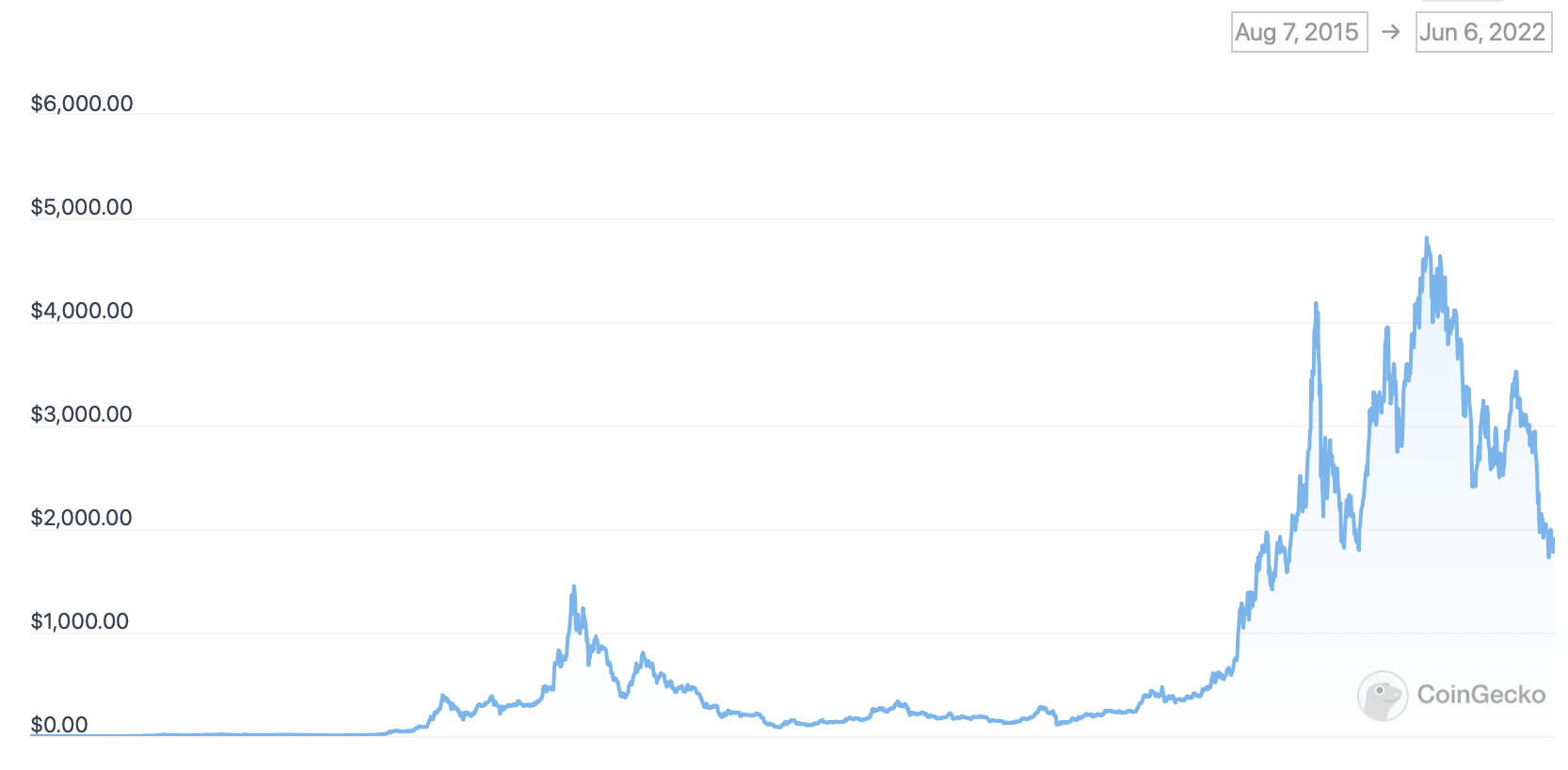
Why should people even consider ETH staking if the annual interest is only 5%? They’d better buy a property and rent it. You can expect the same profit from renting an apartment. But the cost of an apartment doesn’t fluctuate from $4800 to $1800 within a couple of months. The risks are much lower.
Does it mean that staking will be used for money laundering? Why else would someone invest in such an unprofitable and risky asset?
What if someone invests illegal ETH coins in the same staking pool you’re using? The authorities might start the investigation and put the platform operation on hold or even close the platform. You may lose any control over your coins.
Also, imagine investing 32 ETH at a rate of $4,800 per ETH and discovering in a month that 1 ETH now costs $1,500. We really are clueless as to who may be interested in such business.
Remember to follow us on Twitter to get all the news as soon as possible.
The 2Miners pool co-founder, businessman, miner. In 2017 started mining cryptocurrencies and built many rigs on his own. As a result, he gained lots of practical knowledge and became interested in sharing it with others.
In his articles on 2Miners, he shares useful tips that he tried and tested himself. For example, Darek gives advice on how to buy hardware components for the basic mining rig and how to connect them to each other correctly. He also explained lots of complicated terms in simple words, such as shares, mining luck, block types, and cryptocurrency wallets. After the pool was launched, he published a series of articles ‘Crypto Mythbusters’ where he explained how to protect the network against 51% attack, talked about cryptocurrency mining difficulty and difficulties of launching your own node.