September 2026 Work Progress: Kaspa Reward Cut and Quai Reward Changes
October 4, 2026
September was a quiet maintenance month. Kaspa cut its block reward on schedule, and we upgraded three nodes: Ergo, Pearl, and Quai. The Quai release is the one worth reading, because it changes how Qi mining rewards and fee rewards are calculated.
Kaspa (KAS) Block Reward Reduction
As defined by the Kaspa Tokenomics and the official emission schedule, Kaspa underwent another scheduled block reward reduction in September.
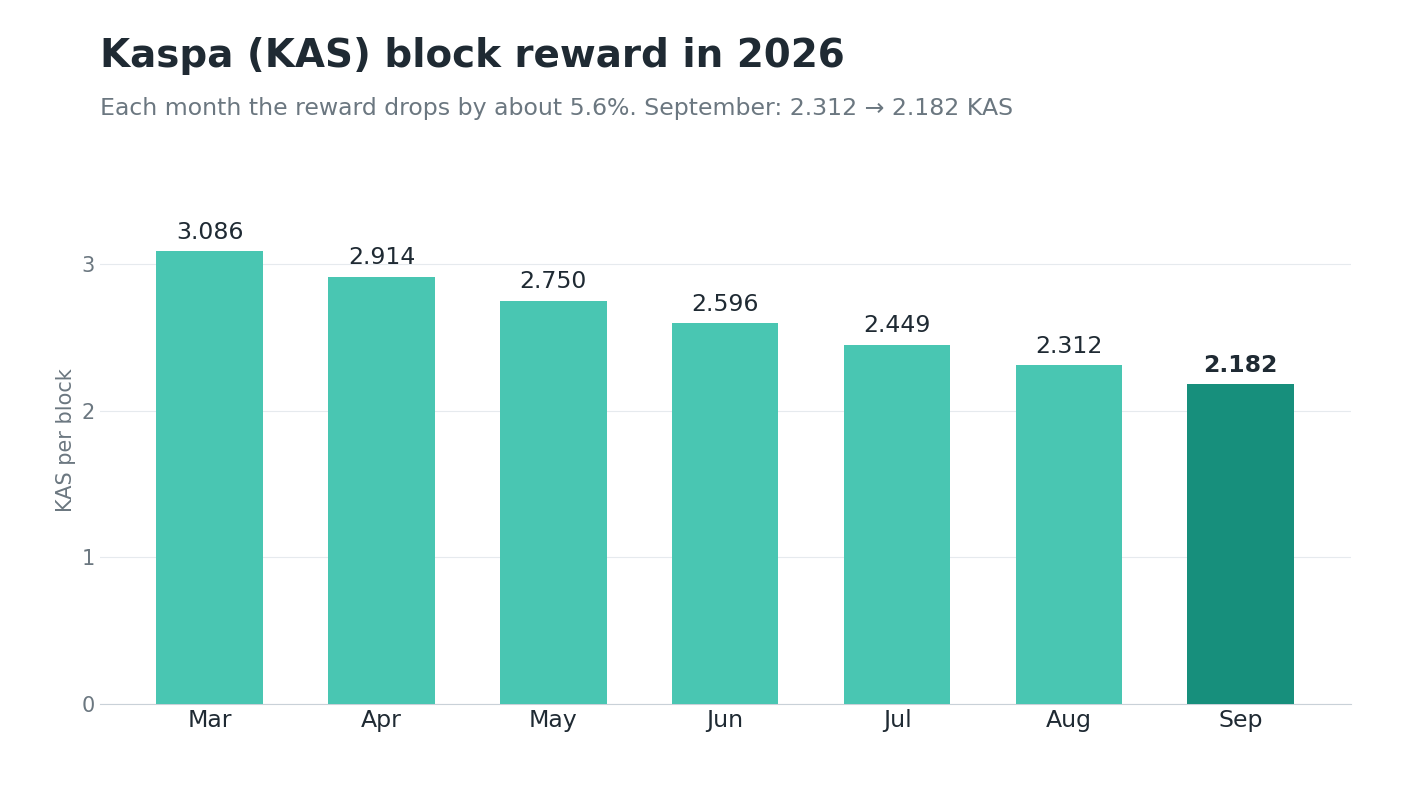
Previous Reward: 2.312 KAS
New Reward: 2.182 KAS
The reward drops by about 5.6% every month, so since March it has fallen from 3.086 KAS to 2.182 KAS per block.
Please pay attention! Kaspa mining profitability has changed. We have already updated 2CryptoCalc to reflect the new reward values. Mining continues on the KAS pool and KAS SOLO.
Node Updates
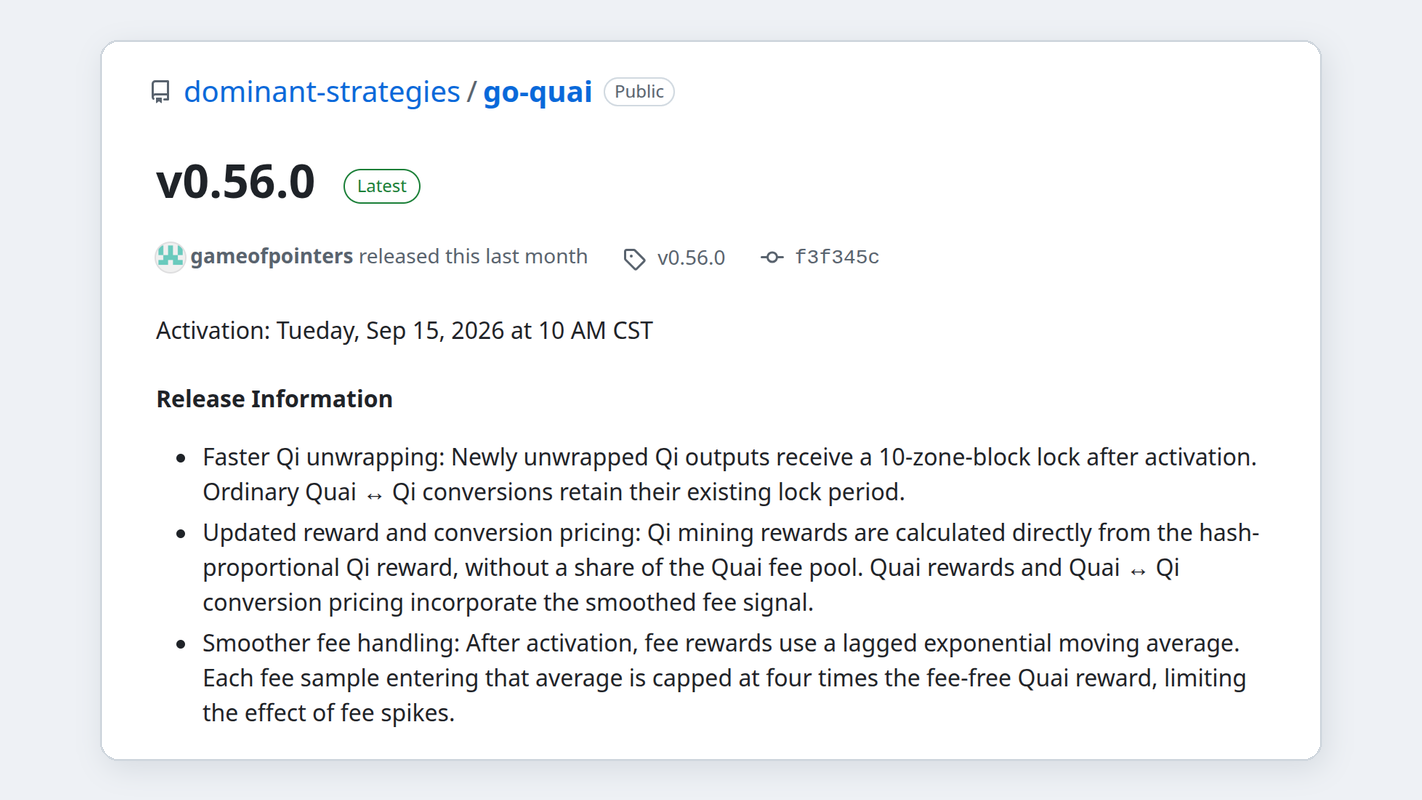
Quai v0.56.0
A mandatory upgrade that activated on September 15. What changed for miners:
Qi rewards now come straight from the hash-proportional Qi reward and no longer include a share of the Quai fee pool.
Fee rewards are smoothed. They follow a lagged moving average, and each fee sample is capped at 4× the fee-free Quai reward, which limits the effect of fee spikes on payouts.
Faster Qi unwrapping: newly unwrapped Qi is locked for only 10 zone blocks.
Fixes for UTXO accounting, reorgs, and the database.
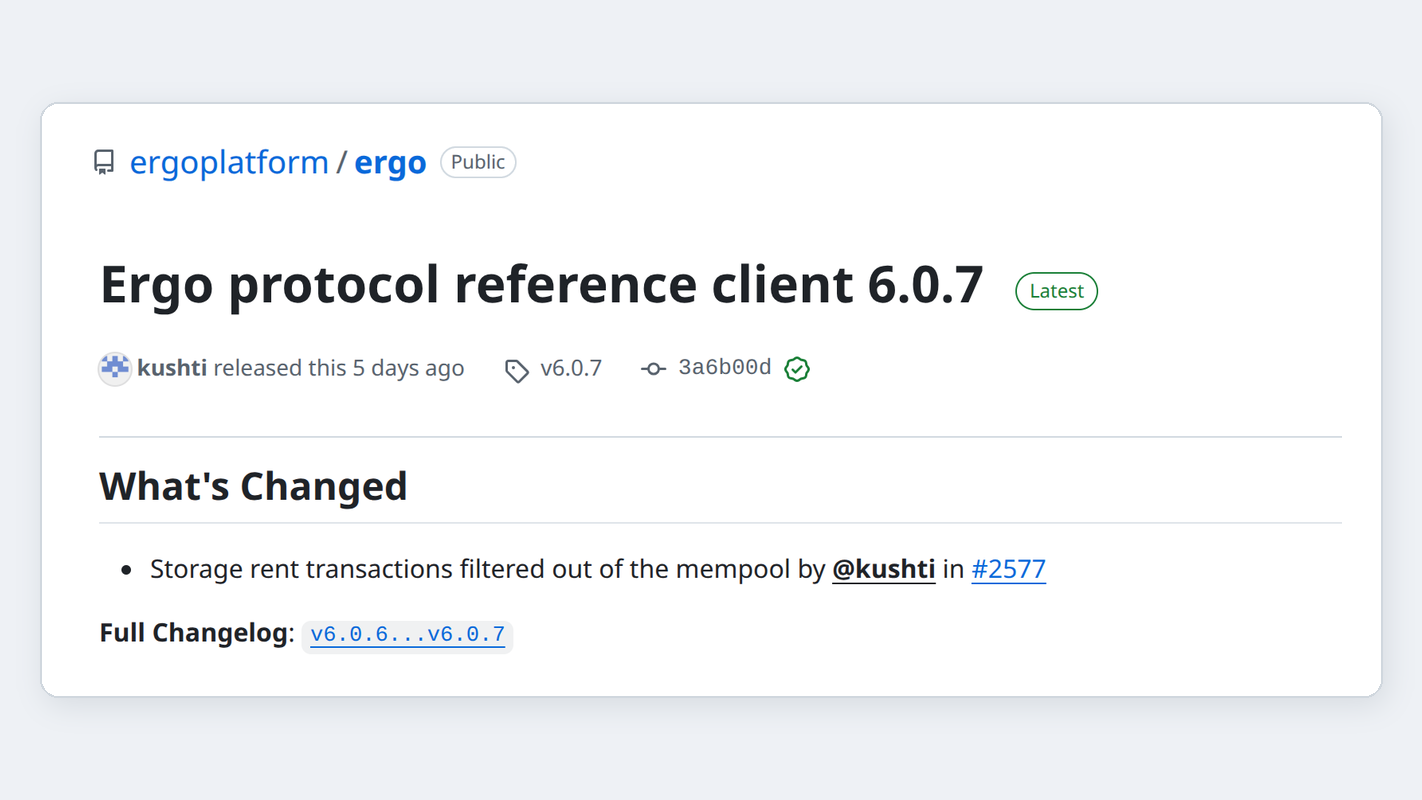
This release has a single change: storage rent transactions are now filtered out of the mempool. Autolykos mining is unchanged. Mine on the ERG pool and ERG SOLO.
Stay Updated
Follow us on X (Twitter) and join our Telegram chat to stay informed about new developments, miner alerts, and network upgrades.
The 2Miners pool co-founder, businessman, miner. In 2017 started mining cryptocurrencies and built many rigs on his own. As a result, he gained lots of practical knowledge and became interested in sharing it with others.
In his articles on 2Miners, he shares useful tips that he tried and tested himself. For example, Darek gives advice on how to buy hardware components for the basic mining rig and how to connect them to each other correctly. He also explained lots of complicated terms in simple words, such as shares, mining luck, block types, and cryptocurrency wallets. After the pool was launched, he published a series of articles ‘Crypto Mythbusters’ where he explained how to protect the network against 51% attack, talked about cryptocurrency mining difficulty and difficulties of launching your own node.
August 2026 Work Progress: Ravencoin Chain Rescue, Pearl Hard Fork, and Kaspa Reward Cut
September 4, 2026
August belonged to Ravencoin. A consensus flaw in KAWPOW header validation let an attacker forge blocks for almost nothing, and the network spent a week deciding which chain was real. We shipped the emergency patch that the Ravencoin project later published as v4.8.0, and together with the other pools we rebuilt the chain from the last clean block. Pearl went through a hard fork at block 99,000, Kaspa cut its block reward again, and we updated our Ergo and Quai nodes.
Ravencoin (RVN) Consensus Exploit and Chain Recovery
This was the most serious incident on any of our pools this year, so here is the whole thing in order.
What broke
The flaw sits in Ravencoin’s KAWPOW block header validation. The nHeight field inside the KAWPOW header was never checked against the block’s actual position in the chain. An attacker who manipulates that field can get a vulnerable node to accept a supplied mix hash without ever doing the real ProgPoW work – no DAG, no memory-hard hashing, no GPU. Forging a block that way is orders of magnitude cheaper than mining one honestly.
The bug had two ugly side effects beyond the forged blocks themselves. Affected nodes could crash on restart, and nodes trying to sync ran into broken header sequences and stalled.
Timeline
August 7, 15:44:01 UTC – the first known invalid block is accepted at height 4,487,776. A self-described security researcher demonstrated the attack on mainnet, and a second attacker copied it.
August 10 – 2Miners releases the emergency patch 4.6.1.1-hf1. It rejects any block whose declared header height does not match its actual position in the chain, and locks a checkpoint at block 4,487,775, the last clean block.
August 10-12 – Upbit and Bitget suspend RVN deposits and withdrawals as a precaution.
August 11 – Ravencoin publicly discloses the vulnerability and advises node operators, exchanges, and explorers to upgrade immediately. Maintainer Hans Schmidt recommends running the 2Miners code until a combined upstream release is ready.
August 19 – Ravencoin publishes v4.8.0, built on the same code we released, bundling the KAWPOW fix with the separate asset transfer quantity overflow patch.
How big the damage was
Scanning a 2,089-block window from 4,489,527 to 4,491,615, we identified 96 forged blocks. Everything confirmed after 4,487,775 on the exploited branch was at risk, which is roughly three days of chain history.
The recovery chain
2Miners and the other pools started building a competing chain from block 4,487,776 that excludes the branch carrying the invalid blocks. Together we hold the majority of Ravencoin’s hash rate, so the clean chain grew faster than the forged one and overtook it. It is now thousands of blocks ahead, peers have reconnected, and the split is settled in favour of the honest chain.
Every RVN mined before August 7 was never in question. Our RVN pool and RVN SOLO have been running on the clean chain throughout.
What you need to do
Run v4.8.0 if you operate your own node, wallet, explorer, or exchange integration. It supersedes our emergency hotfix 4.6.1.1-hf1.
v4.7.0 does not fix this. That release only patched the asset overflow bug and never activated on mainnet, because BIP9 voting did not complete before v4.8.0 became necessary.
Anything older than 4.6.1.1-hf1 is still exposed to the same forged-block trick and may refuse to sync.
If you mine RVN with us and do not run your own node, there is nothing to change on your side. KAWPOW mining and payouts continue as normal.
Pearl (PRL) Salted Noise-Seed Hard Fork at Block 99,000
Pearl activated a hard fork at mainnet block 99,000 on August 11. The change salts the noise seed used by PearlHash, which means shares produced by pre-fork mining software are simply invalid after the fork block.
Please pay attention! This failure mode is quiet. An outdated miner keeps reporting a healthy hashrate on your screen while nothing it submits gets credited. If your PRL earnings flatlined in mid-August, this is why.
Mining software with fork support:
PeakMiner 2.9.0
SRBMiner 3.5.3
Krig 1.2.0
ArcMiner 0.3.1
Fl4shMiner 1.2.7
ForgeMiner 1.5.10
On the node side the fork ships in Pearl 1.4.1, and that is what our node runs. Earlier in the month we also took Pearl 1.3.1 (commit b6d7e5e), a follow-up to the 1.3.0 rank-penalty soft fork released on August 5. Our pools were ready before the fork block and kept producing. Mine on PRL POOL and PRL SOLO, and check profitability on 2CryptoCalc.
Kaspa (KAS) Block Reward Reduction
As defined by the Kaspa Tokenomics, the Crescendo Hard Fork, and the official emission schedule, Kaspa underwent another scheduled block reward reduction in August.
Previous Reward: 2.449 KAS
New Reward: 2.312 KAS
Please pay attention! Kaspa mining profitability has changed. We have already updated 2CryptoCalc to reflect the new reward values. Mining continues on the KAS pool and KAS SOLO.
Node Updates
Ergo – 6.0.4
Released August 18. Most of this release is API hardening and test work, but three items matter if you run an Ergo node or care about block propagation:
Block candidate generation improvements
A fix for lastHeaders in the upcoming state context, so the miner no longer gets stuck on divergence during block pre-validation and validation
A caught-up fix, plus extra index consistency preserved across chain switches
The rest is housekeeping: duplicate IDs are now prevented in the ordered transaction pool, several REST and wallet routes validate their parameters properly, and the testnet version 2 activation height was corrected. Autolykos mining is unchanged. Mine on the ERG pool and ERG SOLO.
Quai – v0.55.1
Tagged August 11. The headline for miners is that go-quai now carries a built-in stratum proxy for solo mining, and the release collects a long run of work on it:
Variable difficulty (vardiff) for the stratum proxy
Optional PROXY protocol support, so the stratum server works behind a load balancer
A blockTemplateUpdates websocket subscription
Bitcoin-style difficulty values instead of raw difficulty in API submissions
A health check service on port 8081 that compares node height against a public RPC
Graceful stratum shutdown, unique job IDs, monotonic session IDs, and a frequency parameter that only updates ASICs at the requested rate
KawPoW handling updates on Quai parent hash change, and guarding of the epoch and light cache DAG size
The 2Miners pool co-founder, businessman, miner. In 2017 started mining cryptocurrencies and built many rigs on his own. As a result, he gained lots of practical knowledge and became interested in sharing it with others.
In his articles on 2Miners, he shares useful tips that he tried and tested himself. For example, Darek gives advice on how to buy hardware components for the basic mining rig and how to connect them to each other correctly. He also explained lots of complicated terms in simple words, such as shares, mining luck, block types, and cryptocurrency wallets. After the pool was launched, he published a series of articles ‘Crypto Mythbusters’ where he explained how to protect the network against 51% attack, talked about cryptocurrency mining difficulty and difficulties of launching your own node.
July 2026 Work Progress: Ethereum Classic Cuts Block Reward by 20%
August 3, 2026
July was a month of shrinking block rewards. Ethereum Classic cut its block reward by 20% under ECIP-1017, Kaspa went through another scheduled reduction, and Zcash activated the Ironwood upgrade that closes the Orchard flaw we reported last month. We also refreshed our Zcash, Nervos, and Pearl nodes and rotated the SSL certificates on all pools.
Ethereum Classic (ETC) Block Reward Reduction
In accordance with the Ethereum Classic Monetary Policy and the ETC emission schedule defined in ECIP-1017, the block reward dropped again in July. The reduction happens every 5,000,000 blocks and takes 20% off the reward each time. This one landed at block 25,000,001.
Previous Reward: 2.048 ETC
New Reward: 1.6384 ETC
Please pay attention! This is a 20% cut to what every ETC block pays out, and it applies to POOL and SOLO alike. We have already updated 2CryptoCalc with the new reward, so the numbers you see there are current.
Mining continues as usual on the ETC pool and ETC SOLO. No configuration changes are needed on your side.
Kaspa (KAS) Block Reward Reduction
As defined by the Kaspa Tokenomics, the Crescendo Hard Fork, and the official emission schedule, Kaspa underwent another scheduled block reward reduction in July.
Previous Reward: 2.596 KAS
New Reward: 2.449 KAS
Please pay attention! Kaspa mining profitability has changed. We have already updated 2CryptoCalc to reflect the new reward values. Mining continues on the KAS pool and KAS SOLO.
Zcash (ZEC) Ironwood Upgrade Activated
Last month we reported the emergency response to the Orchard soundness flaw. July closed that chapter. The Ironwood network upgrade — formally NU6.3 — activated on mainnet at block 3,428,143 on July 28, sealing the old Orchard pool and routing the shielded supply through a public accounting checkpoint known as the turnstile. The upgrade had been pushed back one week from July 21 specifically to give exchanges, wallets, and mining pools time to prepare.
Two things happened around it that matter to node operators:
zcashd reached end of life on July 18. The reference client is done. Zebra is now the node to run.
Zebra 6.2.3 shipped on July 28 as the Ironwood-ready release, built against the NU6.3 versions of the librustzcash libraries.
Our ZEC node runs Zebra 6.2.3 (commit 7121c82). Beyond Ironwood compatibility, the release is about network resilience: peers are no longer penalized for branch ID mismatches during the 40-block window around activation, the stall detector stops disconnecting peers near the chain tip, and outbound connection slots no longer clog with non-serving peers.
What it means for miners on 2Miners: nothing changes in your setup. Equihash mining and payouts ran normally through the activation. If you run your own node, migrate to Zebra — zcashd is no longer maintained. Mining continues on the ZEC pool and ZEC SOLO.
Node Updates
Nervos CKB — 0.208.0 and 0.209.0
Nervos shipped twice in July and we took both. Neither is a mandatory upgrade: all networks stay on the ckb2023 consensus version, and there are no protocol changes in either release.
0.208.0 (commit 585395c, July 14) is routine maintenance — the live cell RPC response now includes the block hash, plus dependency upgrades, a Windows runtime fix, and a rotation of the release signing key. Nothing mining-specific.
0.209.0 (commit d166e28, July 29) is the more useful one for anyone running their own node:
Bearer-token authentication for miner notify mode — relevant to anyone running pool notification plumbing against their own node
Tor support reimplemented directly, with better connection-loss detection
Fixes for unbounded logger and relay-queue memory growth
Transaction pool bug fixes
Eaglesong mining is unaffected. Mine on the CKB pool and CKB SOLO.
Pearl — 1.2.1
Our Pearl node is now on 1.2.1 (commit e72ad36), a maintenance release following the network’s move to v2 certificates in June. PearlHash mining is unchanged. Pearl runs on both PRL POOL and PRL SOLO, and profitability is on 2CryptoCalc.
SSL Certificates Renewed
We rotated the SSL certificates across all pools and restarted the stratum servers with the new certificates. If your miner logged a brief reconnect in July, this is the most likely reason. No action is required — mining resumed automatically, and connections using TLS stratum ports continue to work with no configuration change.
Stay Updated
Follow us on X (Twitter) and join our Telegram chat to stay informed about new developments, miner alerts, and network upgrades.
The 2Miners pool co-founder, businessman, miner. In 2017 started mining cryptocurrencies and built many rigs on his own. As a result, he gained lots of practical knowledge and became interested in sharing it with others.
In his articles on 2Miners, he shares useful tips that he tried and tested himself. For example, Darek gives advice on how to buy hardware components for the basic mining rig and how to connect them to each other correctly. He also explained lots of complicated terms in simple words, such as shares, mining luck, block types, and cryptocurrency wallets. After the pool was launched, he published a series of articles ‘Crypto Mythbusters’ where he explained how to protect the network against 51% attack, talked about cryptocurrency mining difficulty and difficulties of launching your own node.
June 2026 Work Progress: New Pearl Pool, Zcash Hardfork, and Two Delistings
July 1, 2026
June 2026 was a busy month at 2Miners. We launched a brand-new pool for Pearl (PRL), Zcash pushed through an emergency soft fork and hard fork to close the Orchard vulnerability, we refreshed our Beam, Kaspa, Ergo, and CKB nodes, Kaspa went through its scheduled reward reduction, and we retired two coins from the pool — Neoxa and Cortex.
New Pool: Pearl (PRL)
We added a pool for Pearl (PRL), one of the more interesting launches of the year. Pearl is a GPU-mined coin with a twist: instead of wasted hashing, miners run real AI-style matrix math on Nvidia and AMD cards (proof-of-useful-work). It is already live on 2Miners — both POOL and SOLO.
Algorithm: PearlHash
Miner: SRBMiner-MULTI
POOL: prl.2miners.com:1818
SOLO: solo-prl.2miners.com:1919
Password: x
Check profitability on 2CryptoCalc and start on the PRL pool or PRL SOLO. A full deep-dive guide on Pearl is coming soon.
June brought the most important Zcash event in years. A soundness flaw was found in the Orchard shielded-pool proof circuit that could, in theory, be used to counterfeit ZEC inside the shielded pool. The privacy of existing funds and the 21M supply cap were not affected, and there is no evidence the flaw was ever exploited — but it required an immediate, coordinated fix.
Zcash developers, together with key network participants, responded in two phases:
Soft fork (June 2) — temporarily rejected all Orchard transactions to freeze the risk.
Hard fork NU6.2 (June 3) — re-enabled Orchard with a corrected circuit and a new verifying key. Node version 6.20.0 supports NU6.2.
What it means for miners on 2Miners:
Our ZEC node is updated to 6.20.0 — a mandatory upgrade for anyone running a node.
Equihash mining was unaffected and operated normally throughout.
Payouts were suspended for a short time during the soft-fork window (shielded funds could not be moved) and have since resumed.
No wallet or address changes are required.
The upgrade is complete and the network is being closely monitored. Mining continues on the ZEC pool and ZEC SOLO.
Node Updates
We also refreshed several coin nodes this month.
Beam — 7.5.14492 (HF6)
Beam shipped its sixth hard fork (“HF6”) as an emergency network upgrade. This is a node/consensus change — BeamHash III mining is unchanged, so your rigs keep working; only the node needs updating. We have updated our BEAM pool node to stay on the canonical chain.
Rusty Kaspa — v2.0.1
We updated our Kaspa node to Rusty Kaspa v2.0.1, the recommended release around the Toccata hard fork. Mining (kHeavyHash) is unaffected; the update improves node sync and operator tooling.
Ergo — 6.0.3
The release candidate we tested in May has shipped as stable 6.0.3. The most relevant change for miners: the node no longer tries to mine while it is still syncing, which avoids wasted, invalid candidates. It also fixes the mining-candidate cache for custom public keys and brings general sync and mempool improvements. Live on the ERG pool.
CKB — 0.207.0
A routine minor release with no consensus changes — maintenance and housekeeping only, with no action required from miners. Eaglesong mining is unchanged. Available on the CKB pool and CKB SOLO.
Kaspa (KAS) Block Reward Reduction
As defined by the Kaspa Tokenomics and its smooth monthly emission schedule, Kaspa underwent another scheduled block reward reduction in June.
Previous Reward: 2.75 KAS
New Reward: 2.596 KAS
Please pay attention! Kaspa mining profitability has changed. We have already updated 2CryptoCalc to reflect the new reward values. Mining is available on the KAS pool and KAS SOLO.
Neoxa (NEOX) and Cortex (CTXC) Delisting
We have discontinued pool and SOLO operation for Neoxa (NEOX) and Cortex (CTXC). The last payments for both coins have been processed.
If you were mining NEOX or CTXC, we recommend using 2CryptoCalc to find the most profitable coins for your hardware and point your rigs there.
New Guide: Home Bitcoin Mining in 2026
If you mine SHA-256 at home, take a look at our new guide on the best home miners and your real solo odds — Bitcoin versus Bitcoin Cash — and why the coin you point your miner at matters more than raw hashrate: Home Bitcoin Mining in 2026: Best Miners and Your Real Solo Odds.
Stay Updated
Follow us on X (Twitter) and join our Telegram chat to stay informed about new developments, miner alerts, and network upgrades.
The 2Miners pool co-founder, businessman, miner. In 2017 started mining cryptocurrencies and built many rigs on his own. As a result, he gained lots of practical knowledge and became interested in sharing it with others.
In his articles on 2Miners, he shares useful tips that he tried and tested himself. For example, Darek gives advice on how to buy hardware components for the basic mining rig and how to connect them to each other correctly. He also explained lots of complicated terms in simple words, such as shares, mining luck, block types, and cryptocurrency wallets. After the pool was launched, he published a series of articles ‘Crypto Mythbusters’ where he explained how to protect the network against 51% attack, talked about cryptocurrency mining difficulty and difficulties of launching your own node.
Home Bitcoin Mining in 2026: Best Miners and Your Real Solo Odds
June 25, 2026
Home Bitcoin miners are everywhere now — silent desktop ASICs, open-source single-chip boards, app-controlled units that sit on a shelf. They all run SHA-256, but the coin you point them at decides whether you ever catch a block. This guide covers the hardware that actually makes sense at home in 2026, the real solo odds for Bitcoin versus Bitcoin Cash, and how to set both up on 2Miners.
The Home Mining Boom Has a Catch
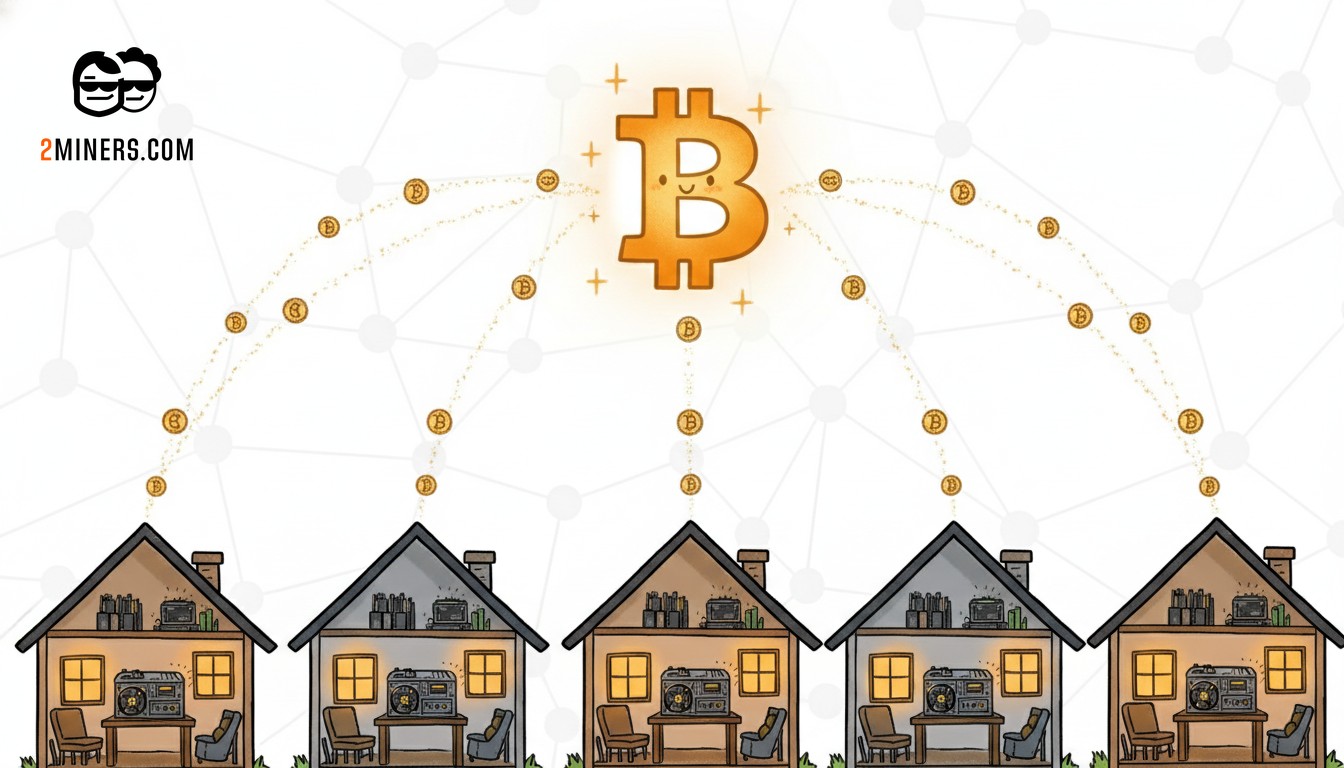
A new generation of quiet, low-power SHA-256 miners has put solo mining back on the desk. A Bitaxe draws less power than a phone charger. A Canaan Avalon Nano is the size of a router and runs near library-quiet. You plug it in, point it at a pool, and you are mining the same algorithm as a warehouse full of Antminers.
The catch is scale. Your home miner does 1 to 15 TH/s. The Bitcoin network does close to 1 ZH/s — that is a billion TH/s. Solo mining is a lottery, and on Bitcoin the jackpot odds are astronomical. But SHA-256 is not only Bitcoin. Bitcoin Cash (BCH) uses the exact same algorithm, the same hardware, and the same block reward — on a network a few hundred times smaller. That one fact changes everything about home solo mining.
Which Home SHA-256 Miners Actually Make Sense
Three categories cover almost everything people run at home today. For a deeper breakdown of individual micro miners, see our Bitcoin solo mining guide.
Plug-in lottery miners (open-source)
Bitaxe Gamma: a single BM1370 chip, around 1.2 TH/s at 15–18 W. Open-source, near-silent, the reference home miner.
NerdQaxe++: four BM1370 chips, roughly 4.8–6 TH/s at about 100 W. The high end of the open-source boards.
NerdMiner V2: an ESP32 learning device measured in kH/s, not TH/s. Treat it as an educational toy — its real-world block odds are effectively zero.
Commercial desktop miners
Avalon Nano 3:4 TH/s at 140 W. Pocket-sized, app-managed.
Avalon Nano 3S: up to 6 TH/s, as quiet as 36 dB, with lower-power modes. The sweet spot for a quiet home unit.
Avalon Mini 3 / Avalon Q:37.5 TH/s and 90 TH/s respectively — a lot more hashrate while staying quiet (Avalon rates the Q at around 40–50 dB, close to a quiet office). The real trade-off is power and heat: at 800–1,674 W they warm a room far more than a pocket-sized Nano.
FutureBit Apollo II: around 6 TH/s in eco mode and runs a full Bitcoin node alongside mining.
Repurposed datacenter ASICs
Antminer S9: about 14 TH/s for very little money used, but roughly 1.3 kW and 75–85 dB of noise. Real hashrate, but loud and hot for a living space.
Antminer S19 / S21: 90–235 TH/s. These are datacenter machines — the most hashrate per box, but not designed to live in a home.
Your Real Odds of Hitting a Block
Forget “thousands of years.” The honest way to picture solo mining is a lottery ticket: most tickets lose, but a single win pays an entire block — 3.125 BTC or 3.125 BCH. The only question is how good your ticket is, and that comes down to one ratio: your hashrate versus the whole network.
Bitcoin network: close to 1 ZH/s — enormous, so the prize is huge and the odds are long.
Bitcoin Cash network: about 3.5 EH/s, roughly 0.35% the size — so the same ticket is about 280–300× more likely to win.
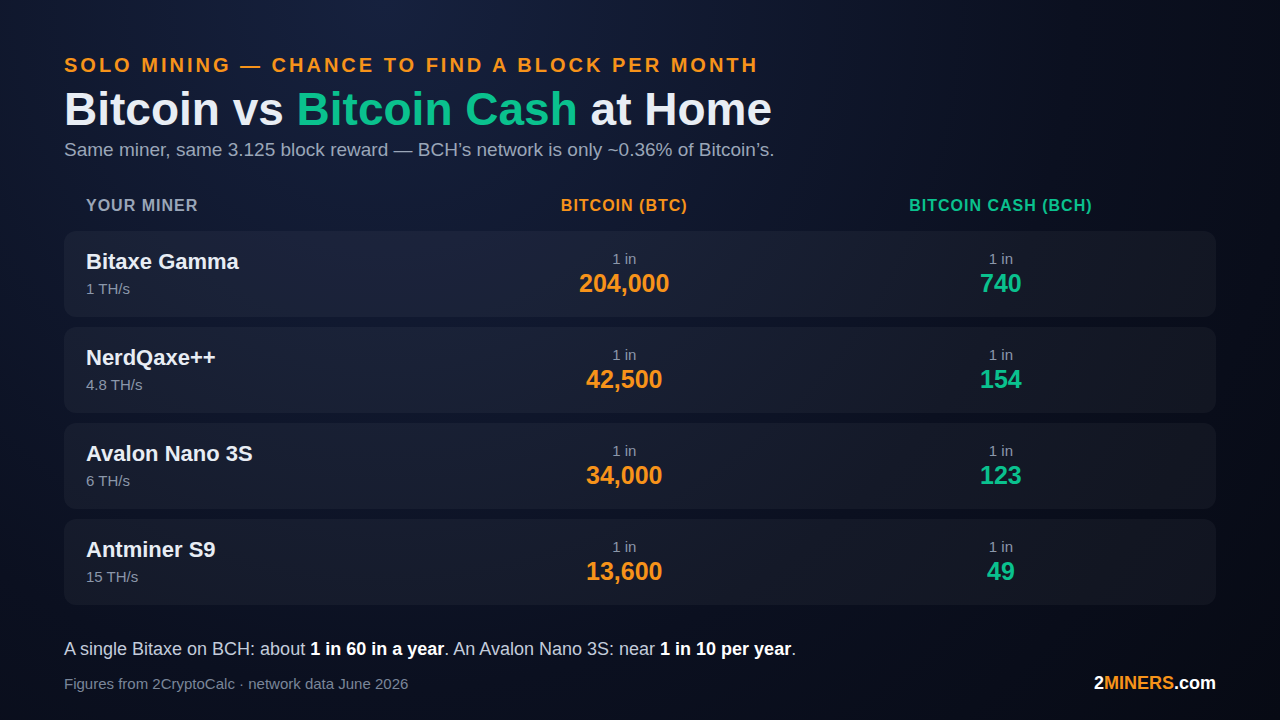
Here is the chance of your miner finding a block in any given month, straight from 2CryptoCalc:
Bitaxe Gamma (1 TH/s) — Bitcoin: ~1 in 204,000 · Bitcoin Cash: ~1 in 740
NerdQaxe++ (4.8 TH/s) — Bitcoin: ~1 in 42,500 · Bitcoin Cash: ~1 in 154
Avalon Nano 3S (6 TH/s) — Bitcoin: ~1 in 34,000 · Bitcoin Cash: ~1 in 123
Antminer S9 (15 TH/s) — Bitcoin: ~1 in 13,600 · Bitcoin Cash: ~1 in 49
Put it in plain lottery terms. A single Bitaxe aimed at Bitcoin has roughly a 1 in 900 million chance on each block — true moonshot territory, but the prize is a whole 3.125 BTC. Aim that same Bitaxe at Bitcoin Cash and your odds climb to about 1 in 60 in a year. A quiet Avalon Nano 3S sits near 1 in 10 per year for a BCH block, and an Antminer S9 around 1 in 4. Those are real, human-scale odds — and a winning block pays the full 3.125 BCH even if it is nearly empty.
Want even better odds on the same SHA-256 hardware? Younger networks like Quai give a home miner a far bigger slice of the pie. See our guide to mining Quai on 2Miners.
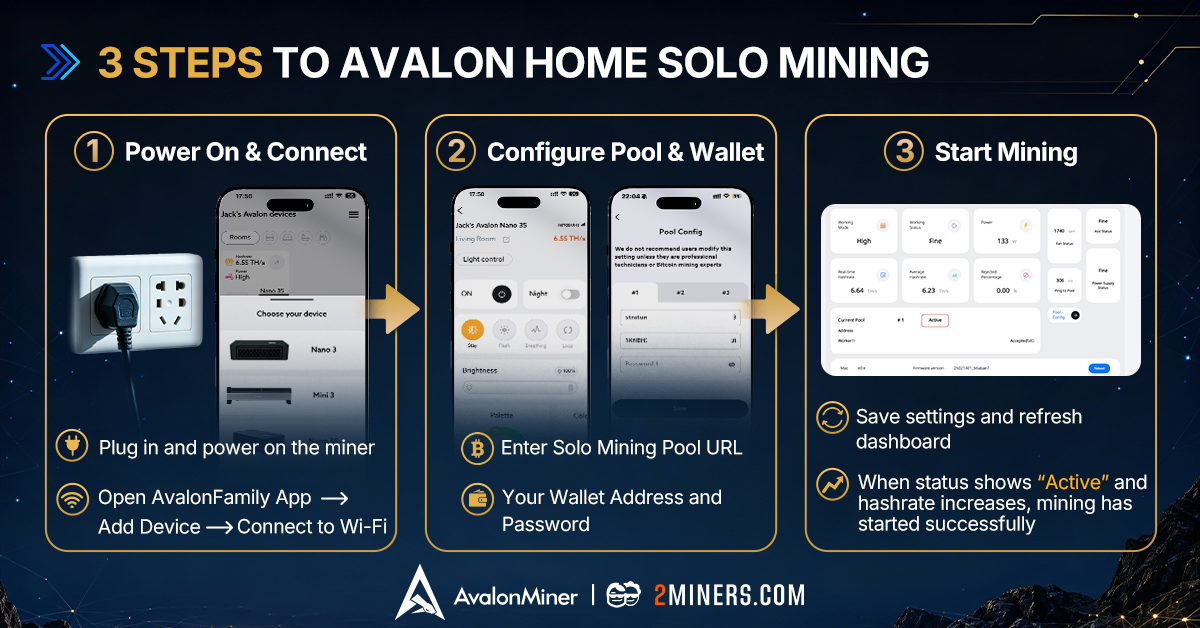
Avalon Home Solo Mining in 3 Steps
Canaan’s Avalon Nano line is built for exactly this — managed entirely from the AvalonFamily app, no command line needed.
Power on and connect. Plug in the miner, open the AvalonFamily app, add the device, and connect it to your Wi-Fi.
Configure pool and wallet. Enter the solo mining pool URL, then your wallet address as the worker and x as the password.
Start mining. Save and refresh the dashboard. When the status reads Active and the hashrate climbs, you are mining.
One word of caution that Avalon’s own screen gives you: do not change advanced frequency or voltage settings unless you genuinely know what you are doing. Stock settings are tuned for stability, and a bad overclock costs you uptime — which on a lottery miner means fewer tickets, not more.
Settings for 2Miners Solo Pools
Bitcoin (BTC) SOLO
Full reward, paid to whoever solves the block. Use the closest region:
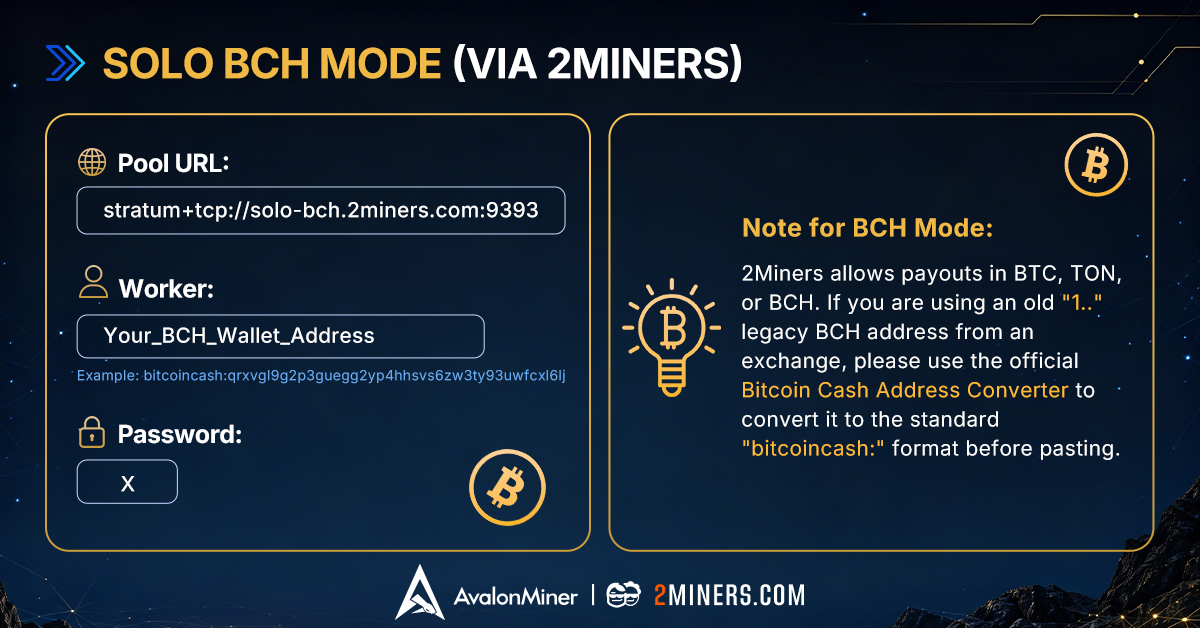
Two things to know about BCH on 2Miners. First, you can take your payout in BTC, TON, or BCH — useful if you would rather accumulate Bitcoin while mining the easier network. Second, if you are pasting an old legacy “1…” address from an exchange, convert it to the modern “bitcoincash:” format with the official Bitcoin Cash Address Converter first, or the pool will not credit you.
Shared mining (PPLNS) pays you a steady trickle for the work you contribute — no luck involved. The problem at home is how small that trickle is. A Bitaxe mining Bitcoin in a shared pool earns on the order of 50 satoshis a day — a fraction of a cent. You will never feel it. That is not the pool’s fault; it is simply what 1 TH/s is worth against a zettahash network.
Solo flips the deal. Same miner, same power bill — but instead of dust every day, you hold a ticket on the entire block reward. Most days nothing happens. Then one block lands and you collect all 3.125 coins yourself. That is the whole point: shared pays you a little, guaranteed; solo pays you nothing, or a fortune. At home scale, where “a little” rounds to nothing anyway, the lottery shot is the rational fun.
This is exactly why Bitcoin Cash is the smart home target. Same miners, same 3.125 reward, but odds hundreds of times better — a genuine chance at a full block while you sleep, instead of a number with no zeroes in front of it. Run your exact miner through 2CryptoCalc to see both the shared payout and the solo probability for any hashrate, then pick your pool: BTC SOLO, BCH SOLO, or BCH shared.
Stay Updated
Follow us on X (Twitter) and join our Telegram chat to stay informed about new developments, miner alerts, and network upgrades.
The 2Miners pool co-founder, businessman, miner. In 2017 started mining cryptocurrencies and built many rigs on his own. As a result, he gained lots of practical knowledge and became interested in sharing it with others.
In his articles on 2Miners, he shares useful tips that he tried and tested himself. For example, Darek gives advice on how to buy hardware components for the basic mining rig and how to connect them to each other correctly. He also explained lots of complicated terms in simple words, such as shares, mining luck, block types, and cryptocurrency wallets. After the pool was launched, he published a series of articles ‘Crypto Mythbusters’ where he explained how to protect the network against 51% attack, talked about cryptocurrency mining difficulty and difficulties of launching your own node.
May 2026 Work Progress: Bitcoin Core 31.0, Quai Fork, and Reward Reductions
June 1, 2026
May 2026 was a month of node maintenance and scheduled emission changes. We updated our Bitcoin, Quai, Zcash, and Ergo nodes to the latest releases — including a critical Zcash security hotfix and the Quai BIP-302 fork — and two coins went through planned block reward reductions: Kaspa and Nexa.
Bitcoin Core 31.0: SOLO Pool Node Updated
We upgraded the node behind our BTC SOLO mining pool to Bitcoin Core 31.0, the latest major release. Block templates are now built on the new cluster-based mempool, and the release continues the migration of the mining interface to the multiprocess IPC architecture.
What changed:
Cluster mempool. Transaction ordering was rebuilt around clusters, improving how block templates are assembled and how fee-bumping (RBF and CPFP) is evaluated.
Mining interface (IPC). Block-template creation moved further toward the separate mining interface; coinbase data is now returned in structured form.
Node performance. The default database cache was raised to 1024 MiB on machines with 4 GB+ of RAM, and the fee-estimation floor was lowered to 0.1 sat/vB.
Nothing changes for you as a SOLO miner — we run and maintain the node. Point your SHA-256 hardware at solo-btc.2miners.com:2626 with your Bitcoin address as the worker name. If your rig finds a block, the full reward (3.125 BTC plus fees) is yours.
Quai activated the BIP-302 consensus fork with go-quai v0.53.0 on May 15, 2026. We updated our Quai nodes ahead of activation, so the QuaiKawPow and QuaiSHA pools stayed in sync through the fork.
Key changes for miners:
Reward recalculation. The fork renormalizes Quai’s block reward against SHA-equivalent difficulty; KawPoW difficulty is now expressed in SHA terms.
Short conversion freeze. A brief hold interval applied around the fork’s activation window.
Stability fixes. Added a recovery step when Prime/Region/Zone headers are out of sync on restart.
Mining is available on the QuaiKawPow and QuaiSHA pools, with SOLO options for both.
Zcash (ZEC) Node Update: Version 6.12.3 — Security Hotfix
Zcash released v6.12.3, a security hotfix that we applied to our ZEC pool node immediately.
The release fixes CVE-2024-52911, a critical use-after-free vulnerability in block validation. Any inbound peer could trigger it by sending a crafted invalid block, crashing the node during script verification — and bouncing invalid blocks between peers could amplify a single crash into a network-wide outage. Every multi-core node running the default settings was affected on v6.12.2 and earlier.
If you run your own Zcash node, upgrade to 6.12.3 without delay. Our pool node is already patched.
Ergo (ERG) Node Update: Version 6.0.3-RC1
Ergo published 6.0.3-RC1, a release candidate focused on block propagation and mempool handling. We are testing it against our ERG pool node.
Notable changes:
Faster block announcement. A new block is now announced to peers immediately, before full validation — this reduces propagation delay and helps lower stale/orphan rates for miners.
Mempool improvements. Better handling of fee-based transaction replacement and a fix for duplicate transaction IDs.
As a release candidate, 6.0.3-RC1 is a pre-release; we will move our pool to the stable build once it ships.
Kaspa (KAS) Block Reward Reduction
As defined by the Kaspa Tokenomics and its smooth monthly emission schedule, Kaspa underwent another scheduled block reward reduction in May.
Previous Reward: 2.914 KAS
New Reward: 2.75 KAS
Please pay attention! Kaspa mining profitability has changed. We have already updated 2CryptoCalc to reflect the new reward values. Mining is available on the KAS pool and KAS SOLO.
Nexa (NEXA) Block Reward Reduction
In line with the Nexa tokenomics, the Nexa block reward was halved in May.
Previous Reward: 10,000,000 NEXA
New Reward: 5,000,000 NEXA
Please pay attention! Nexa mining rewards per block have been cut in half. We have updated 2CryptoCalc accordingly. Mining is available on the NEXA pool and NEXA SOLO.
Stay Updated
Follow us on X (Twitter) and join our Telegram chat to stay informed about new developments, miner alerts, and network upgrades.
The 2Miners pool co-founder, businessman, miner. In 2017 started mining cryptocurrencies and built many rigs on his own. As a result, he gained lots of practical knowledge and became interested in sharing it with others.
In his articles on 2Miners, he shares useful tips that he tried and tested himself. For example, Darek gives advice on how to buy hardware components for the basic mining rig and how to connect them to each other correctly. He also explained lots of complicated terms in simple words, such as shares, mining luck, block types, and cryptocurrency wallets. After the pool was launched, he published a series of articles ‘Crypto Mythbusters’ where he explained how to protect the network against 51% attack, talked about cryptocurrency mining difficulty and difficulties of launching your own node.
April 2026 Work Progress: New Homepage, Quai Pools, and Reward Reductions
May 1, 2026
April was a busy month at 2Miners. We rolled out a completely redesigned homepage, launched mining pools for Quai Network on two algorithms, updated the Zcash node to v6.12.1, and saw scheduled block reward reductions on both Kaspa and Ergo.
New 2Miners Homepage Design
The 2miners.com homepage has been completely redesigned. The new layout is faster, cleaner, and built around what miners actually look for on the front page — supported coins, pool stats, and quick access to mining settings. Take a look and let us know what you think.
Quai Network (QUAI) — New Mining Pools
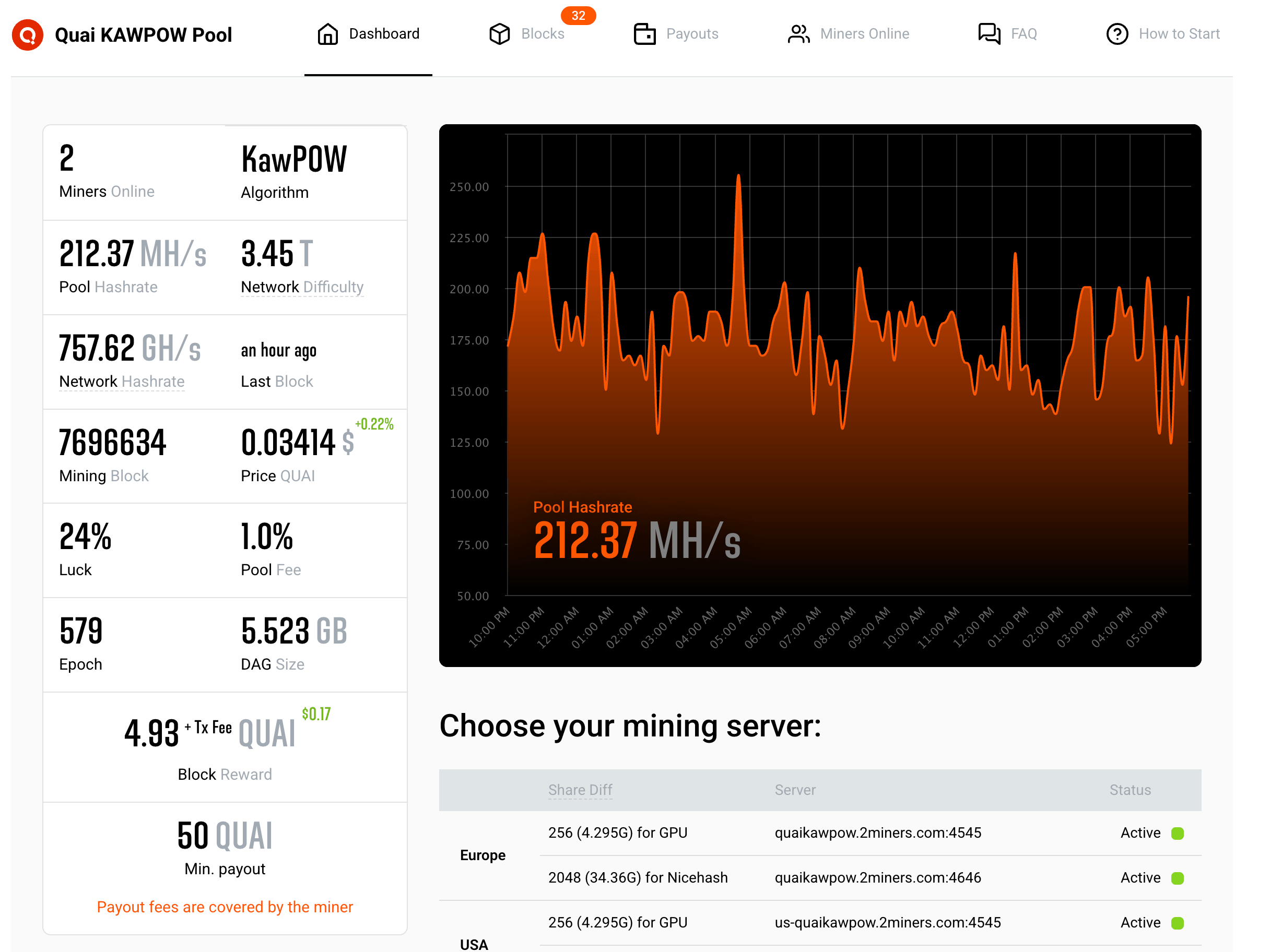
2Miners launched mining pools for Quai Network on two algorithms: SHA-256 for ASIC miners and KawPow for GPU rigs. Both pool and solo are available across Europe, USA, and Asia. Full setup guide is in our Quai mining announcement.
We updated our Zcash node to zcashd v6.12.1, released on April 17. This is a security release fixing several vulnerabilities that could have caused nodes to crash, diverge from consensus with Zebra, or disable the defence-in-depth provided by pool turnstile checks.
The issues were reported privately by white-hat researcher Alex “Scalar” Sol and handled through coordinated disclosure by Shielded Labs, Zcash Open Development Lab (ZODL), and Zcash Foundation engineers, in coordination with mining pools.
Vulnerabilities addressed:
An Orchard transaction with an rk encoding the identity point on the Pallas curve could cause zcashd to panic during proof verification. Fixed by rejecting identity rk before verification.
The epk (ephemeral public key) in each Orchard action must encode a non-identity point. Zebra enforced this; zcashd did not — creating a potential consensus split. Now rejected.
A duplicate block header could silently reset pool balance tracking fields, disabling ZIP 209 turnstile enforcement. Pool value initialization now happens after the duplicate-data check.
The same bug could cause corrupted per-block pool deltas to be persisted to disk. The release adds a chain supply checkpoint at NU6.1 activation covering all value pools and recomputes shielded pool deltas from block data on startup.
Related changes also harden pool balance accumulation against signed integer overflow and improve exception safety around value computation. Mining on the ZEC pool and ZEC SOLO continues uninterrupted.
Kaspa (KAS) Block Reward Reduction
As defined by the Kaspa Tokenomics, the Crescendo Hard Fork, and the official emission schedule, Kaspa underwent another scheduled block reward reduction in April.
Previous Reward: 3.086 KAS
New Reward: 2.914 KAS
Please pay attention! Kaspa mining profitability has changed. We have already updated 2CryptoCalc to reflect the new reward values. Mining is available on the KAS pool and KAS SOLO.
Ergo (ERG) Block Reward Reduction
In line with the Ergo emission schedule defined by EIP-27, the network underwent a scheduled block reward reduction in April. Unlike Kaspa’s gradual monthly reductions, Ergo’s cuts happen in larger steps, and this one halved the reward.
Previous Reward: 6 ERG
New Reward: 3 ERG
Ergo mining profitability has dropped accordingly. Updated values are already reflected on 2CryptoCalc.
Stay Updated
Follow us on X (Twitter) and join our Telegram chat to stay informed about new developments, miner alerts, and network upgrades.
The 2Miners pool co-founder, businessman, miner. In 2017 started mining cryptocurrencies and built many rigs on his own. As a result, he gained lots of practical knowledge and became interested in sharing it with others.
In his articles on 2Miners, he shares useful tips that he tried and tested himself. For example, Darek gives advice on how to buy hardware components for the basic mining rig and how to connect them to each other correctly. He also explained lots of complicated terms in simple words, such as shares, mining luck, block types, and cryptocurrency wallets. After the pool was launched, he published a series of articles ‘Crypto Mythbusters’ where he explained how to protect the network against 51% attack, talked about cryptocurrency mining difficulty and difficulties of launching your own node.
How to Mine Quai (QUAI) on 2Miners: SHA256 and KawPow Pools
April 28, 2026
2Miners has launched a new mining pool for Quai Network (QUAI) with support for two algorithms — SHA256 for ASIC miners and KawPow for GPU rigs. Both PPLNS and SOLO options are live and accepting connections. This guide covers everything: what Quai is, which wallet to use, and how to point your hardware at the pool.
What Is Quai Network
Quai Network is a Proof-of-Work blockchain built around a new consensus mechanism called Proof of Entropy Minima (PoEM). It uses a hierarchical sharded structure — one Prime chain, three Region chains, and nine Zone chains — connected through merged mining, where a single hash secures the entire network. The architecture targets over 50,000 transactions per second across shards, with roughly 5-second block times per shard and around 30-second cross-shard settlement.
The network has a dual-token design. QUAI is the EVM-compatible token with a logarithmic, deflationary emission schedule similar to Bitcoin. Qi is a separate UTXO-based token with linear emission tied to mining difficulty. Miners can choose which token to earn — but on 2Miners, the pool currently mines and pays out QUAI.
Genesis supply is roughly 1.33 billion QUAI. The token is already trading on MEXC, Gate.io, LBank, and Kraken. Block explorer: quaiscan.io.
Quai Mining Algorithms
Quai is unusual: thanks to the SOAP upgrade, the network supports three Proof-of-Work algorithms — SHA256, Scrypt, and KawPow. All three secure the same chain through merged mining. 2Miners runs pools for two of them:
SHA256 — for Bitcoin-style ASIC miners (Antminer S9 through S21, Whatsminer, Avalon).
KawPow — for GPUs. The same algorithm previously used by Ravencoin, supported by all modern NVIDIA and AMD cards.
If you already mine BTC or BCH on SHA256 hardware, or have a Ravencoin-era GPU rig sitting idle, you can point it at Quai with no hardware changes — just a new pool address and wallet.
Quai Wallet Setup
Before connecting your miner, you need a Quai wallet address. There are three options:
Pelagus Wallet — the official Quai browser extension (Chrome). Generates an address in under a minute. Recommended for most miners.
Tangem — hardware wallet support for cold storage.
Exchange deposit address — MEXC, Gate.io, LBank, or Kraken. Useful if you plan to sell or convert QUAI immediately. Make sure the exchange supports Quai mainnet deposits before pointing your miner at the address.
Quai addresses use the standard EVM hex format and start with 0x, for example: 0x004b0015A5a719765d2CeBF08dE8cfb965593F17. Keep your address handy — you will paste it as the worker name in your miner configuration.
Mine Quai with ASIC (SHA256)
Any SHA256 ASIC works. That covers the entire Bitmain Antminer S-series (S9, S11, S15, S17, S19, S21), Whatsminer M-series, Canaan Avalon, Innosilicon T-series, and any custom or refurbished SHA256 device. Firmware updates are not required.
Quai SHA256 Pool (PPLNS)
Use the PPLNS pool if you want regular, predictable payouts based on shares submitted. Fee: 1%. Minimum payout: 50 QUAI. Payouts run automatically every 2 hours.
Europe: stratum+tcp://quaisha.2miners.com:8080
USA: stratum+tcp://us-quaisha.2miners.com:8080
Asia: stratum+tcp://asia-quaisha.2miners.com:8080
Worker: YOUR_QUAI_WALLET_ADDRESS
Password: x
Three share difficulty levels are available per region: 524K (port 8080), 1M (port 8181), 16M (port 8282). Use the lowest unless you operate 500+ ASICs or rent hashrate from NiceHash. SSL ports are 18080, 18181, and 18282.
The choice depends on your hashrate and risk tolerance.
PPLNS pays you a steady share of every block the pool finds, proportional to the work your miner contributed. Predictable income, smaller variance, lower payout floor.
SOLO pays you the full block reward — but only when your miner finds a block alone. Higher variance, potentially much larger payouts, no dilution.
If you have a single ASIC or one or two GPUs, PPLNS is the safer choice. If you run a serious operation, or want to take a deliberate shot at full block rewards, SOLO makes sense. Read more: Solo Mining Pools: How to Catch Your Luck.
Estimate Your Profitability
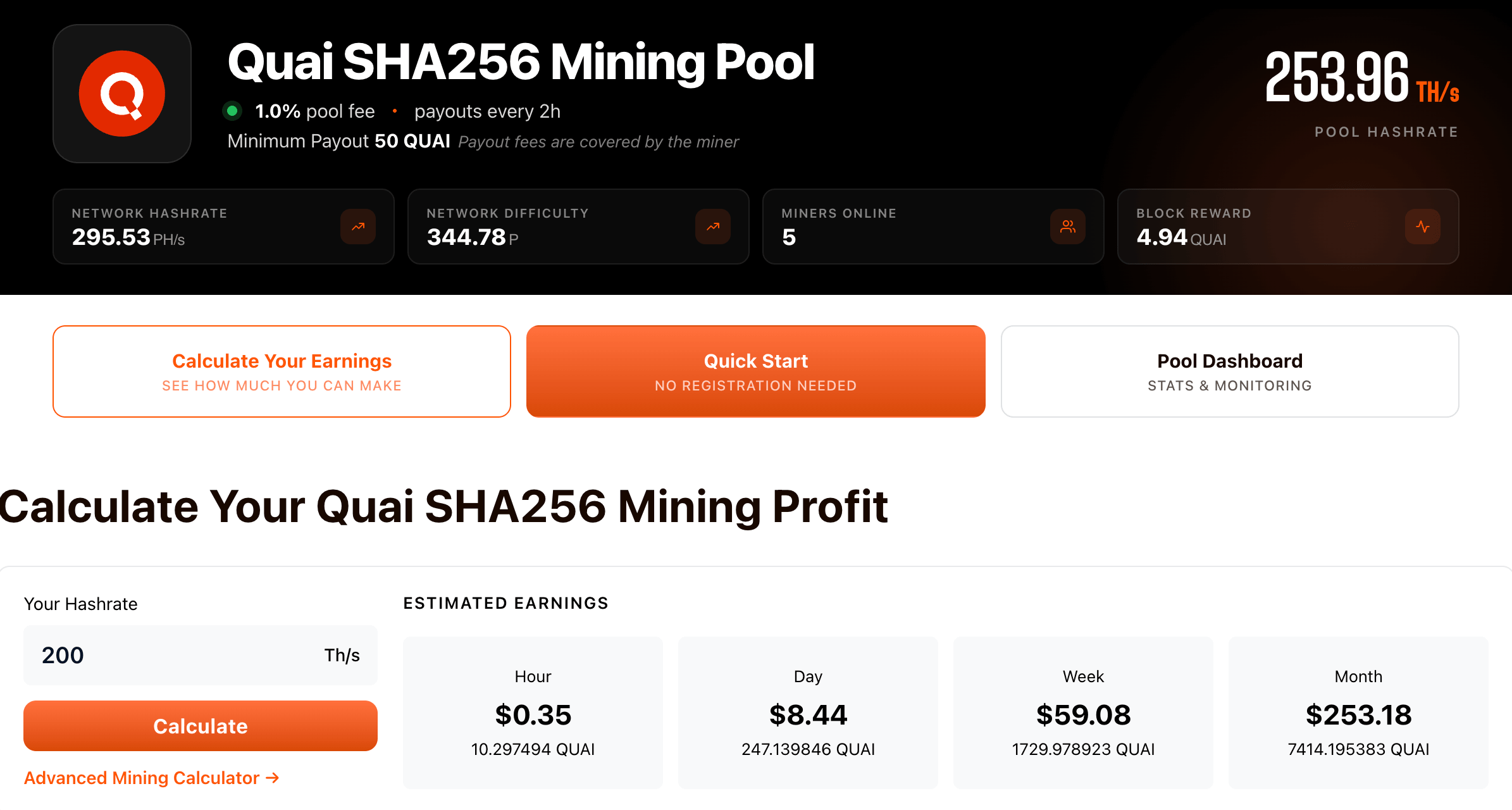
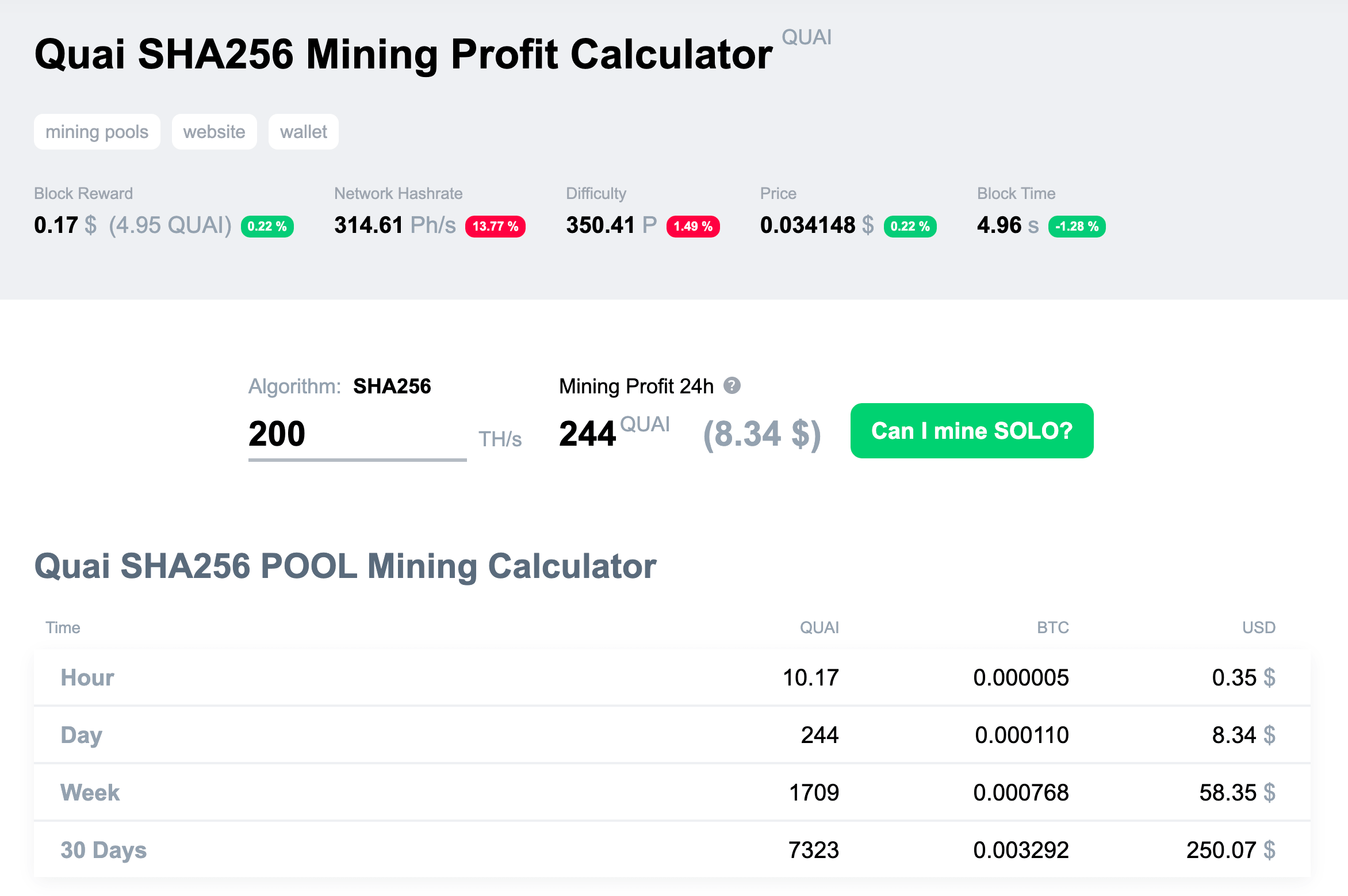
Quai is already supported in 2CryptoCalc. Enter your hashrate and electricity cost to see expected daily revenue in USD and QUAI for both algorithms. The calculator pulls live network difficulty and exchange rates, so the estimate stays current as conditions change.
The 2Miners pool co-founder, businessman, miner. In 2017 started mining cryptocurrencies and built many rigs on his own. As a result, he gained lots of practical knowledge and became interested in sharing it with others.
In his articles on 2Miners, he shares useful tips that he tried and tested himself. For example, Darek gives advice on how to buy hardware components for the basic mining rig and how to connect them to each other correctly. He also explained lots of complicated terms in simple words, such as shares, mining luck, block types, and cryptocurrency wallets. After the pool was launched, he published a series of articles ‘Crypto Mythbusters’ where he explained how to protect the network against 51% attack, talked about cryptocurrency mining difficulty and difficulties of launching your own node.
March 2026 Work Progress: Bitcoin SOLO Pool, Calculator Redesign, and Mobile App Launch
April 1, 2026
March 2026 brought three major launches to 2Miners: a completely redesigned mining profit calculator with Bitcoin support, a new BTC SOLO mining pool, and the official 2Miners Stats mobile app for iOS and Android. On top of that, Kaspa had another scheduled block reward reduction, and we updated GRIN, MWC, and Bitcoin Cash nodes.
Mining Profit Calculator Redesign: SHA-256, New Interface, and AI Integration
2CryptoCalc received its biggest update yet. The entire calculator has been rebuilt with a new interface and several major additions.
SHA-256 support. Bitcoin (BTC) and Bitcoin Cash (BCH) mining calculations are now available — real-time price, network hashrate, block reward, and 24-hour profit estimates.
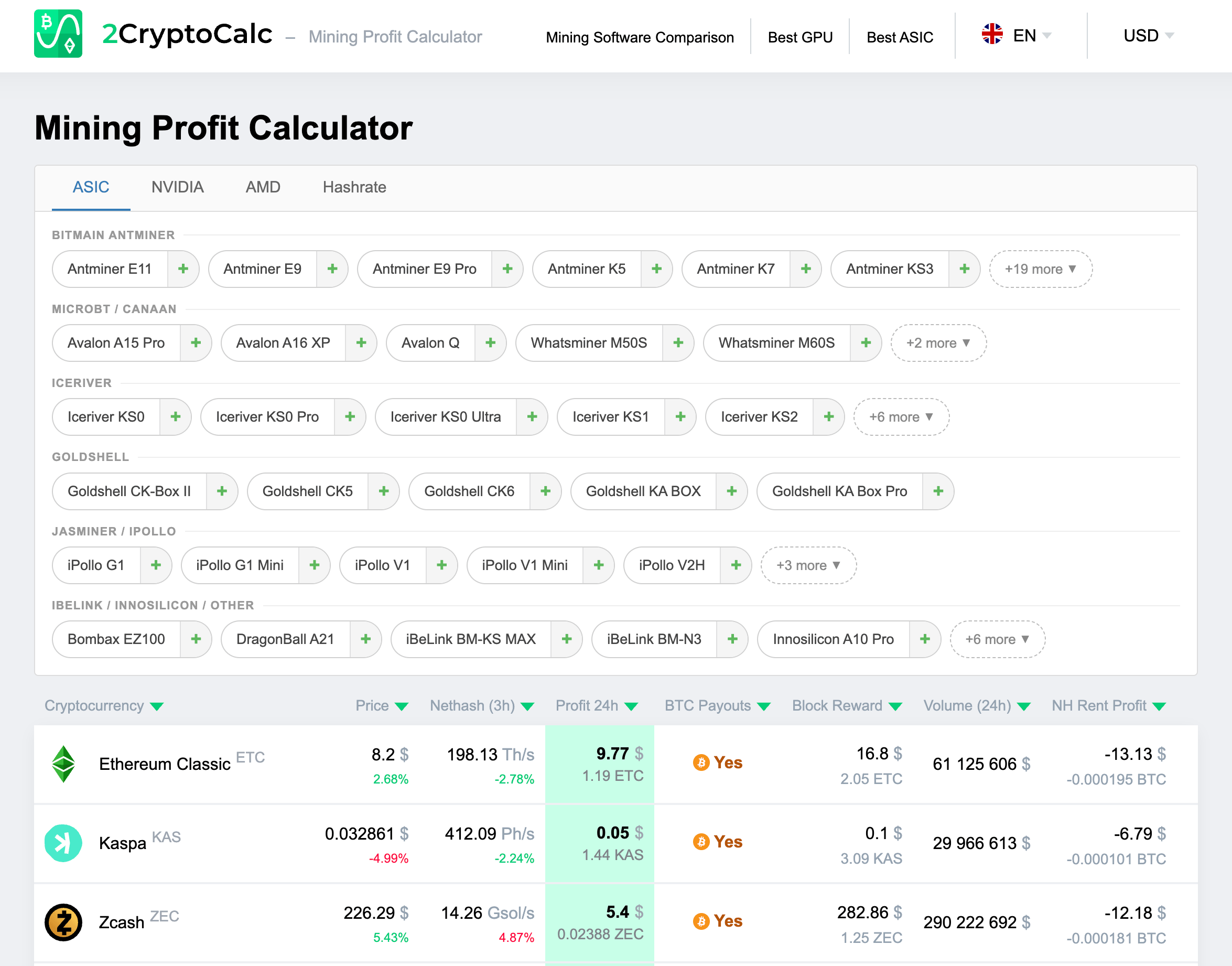
New layout. Hardware is organized under four tabs: ASIC, NVIDIA, AMD, and Hashrate. You can add multiple devices, set quantities, and compare profitability across all supported coins in one view.
More ASIC miners. Full Bitmain Antminer S19/S21 family (S21, S21+, S21 Pro, S21 XP, S21 XP Hyd, S23, S23 Hyd, T21), additional IceRiver KAS miners, Goldshell CKB models, and iBeLink/Innosilicon Equihash units.
MCP server for AI. AI assistants can now query live mining data directly through a built-in MCP server — ask about profitability, compare devices, or get pool links in real time.
We opened a BTC SOLO mining pool. Connect your SHA-256 hardware to solo-btc.2miners.com:2626, set the worker to your Bitcoin wallet address, and start mining.
This is a SOLO pool. If your miner finds a block, the full reward (3.125 BTC + transaction fees) goes directly to you. The pool provides the infrastructure — servers in Europe, US, and Asia with DDoS protection and low latency.
As defined by the Kaspa Tokenomics, the Crescendo Hard Fork, and the official emission schedule, Kaspa underwent another scheduled block reward reduction in March.
Previous Reward: 3.270 KAS
New Reward: 3.086 KAS
Please pay attention! Kaspa mining profitability has changed. We have already updated 2CryptoCalc to reflect the new reward values.
Network and Node Upgrades
GRIN v5.4.0
GRIN released version 5.4.0 — the first major release since v5.3.3.
The 2Miners pool co-founder, businessman, miner. In 2017 started mining cryptocurrencies and built many rigs on his own. As a result, he gained lots of practical knowledge and became interested in sharing it with others.
In his articles on 2Miners, he shares useful tips that he tried and tested himself. For example, Darek gives advice on how to buy hardware components for the basic mining rig and how to connect them to each other correctly. He also explained lots of complicated terms in simple words, such as shares, mining luck, block types, and cryptocurrency wallets. After the pool was launched, he published a series of articles ‘Crypto Mythbusters’ where he explained how to protect the network against 51% attack, talked about cryptocurrency mining difficulty and difficulties of launching your own node.