2CryptoCalc Major Update: SHA-256, Bitcoin Mining, and MCP for AI
March 30, 2026
2CryptoCalc, the mining profit calculator used by miners on 2Miners, has received a major update. The interface has been redesigned, SHA-256 support has been added with Bitcoin and Bitcoin Cash, the ASIC device list has expanded significantly, and AI assistants can now access real-time mining data through a built-in MCP server.
Cleaner Interface
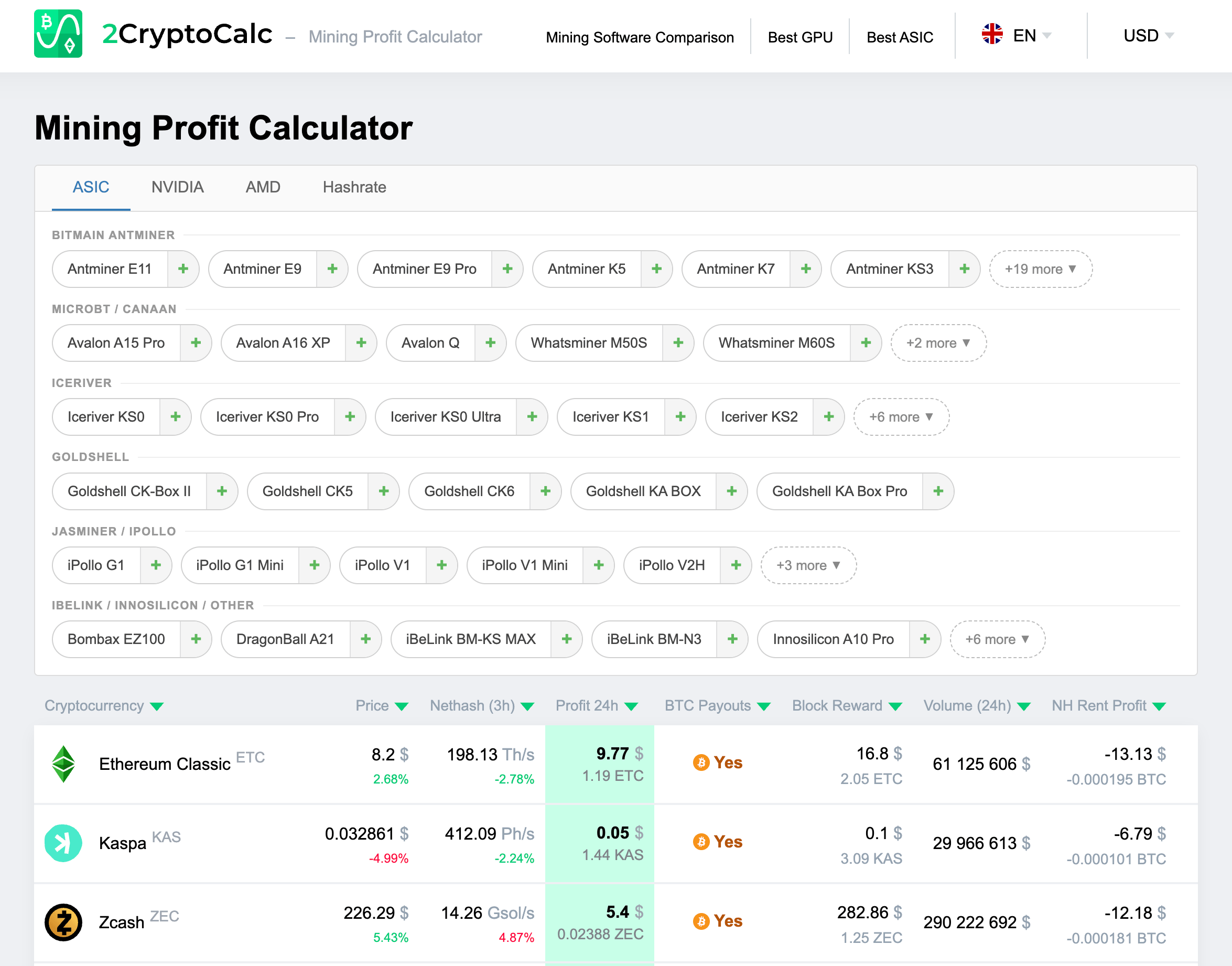
The calculator has been rebuilt from the ground up with a simplified layout. The main page now organizes miners by manufacturer and algorithm, making it faster to find and compare devices. Hardware is grouped under four tabs: ASIC, NVIDIA, AMD, and Hashrate. You can add multiple devices, set quantities, and see profitability across all supported coins in one view.
SHA-256 Added: Bitcoin and Bitcoin Cash
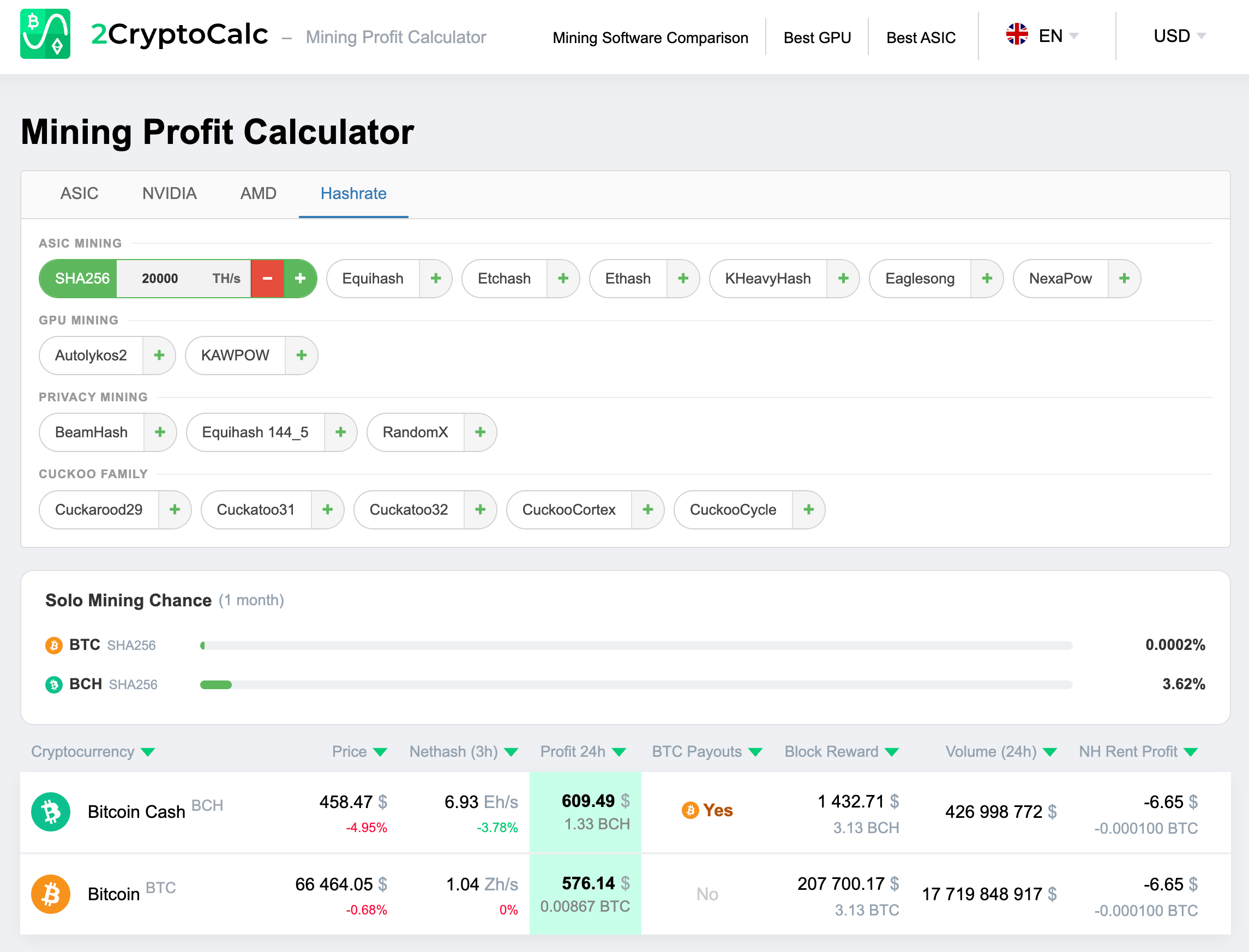
The most significant addition is full SHA-256 support. 2CryptoCalc now covers Bitcoin (BTC) and Bitcoin Cash (BCH) alongside the existing lineup of ETC, KAS, ZEC, CKB, RVN, and GRIN. Both coins appear in the profitability table with real-time price, network hashrate, block reward, and 24-hour profit estimates.
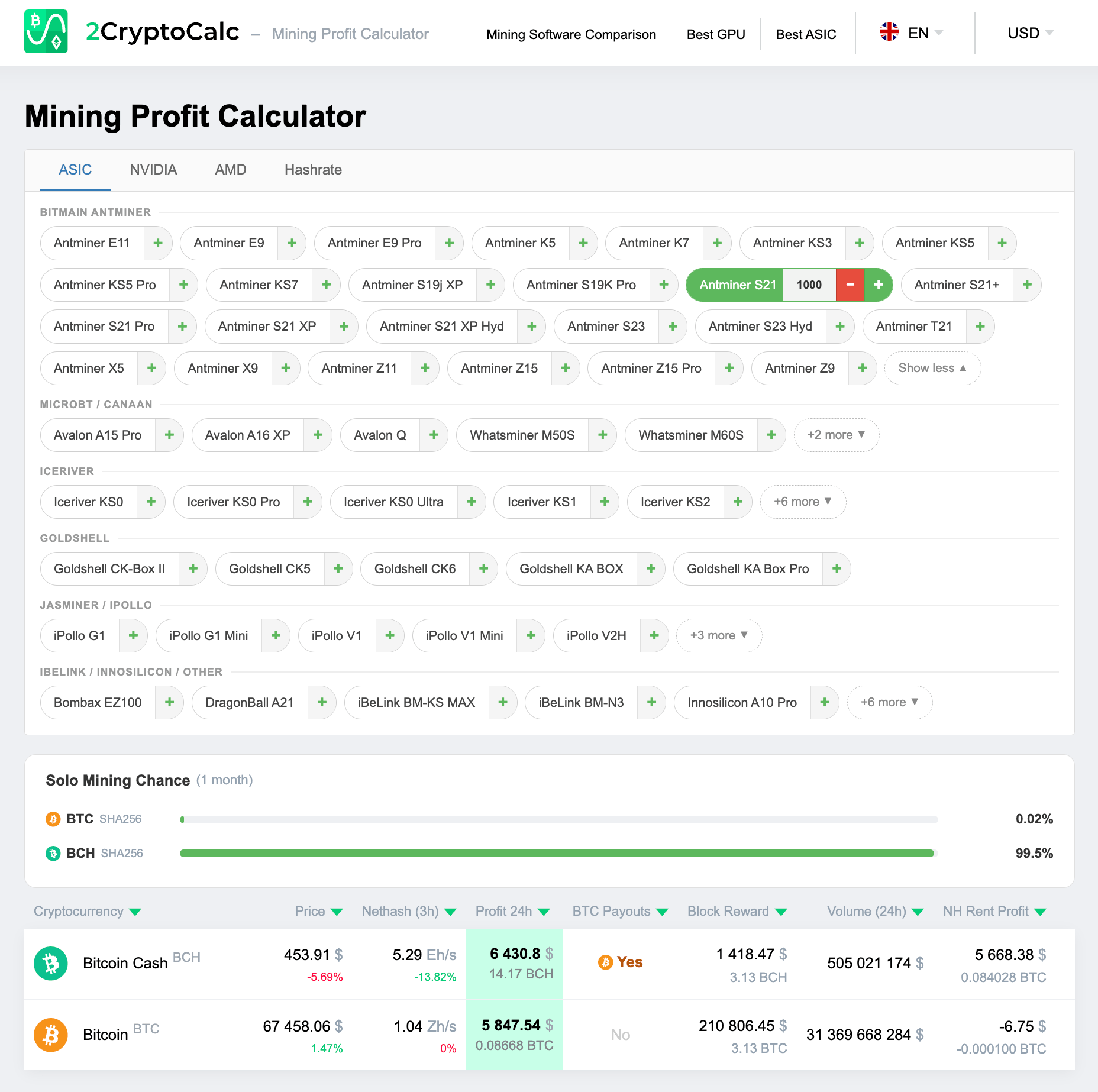
The Hashrate tab lets you enter any SHA-256 hashrate directly to calculate expected earnings. Select 1,000 Antminer S21 units (SHA-256, 200 TH/s each) and the calculator instantly shows combined output across BCH and BTC pools, including solo mining probability for the selected period.
New ASIC Devices
The SHA-256 miner database now includes the full Bitmain Antminer S19 and S21 family: S19j XP, S19K Pro, S21, S21+, S21 Pro, S21 XP, S21 XP Hyd, S23, S23 Hyd, and T21. Each model includes its SHA-256 hashrate, power consumption, and profitability across BTC and BCH.
Non-SHA-256 device coverage has also expanded. New entries include additional IceRiver KAS miners, Goldshell models for CKB, and several iBeLink and Innosilicon units for Equihash. The full list is visible under the ASIC tab on the main calculator page.
Hashrate Calculator
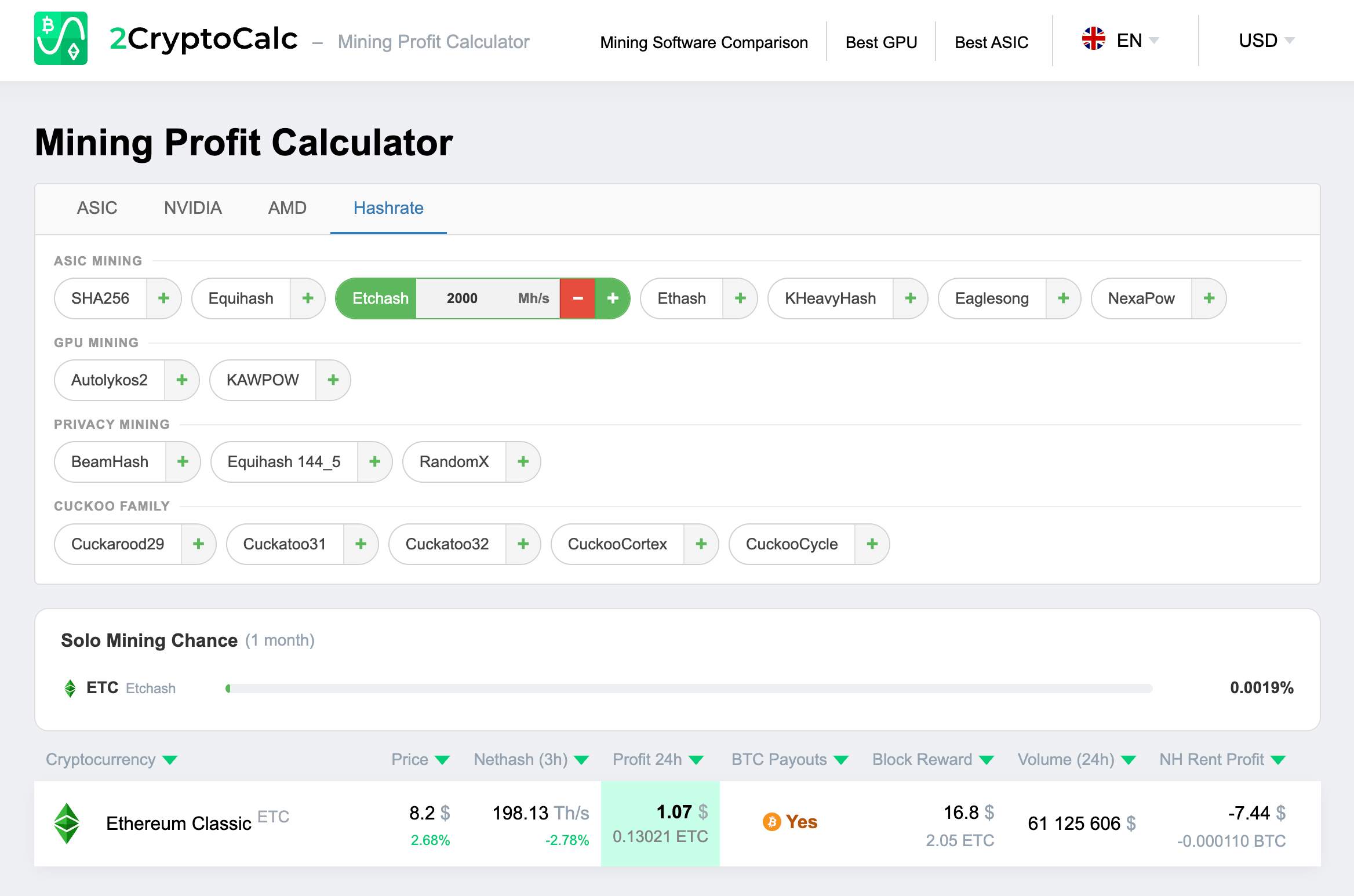
The Hashrate tab works without selecting a specific device. Choose an algorithm, enter your hashrate in the relevant unit, and get the full coin comparison instantly. For example: entering 2,000 Mh/s on Etchash shows current ETC earnings with live network difficulty. The same tab covers SHA-256, Equihash, KHeavyHash (KAS), Eaglesong (CKB), KAWPOW (RVN), and all other supported algorithms.
MCP Server for AI Assistants
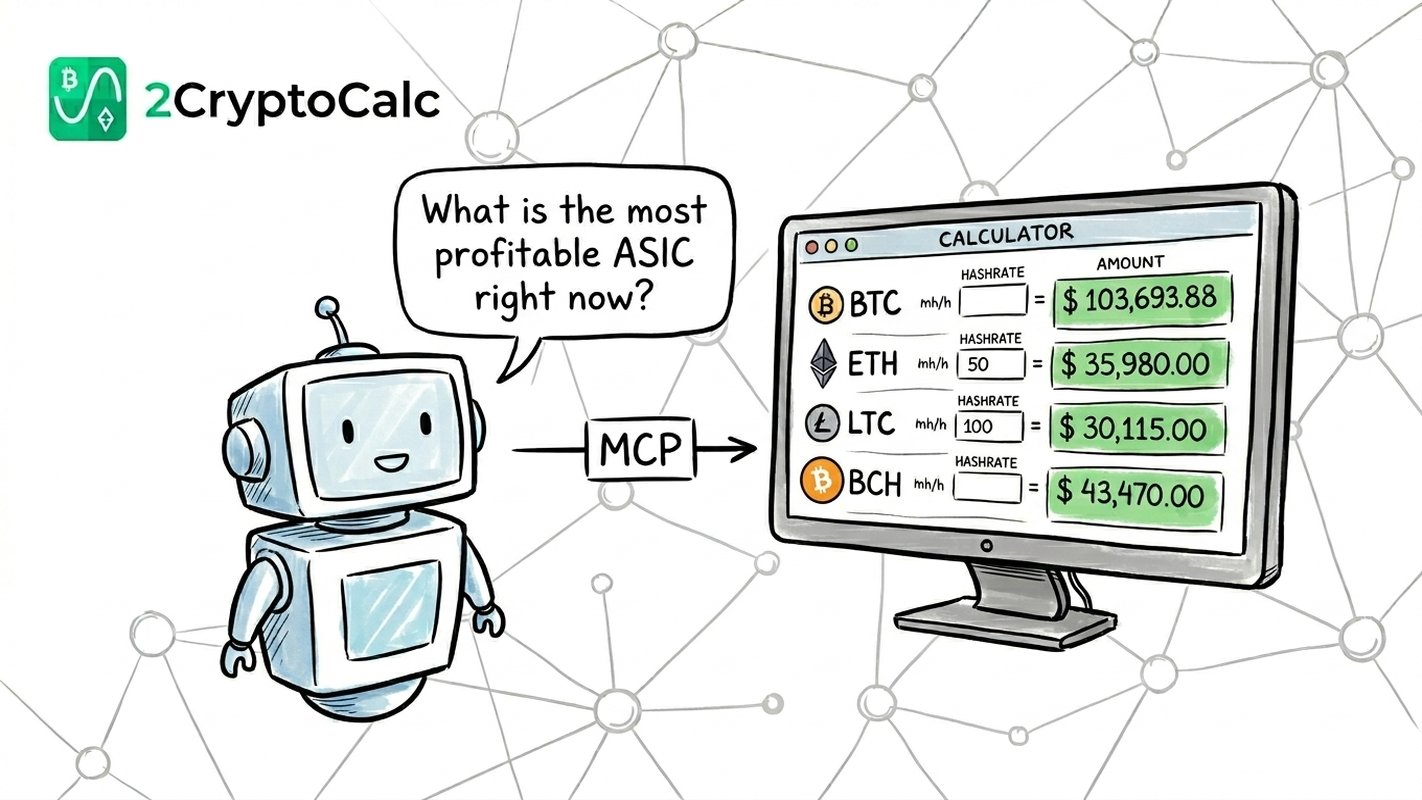
2CryptoCalc now provides an MCP (Model Context Protocol) server at https://2cryptocalc.com/mcp-for-ai. This lets AI assistants such as Claude and ChatGPT query live mining data directly, without manual lookups.
Once connected, an AI assistant can answer questions like “What is the most profitable SHA-256 ASIC right now?”, “How much can I earn mining ETC with an Antminer E9 Pro?”, or “Compare KAS vs ETC profitability for an IceRiver KS3.” Results include direct links to the relevant 2Miners pool pages.
The MCP server exposes seven tools:
list_asics — all ASIC miners with hashrates, prices, and algorithms
list_gpus — GPU list with hashrates, VRAM, and supported coins
list_algorithms — all mining algorithms with default hashrate units
calculate_asic_profitability — profit calculation for a specific ASIC model and quantity
calculate_gpu_profitability — profit calculation for GPU models
calculate_hashrate_profitability — profit by raw hashrate and algorithm
get_coin_details — price, difficulty, block reward, and estimated earnings for any supported coin
Setup instructions for Claude Code, Claude Desktop, and the Claude API are on the MCP page.
Start Mining
All profitability results on 2CryptoCalc include direct links to the corresponding 2Miners pool. Use the calculator to find your best option, then connect your miner.
The 2Miners pool co-founder, businessman, miner. In 2017 started mining cryptocurrencies and built many rigs on his own. As a result, he gained lots of practical knowledge and became interested in sharing it with others.
In his articles on 2Miners, he shares useful tips that he tried and tested himself. For example, Darek gives advice on how to buy hardware components for the basic mining rig and how to connect them to each other correctly. He also explained lots of complicated terms in simple words, such as shares, mining luck, block types, and cryptocurrency wallets. After the pool was launched, he published a series of articles ‘Crypto Mythbusters’ where he explained how to protect the network against 51% attack, talked about cryptocurrency mining difficulty and difficulties of launching your own node.
2Miners has launched a Bitcoin Solo mining pool. Bitcoin is the foundation of the entire crypto industry — and now you can mine it directly on 2Miners infrastructure. The pool is live and accepting miners right now.
2Miners Bitcoin Solo Pool Is Now Live
Bitcoin needs no introduction. It is the first, most recognized, and most valuable cryptocurrency ever created. For years, miners have been asking us to add BTC. We finally did — but not as a regular PPLNS pool.
Want to skip straight to mining? Point your SHA-256 miner at solo-btc.2miners.com:2626 set the worker to your Bitcoin wallet address, password x — and you are already in the game. The full guide is below.
Here is the honest reason we did not launch a regular Bitcoin PPLNS pool earlier: in BTC mining specifically, competing with giants like Foundry, AntPool, and F2Pool requires enormous pooled hashrate — we are talking hundreds of exahashes. With other coins we regularly outperform much larger pools, but Bitcoin is a different scale entirely. Without critical mass, miners in a small PPLNS pool face unpredictably long waits between blocks, which is unfair to our users. Disappointing miners is something we never want to do — we always stand behind our pools and the people who use them.
SOLO changes the equation. In solo mining, your machine works independently. If it finds a block, the full reward goes directly to you — the pool only provides the infrastructure. No competition for pool share, no diluted payouts. Our job is to keep the servers fast and reliable. That we do perfectly.
We have been proving this across more than 10 years of running mining pools for dozens of coins. And specifically on SHA-256, we already have three years of experience with Bitcoin Cash — running both PPLNS and SOLO without issues. The BTC solo pool is built on the same codebase and the same server infrastructure.
The 2Miners BTC solo pool is for anyone mining Bitcoin on SHA-256 hardware — from a single old ASIC on a shelf to a full warehouse operation.
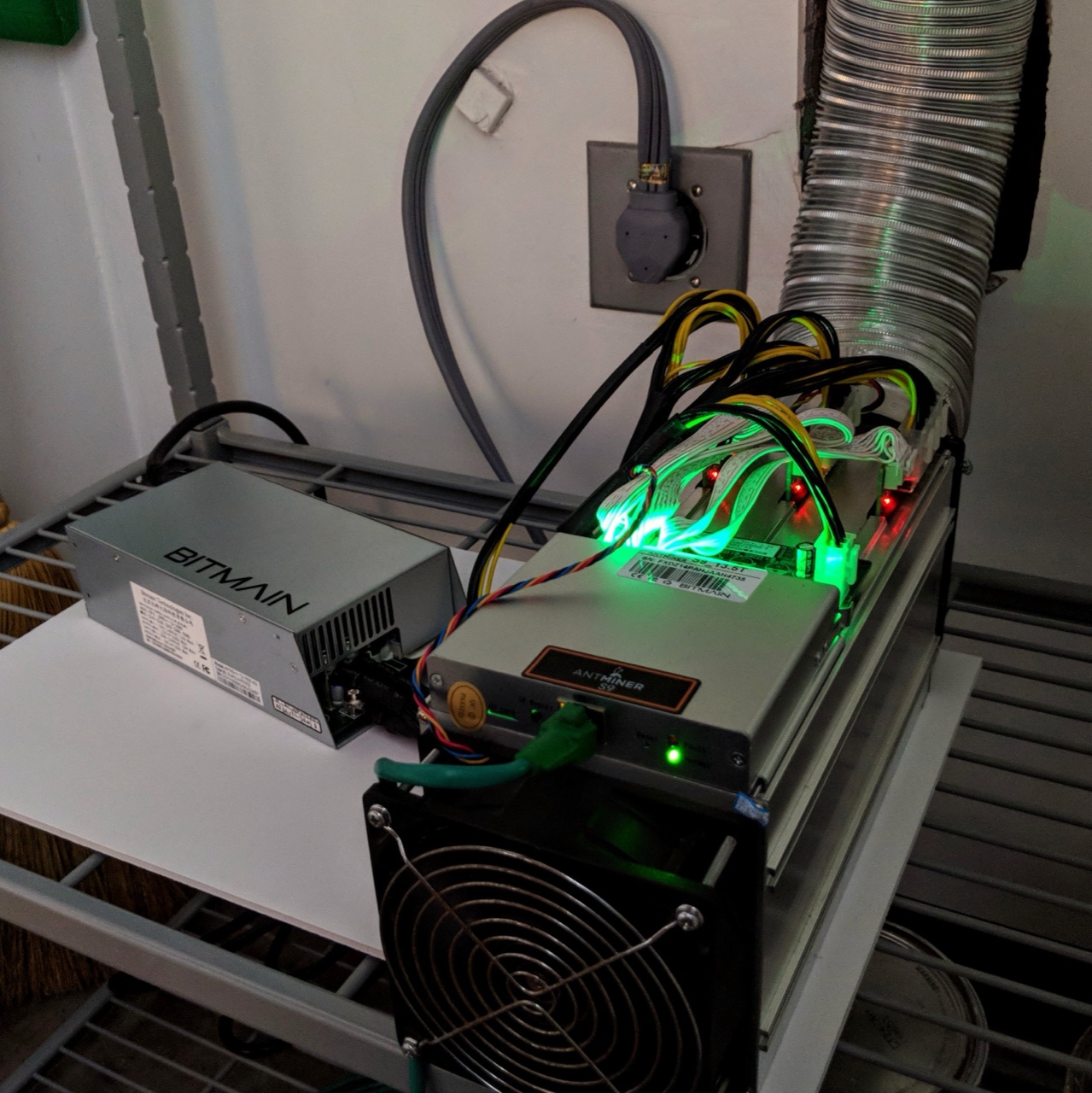
Old ASICs still running. An Antminer S9 delivers around 14 TH/s. In a regular pool at today’s difficulty, that earns almost nothing after electricity. On a solo pool, every hash is a real chance at the full block reward. The cost of trying is just your electricity bill.
Large operations going solo. If you have serious hashrate and want to keep 100% of every block you find, this pool is ready. Our servers handle high-load connections without issue.
Micro miners. A new category of compact, low-power devices built specifically for home solo mining. See the section below.
Hashrate renters. You do not need your own hardware. Services like NiceHash and MiningRigRentals let you rent SHA-256 hashrate by the hour and point it at any solo pool. Buy a few terahashes for an afternoon and take your shot. The pool supports both services natively — setup instructions are on the help page.
Micro Bitcoin Miners
A growing category of open-source, low-power Bitcoin ASIC devices has emerged for exactly this use case. They run SHA-256, connect over Wi-Fi, draw between 1W and 160W, and cost anywhere from $15 to $500. Most are available on AliExpress, Amazon, and dedicated retailers worldwide. These are real miners pointing at a real pool — not simulations.
NerdMiner V2
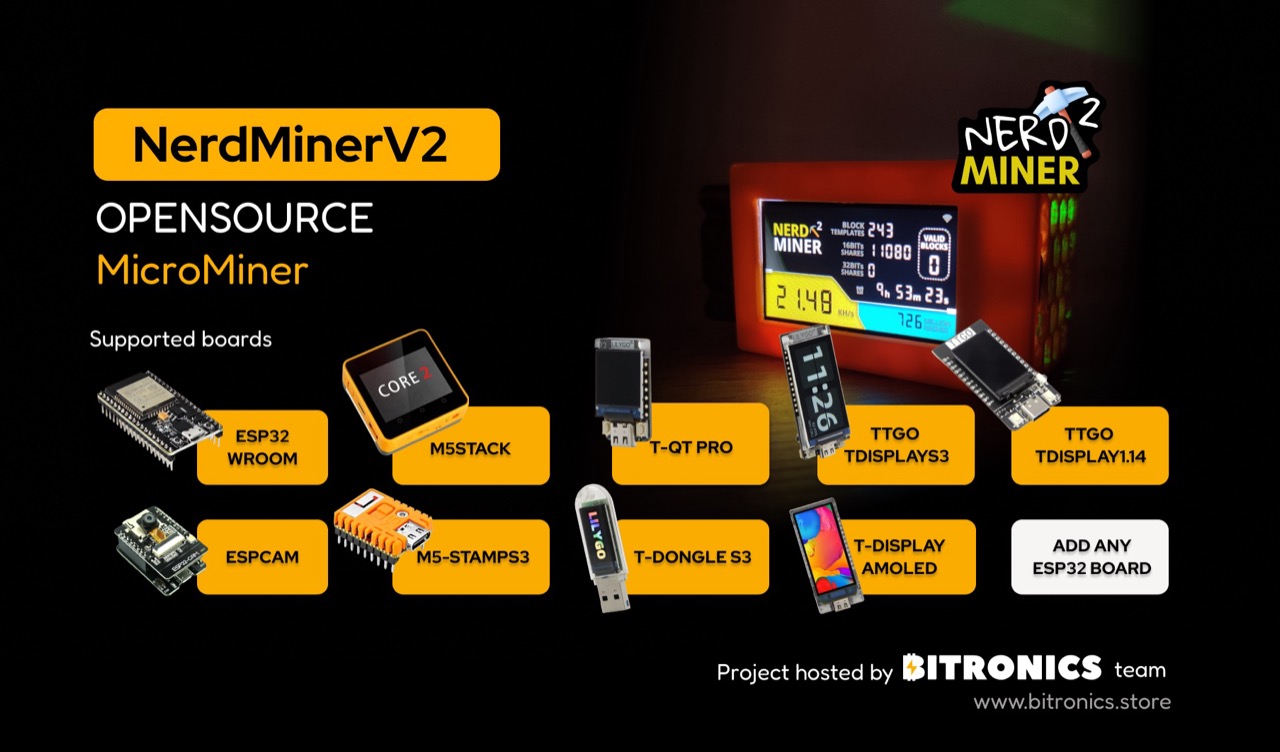
The NerdMiner V2 is an ESP32-based open-source device that costs around $15–30 on AliExpress. It runs the SHA-256 algorithm at roughly 55–300 KH/s depending on the version, drawing about 1–5W. It fits in your hand, makes no noise, and runs off a USB cable.
This is the most affordable entry into Bitcoin solo mining. The odds of finding a block are astronomically small — but the electricity cost is essentially zero, and the device doubles as a live Bitcoin network display on your desk.
Bitaxe Gamma 602
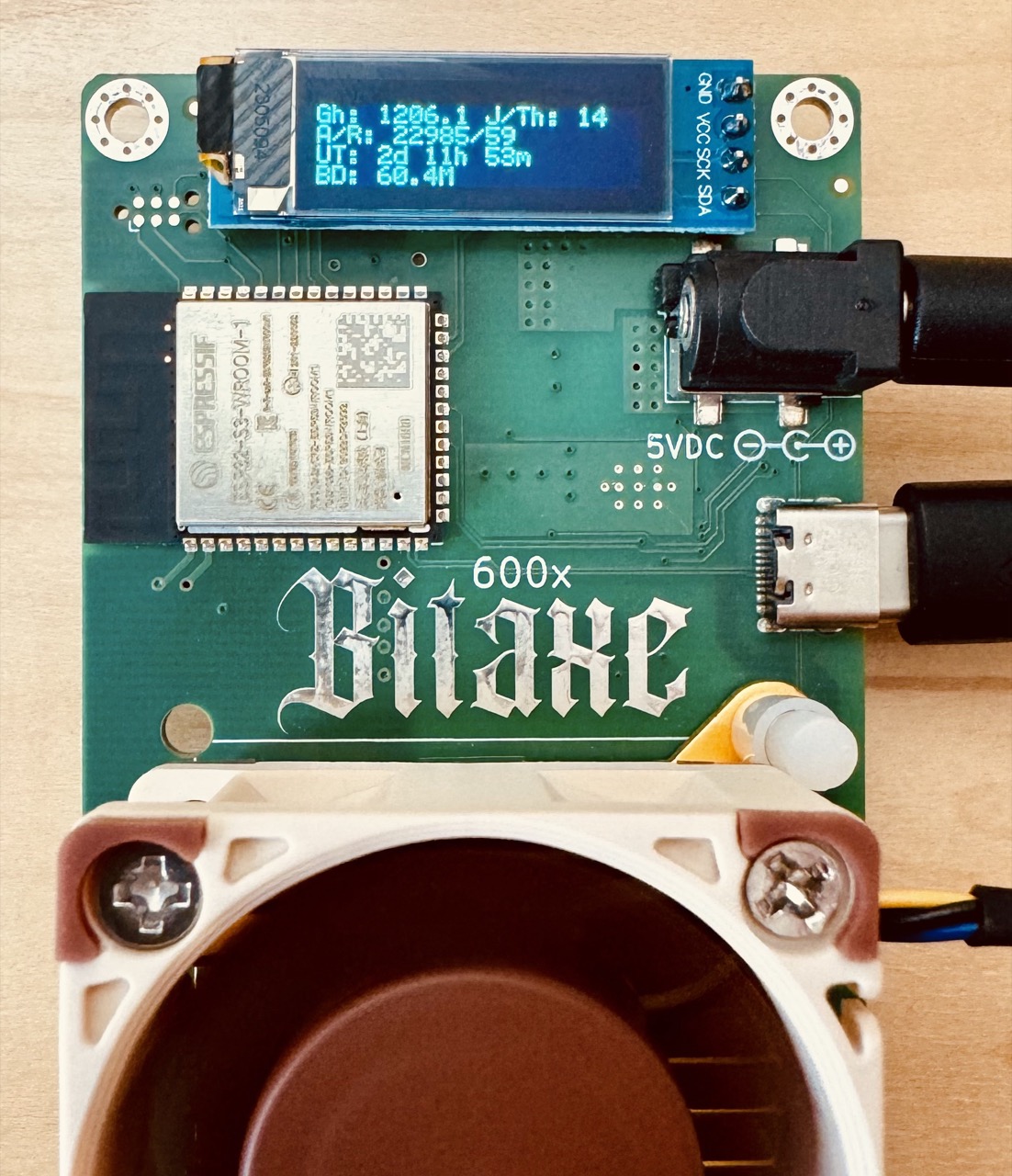
The Bitaxe Gamma is a proper open-source ASIC miner built around the BM1370 chip — the same chip used in the Bitmain Antminer S21 Pro. It delivers 1.1 TH/s at approximately 18W and costs around $77. Setup takes under five minutes via a browser-based interface called AxeOS.
This is not a toy. In November 2025, a cluster of six Bitaxe Gamma units found Bitcoin block #924,569 and earned 3.08 BTC — worth approximately $266,000 at the time.
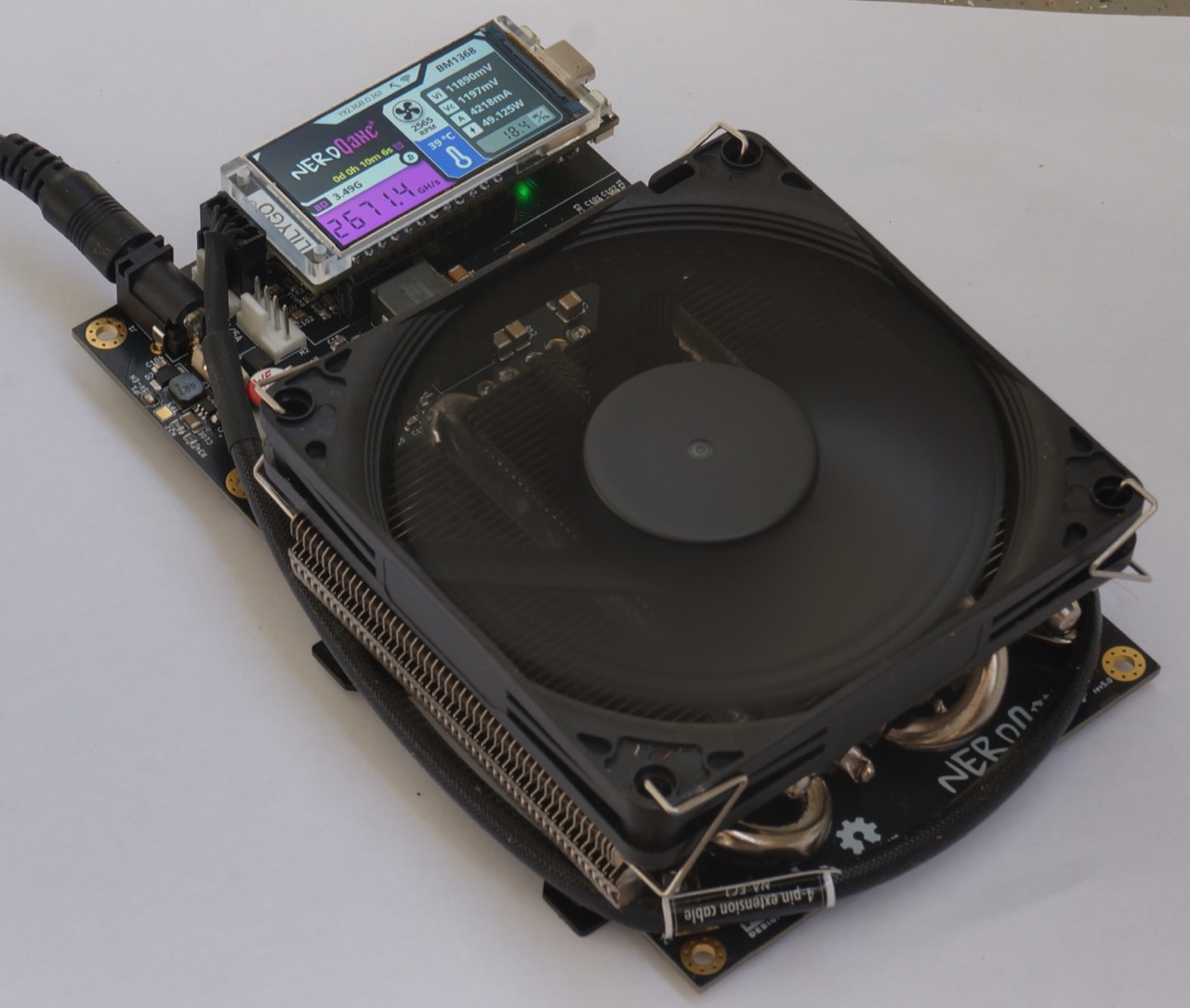
NerdQaxe++
The NerdQaxe++ puts four BM1370 chips on a single board, delivering around 4.8 TH/s at approximately 35W. It is one of the most efficient devices in this category — similar hashrate to several old-generation ASICs, but in a quiet desktop form factor. Available from multiple open-source hardware retailers.
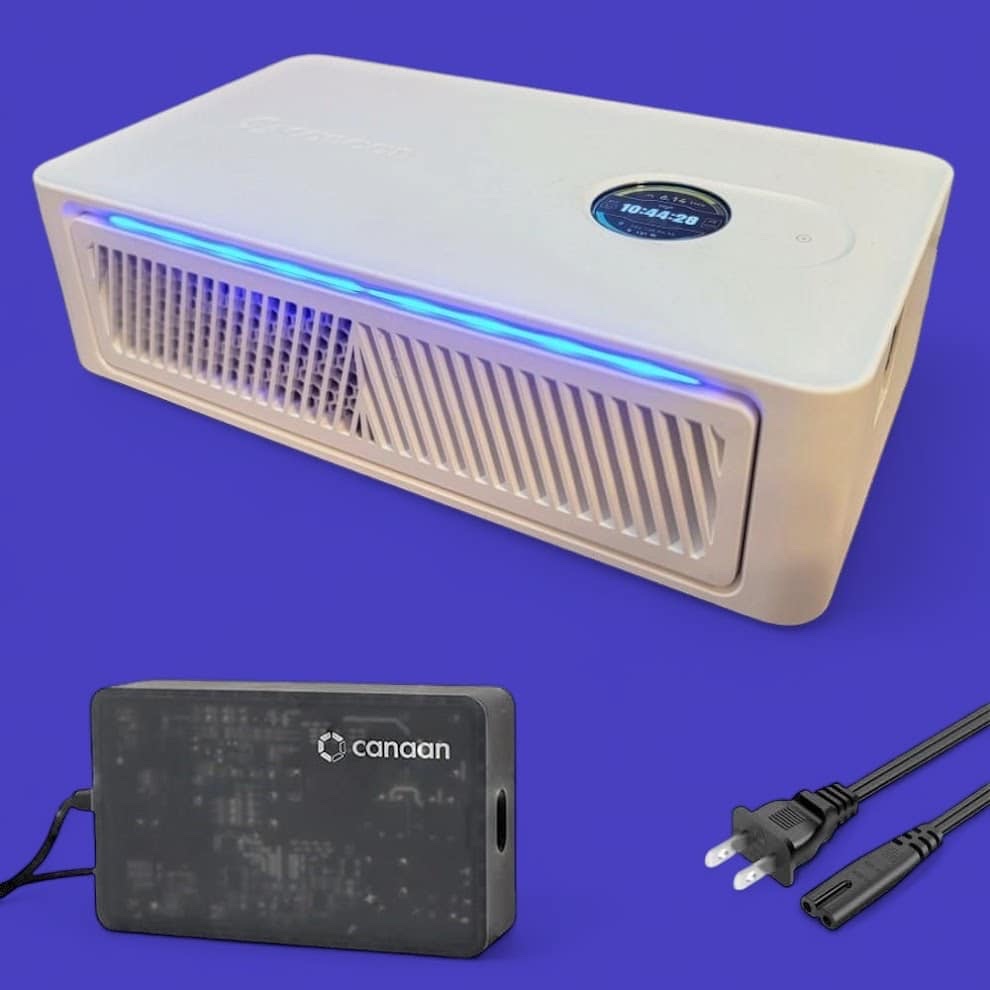
Canaan Avalon Nano 3S
The Canaan Avalon Nano 3S is a commercial compact miner with a built-in touchscreen, delivering around 6 TH/s. Unlike the open-source Bitaxe family, it comes fully assembled from Canaan — the same company that manufactures large industrial Bitcoin miners. A good option if you prefer a polished consumer product over open-source hardware.
Pool Details and Share Difficulty
The 2Miners BTC solo pool runs dedicated servers in three regions:
Europe: solo-btc.2miners.com
USA: us-solo-btc.2miners.com
Asia: asia-solo-btc.2miners.com
Fee: 1.5% — among the lowest available for BTC solo mining.
Each region offers three share difficulty levels: 524K, 1M, and 16M. If you are unsure, use 524K. Use 16M if you are connecting via NiceHash or have very high hashrate.
An important note: share difficulty does not affect your rewards in any way. In solo mining, what matters is whether your miner finds a valid block — shares are just how the pool measures activity and plots your hashrate graph. A lower difficulty means more frequent share submissions and smoother statistics. A higher difficulty means each share takes longer to find but carries more weight. You can read the full explanation in our article: What is Share and Share Difficulty.
In practice, pick a difficulty level where your miner submits a share roughly every one to two minutes. This gives you a clean hashrate graph without unnecessary network traffic — useful if your connection is slow or unstable.
How to Start Mining Bitcoin Solo on 2Miners
Step 1 — Create a Bitcoin wallet. We recommend Bitcoin Core for desktop, or a hardware wallet — Ledger, Trezor, or Jade — for maximum security. If neither is an option, any mobile wallet works: Trust Wallet, Exodus, BlueWallet, or similar. You can also mine directly to any exchange address — obviously, every major exchange supports Bitcoin deposits.
Step 2 — Configure your miner. Use the settings below. Replace YOUR_WALLET_ADDRESS with your actual address.
Pool 1 (Europe): solo-btc.2miners.com:2626
Pool 2 (USA): us-solo-btc.2miners.com:2626
Pool 3 (Asia): asia-solo-btc.2miners.com:2626
Worker: YOUR_WALLET_ADDRESS
Password: x
For Bitaxe and NerdMiner devices, enter the same stratum address in the AxeOS web interface. Algorithm: SHA256. Full setup guide including SSL connections and NiceHash/MiningRigRentals configuration: solo-btc.2miners.com/help.
Step 3 — Check your stats. As soon as your miner submits its first share, your statistics will be available at solo-btc.2miners.com — just enter your wallet address. You can also monitor your workers in real time using the 2Miners mobile app: iOS and Android.
Calculate Your Odds
Use 2CryptoCalc to estimate your probability based on your hashrate and the current network difficulty.
An Antminer S9 at 14 TH/s has roughly a 1 in 1.273B chance of finding a block in any given month. Long odds — but a real number, not zero.
And it happens. Solo miners with a handful of terahashes have found blocks. The Bitaxe cluster example above is real. Every hash you submit is a valid lottery entry.
The prize is not just 3.125 BTC. Bitcoin miners also collect all transaction fees included in the block. At current network activity, a freshly mined block is typically worth $200,000 or more in total. That is the jackpot your miner is working toward, around the clock, for the cost of electricity.
Stay Updated
Follow us on X (Twitter) and join our Telegram chat to stay informed about new developments, miner alerts, and network upgrades.
The 2Miners pool co-founder, businessman, miner. In 2017 started mining cryptocurrencies and built many rigs on his own. As a result, he gained lots of practical knowledge and became interested in sharing it with others.
In his articles on 2Miners, he shares useful tips that he tried and tested himself. For example, Darek gives advice on how to buy hardware components for the basic mining rig and how to connect them to each other correctly. He also explained lots of complicated terms in simple words, such as shares, mining luck, block types, and cryptocurrency wallets. After the pool was launched, he published a series of articles ‘Crypto Mythbusters’ where he explained how to protect the network against 51% attack, talked about cryptocurrency mining difficulty and difficulties of launching your own node.
2Miners Mining Pool Mobile App: Looking for Beta Testers
March 3, 2026
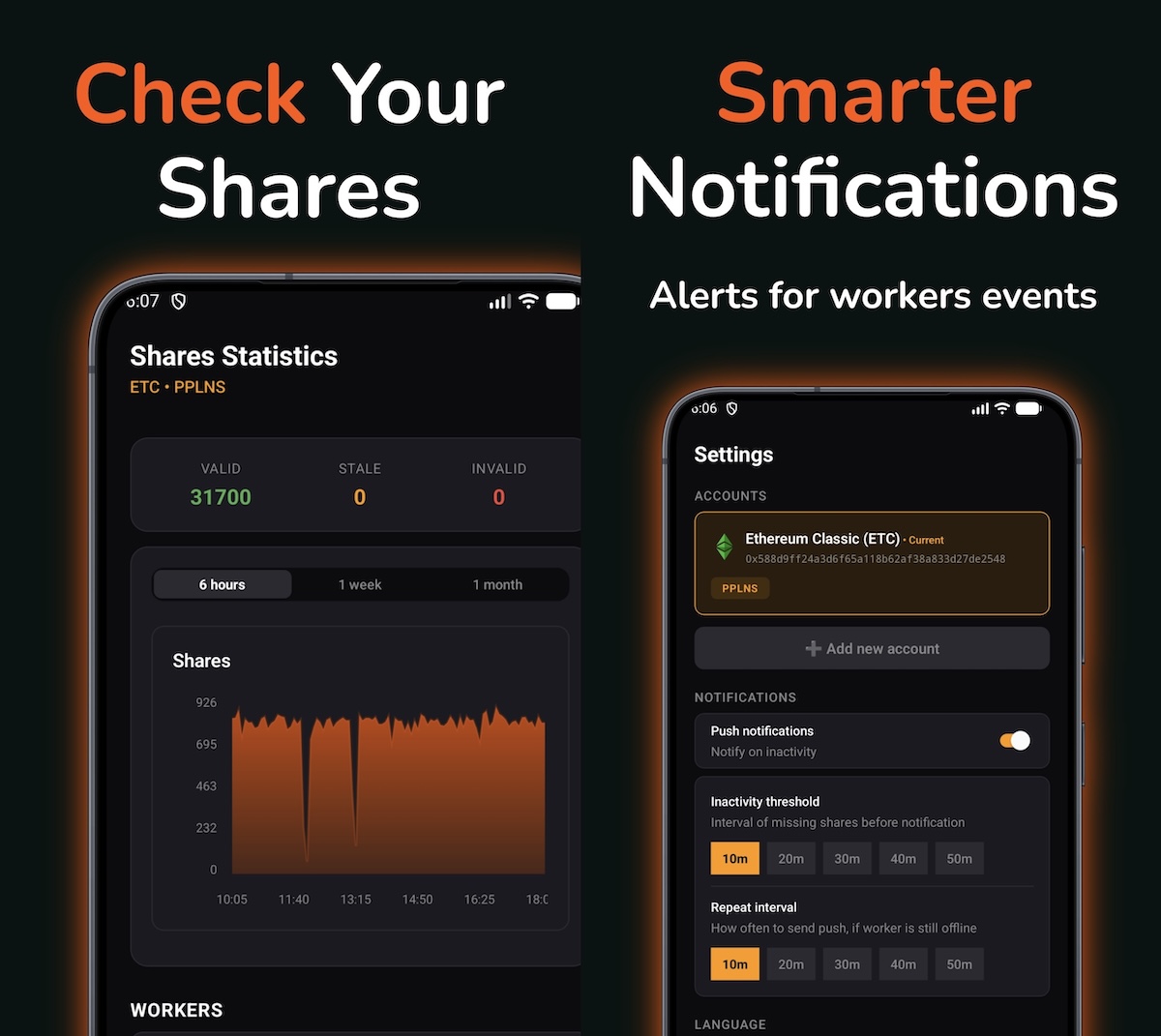
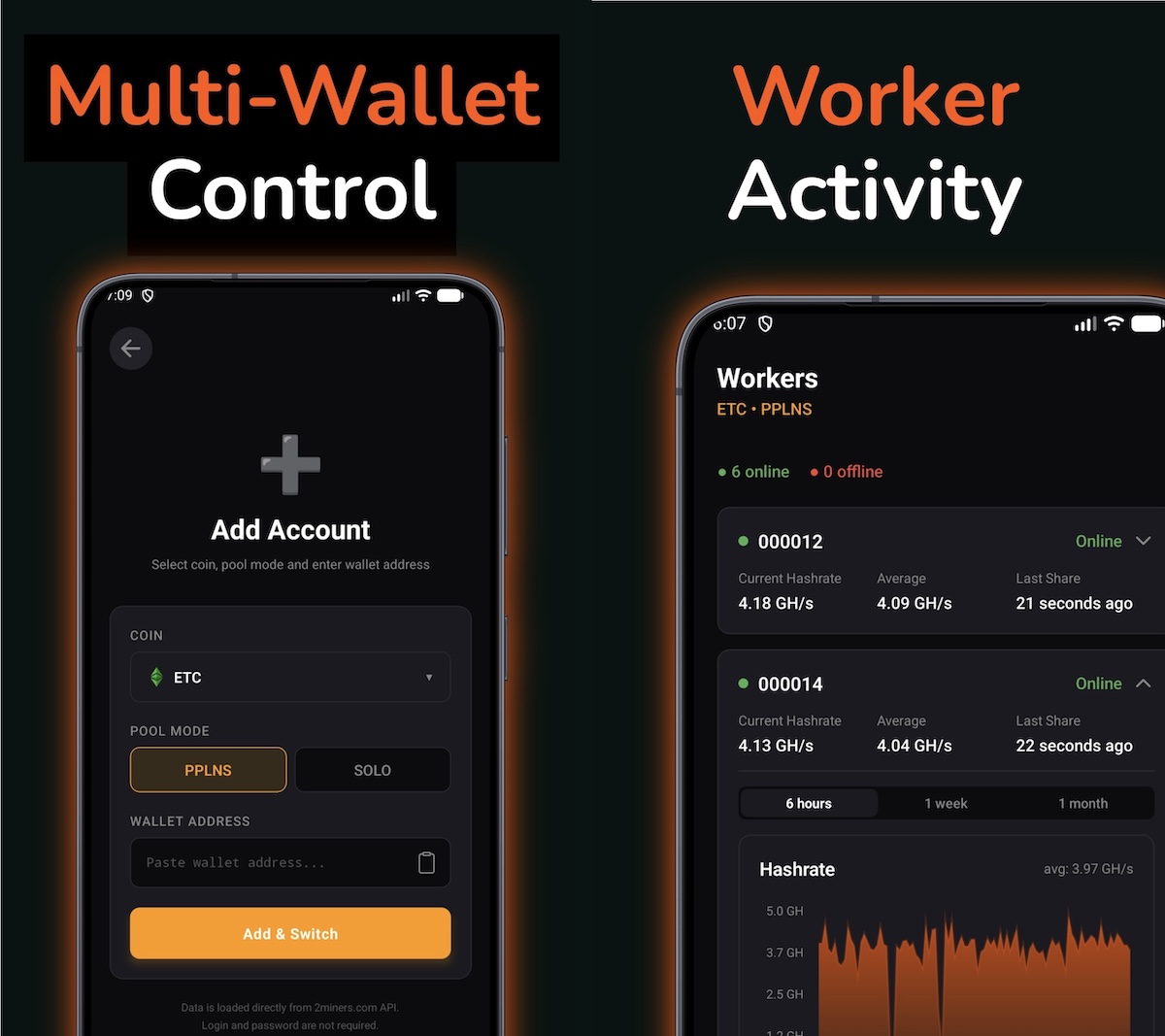
The 2Miners team is developing an app for all mining pool users. This new tool allows you to monitor your workers and get real-time updates on their status. While the app is not yet available to the general public, you can try it out now through our beta testing program.
2Miners App Features and Capabilities
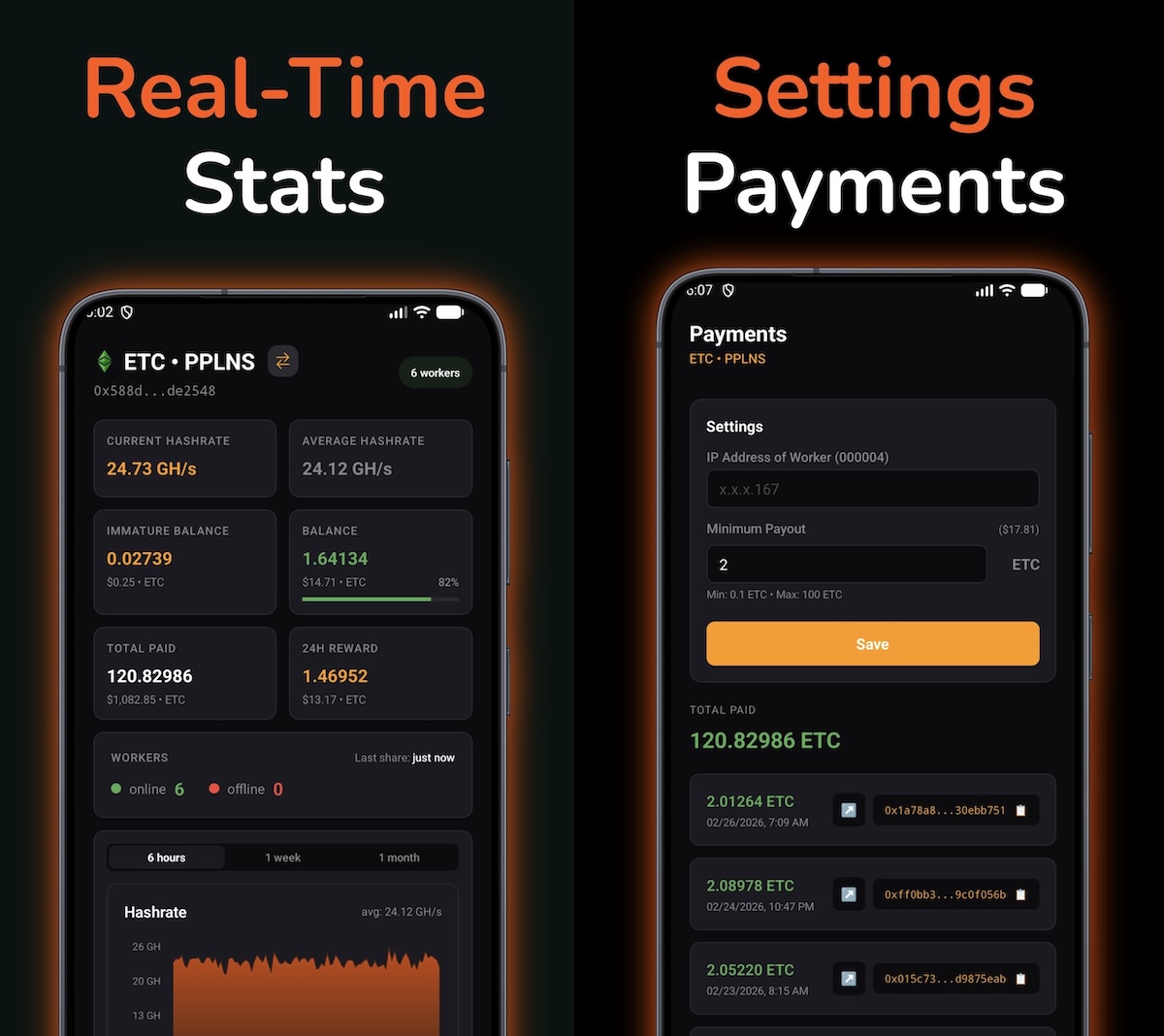
The 2Miners mobile app will be available for both iOS and Android smartphones. Its key feature is support for real-time push notifications regarding worker performance.
In practice, this means you will receive a notification if a worker goes offline, allowing you to react quickly and minimize downtime. You will also be notified when a miner comes back online.
The 2Miners app also includes several additional features:
Real-time hashrate statistics;
Share monitoring (valid, invalid, and stale);
Worker activity tracking;
Multi-wallet support;
Overview of payment and payout settings.
How to Join the 2Miners App Beta Test
2Miners mining pool users with Android devices can join the public beta test. Your feedback and ideas will help shape the future of a product used by tens of thousands of miners worldwide.
Beta testing provides early access to all features. Additionally, developers will review bug reports and consider suggestions for new functionality.
To join the 2Miners mobile app beta test, follow these steps:
Use the program and share your feedback in the Telegram chat.
2Miners App Testing for iOS Devices
Public beta testing for iOS devices is unavailable due to platform-specific restrictions. However, the 2Miners iOS app already exists and is currently in use.
Therefore, iPhone users can also look forward to the upcoming release, which will simplify mining on the 2Miners pool.
February 2026 Work Progress: iOS and Android App Development
March 2, 2026
February 2026 was a major milestone month for 2Miners. We began beta testing our brand new mobile application for Android and iOS, introducing real-time worker push notifications. In addition, Kaspa underwent another scheduled block reward reduction. Here are the details.
2Miners Mobile App: iOS & Android Development
We are developing a brand new 2Miners mobile application for iOS and Android.
The key feature — and the main reason many miners have been waiting for this — is real-time push notifications about worker activity.
You will now be able to receive instant alerts when:
Your worker goes offline
Your worker comes back online
No more refreshing the website. No more discovering hours later that your rig stopped mining. The app sends immediate notifications directly to your phone.
In addition to push alerts, the app includes:
Real-time hashrate statistics
Shares monitoring (valid / stale / invalid)
Worker activity tracking
Multi-wallet support
Payments and payout settings overview
Android Beta Testing — We Need Your Help
We need your help! We are launching beta testing of our new Android app and are looking for the first brave miners ready to try it.
What you get:
Early access to all features
The ability to influence product development
Your bug reports and suggestions will be prioritized by our team
Found a bug? Have an idea? Message us in our Telegram chat or send an email to info@2miners.com.
Your feedback will directly shape the final release version.
Kaspa (KAS) Block Reward Reduction
In accordance with the Kaspa Tokenomics, the Crescendo Hard Fork, and the official emission schedule, Kaspa underwent another scheduled block reward reduction in February.
Previous Reward: 3.46 KAS
New Reward: 3.27 KAS
Please pay attention! Kaspa mining profitability has changed again. We have already updated 2CryptoCalc to reflect the new reward value so you can accurately calculate your expected returns.
What’s Next
February was focused on building tools to make mining management easier and more responsive. The mobile app is a big step toward improving real-time monitoring and control for miners worldwide.
We look forward to your feedback and will continue refining the app before the full public release.
The 2Miners pool co-founder, businessman, miner. In 2017 started mining cryptocurrencies and built many rigs on his own. As a result, he gained lots of practical knowledge and became interested in sharing it with others.
In his articles on 2Miners, he shares useful tips that he tried and tested himself. For example, Darek gives advice on how to buy hardware components for the basic mining rig and how to connect them to each other correctly. He also explained lots of complicated terms in simple words, such as shares, mining luck, block types, and cryptocurrency wallets. After the pool was launched, he published a series of articles ‘Crypto Mythbusters’ where he explained how to protect the network against 51% attack, talked about cryptocurrency mining difficulty and difficulties of launching your own node.
January 2026 Work Progress: Multiple Halvings, Node Updates, and Quai Preparations
February 2, 2026
January marked a steady but important start to the new year for miners on the 2Miners pool. The month brought several regular node updates, continued work on expanding our pool offerings, and multiple scheduled reward reductions across major mineable coins. Here is a full summary of what happened.
Node Updates
Ergo (ERG) Node Update 6.0.2
In January, the Ergo network released version 6.0.2 of its node software. This was a regular maintenance update focused primarily on stability, indexing reliability, and wallet behavior.
The most important fix addressed an issue with a non-versioned tree.template in IndexedContractTemplate, which could previously cause indexers to become stuck. Alongside this fix, several internal improvements and tests were included to improve overall node reliability.
Key changes in this release included:
Added tests for accepting solutions from previous candidates
Updated agent rules logic
Fixed duplicate address generation after wallet restoration
General cleanup and preparation for the 6.0.2 release
No action was required from miners beyond keeping their nodes and infrastructure up to date.
Zcash (ZEC) Node Update 6.11.0
Zcash released version 6.11.0 of zcashd in January. This was also a regular update and introduced no changes to consensus rules or mining behavior.
The sole purpose of this release was to set a new end-of-service halt height. From a miner’s perspective, nothing changed operationally.
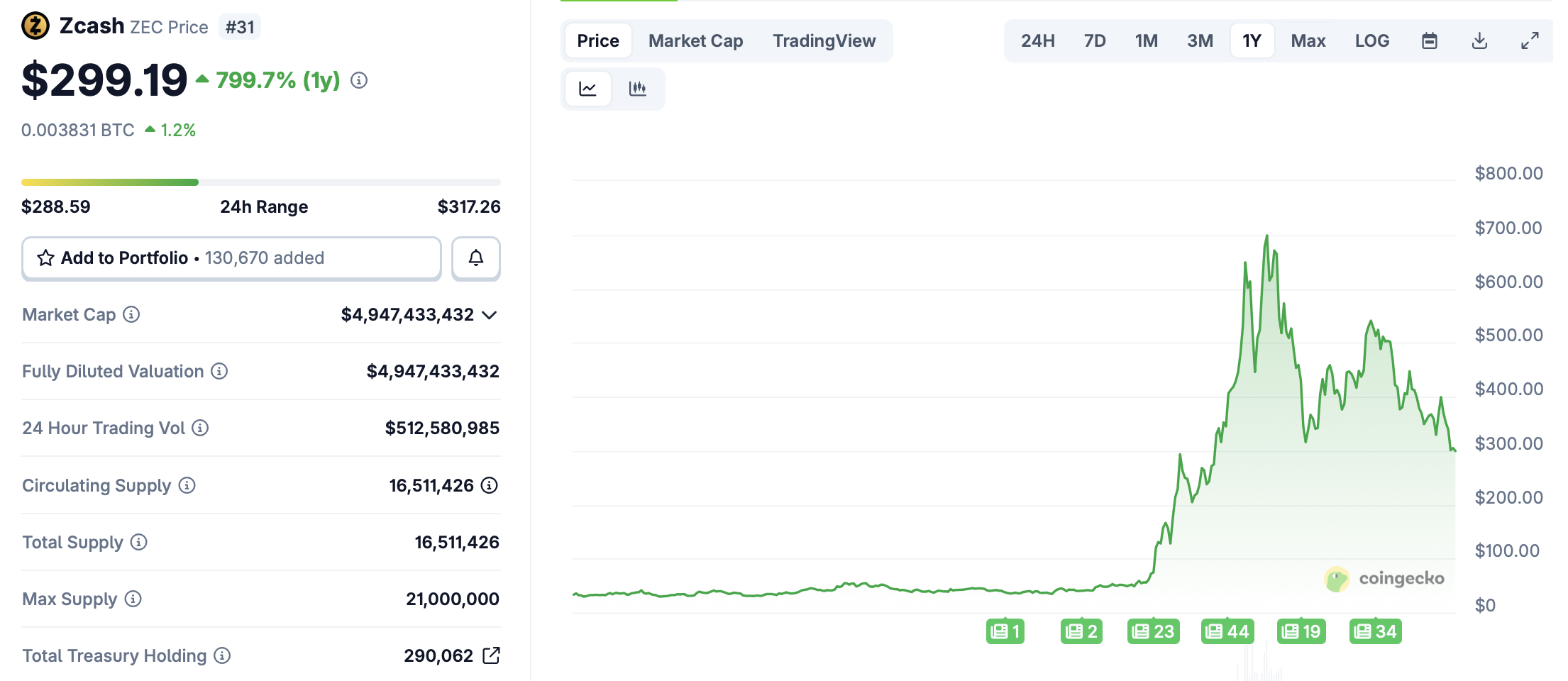
It is worth noting that Zcash has remained one of the main drivers of crypto mining activity over the past months. Following the strong price surge at the end of 2025, interest in ZEC mining has stayed high, keeping both GPU and ASIC miners actively engaged on the network.
New Coin in Progress: Quai Network
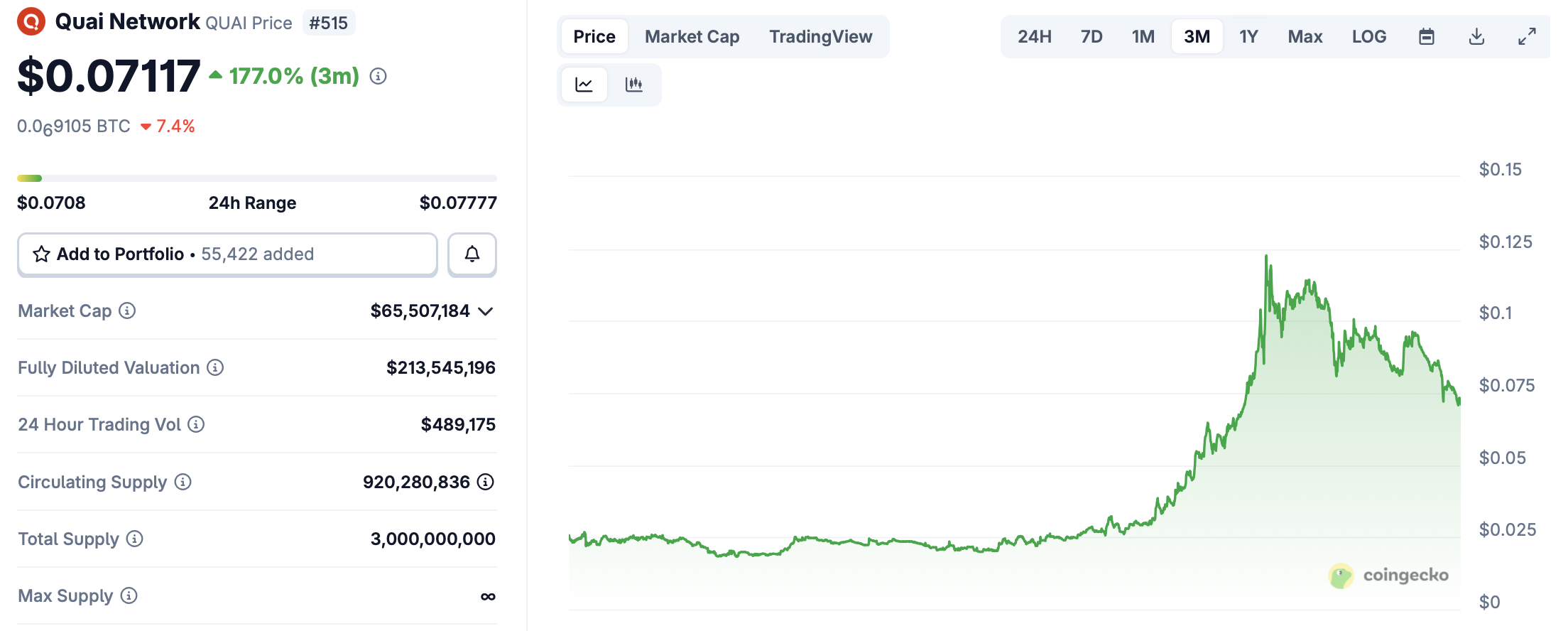
We are actively working on adding support for a new coin — Quai Network (QUAI).
Quai is a next-generation blockchain designed for high throughput and scalability using a multi-chain architecture. It focuses on enabling fast, decentralized, and scalable global payments while maintaining strong security guarantees. The network is built around the Proof-of-Entropy-Minima (PoEM) consensus mechanism and supports merged mining across multiple chains.
Our SHA256 pool for Quai is already up and running internally, and only a few final tests remain. We plan to officially announce the pool launch in February.
More details and connection information will be shared once testing is complete.
Reward Reductions Across Multiple Coins
January also included several scheduled reward reductions in accordance with the emission policies of multiple networks. Please pay close attention, as these changes directly affect mining profitability.
Ravencoin (RVN) Halving
Following the official Ravencoin halving rules, the network underwent a block reward reduction in January.
Previous Reward: 2500 RVN
New Reward: 1250 RVN
This halving event permanently reduced Ravencoin mining rewards by 50%.
Kaspa (KAS) Reward Reduction
As defined by the Kaspa Tokenomics, the Crescendo Hard Fork, and the official emission schedule, Kaspa experienced another scheduled block reward reduction.
Previous Reward: 3.67 KAS
New Reward: 3.46 KAS
Kaspa continues its gradual reward decrease model, and miners should regularly recalculate expected profitability.
Ergo (ERG) Reward Reduction
In accordance with the Ergo Tokenomics and emission schedule, Ergo also underwent a significant block reward reduction.
Previous Reward: 9 ERG
New Reward: 6 ERG
This reduction represents a major step in Ergo’s long-term emission plan.
Please pay attention! We have already updated 2CryptoCalc to reflect all of the above reward changes so you can accurately assess mining profitability.
Looking Ahead
January set a solid foundation for the year ahead. While many updates were routine, the continued evolution of emission schedules and the upcoming addition of new coins like Quai show that crypto mining remains dynamic and competitive.
Follow us on X (Twitter) and join our Telegram community to stay informed about upcoming launches, updates, and important miner alerts.
The 2Miners pool co-founder, businessman, miner. In 2017 started mining cryptocurrencies and built many rigs on his own. As a result, he gained lots of practical knowledge and became interested in sharing it with others.
In his articles on 2Miners, he shares useful tips that he tried and tested himself. For example, Darek gives advice on how to buy hardware components for the basic mining rig and how to connect them to each other correctly. He also explained lots of complicated terms in simple words, such as shares, mining luck, block types, and cryptocurrency wallets. After the pool was launched, he published a series of articles ‘Crypto Mythbusters’ where he explained how to protect the network against 51% attack, talked about cryptocurrency mining difficulty and difficulties of launching your own node.
December 2025 Work Progress: The End of Clore, Year Results
December 31, 2025
December 2025 marked the end of the year with a mix of educational content, difficult news for some miners, scheduled protocol changes, and a broader look at the state of crypto mining as we head into 2026. Here is a full summary of what happened this month.
GRIN Wallet Guide: Helping Miners Get Started
In December, we published a detailed step-by-step guide explaining how to use the GRIN wallet correctly. GRIN remains one of the coins that can be very profitable to mine, but it also causes constant confusion among miners — especially those encountering it for the first time.
The main issue is that GRIN cannot be mined directly to an address generated on a cryptocurrency exchange. Instead, miners must use a local GRIN wallet and properly configure transaction methods such as HTTP or file-based transactions. This additional complexity often leads to setup errors, failed payouts, or miners abandoning GRIN altogether.
That is exactly why we created this guide — to walk miners through the entire process step by step and remove unnecessary friction:
If you are mining or planning to mine GRIN, we strongly recommend reading this article carefully.
Clore Mining Has Ended
We regret to share extremely unpleasant — and frankly unacceptable — news regarding Clore (Clore.ai).
The Clore team has unilaterally ended mining and migrated the project to an ERC token. Mining beyond block 1,584,180 is completely pointless — everything mined after that block belongs to a fork that is not supported by any exchange.
What makes this situation especially troubling is how it was handled. The Clore developers never contacted mining pools in any way. There were:
no advance warnings,
no technical notices,
no timelines or transition plans.
As a result, a huge number of miners and pools unknowingly continued mining a worthless fork. The only communication from the Clore team was an after-the-fact message on Twitter saying “thanks to the miners” — a platform that many miners do not even follow.
This approach is deeply disappointing. This is not how things are done, and it is not how you treat the pools and miners who secured and supported your network.
As a direct consequence:
all Clore pools were shut down immediately;
no further payouts are possible;
a significant amount was already paid out into a worthless, unsupported fork.
This situation came as a shock to us as well. While we sincerely apologize to all affected miners, the responsibility for what happened lies entirely with the Clore.ai management and development team.
Please switch to mining other coins as soon as possible. Use 2CryptoCalc to find suitable alternatives based on your hardware.
Kaspa (KAS) Block Reward Reduction
In accordance with the Kaspa Tokenomics, the Crescendo Hard Fork, and the official emission schedule, Kaspa underwent another scheduled block reward reduction in December.
Previous Reward: 3.89 KAS
New Reward: 3.67 KAS
Please pay attention! Kaspa mining profitability has changed accordingly. We have already updated 2CryptoCalc so you can accurately recalculate your expected доходность.
Year-End Recap: Crypto Mining in 2025
As 2025 comes to an end, it is clear that crypto mining continues to evolve — not always in easy or predictable ways.
Unfortunately, many small and poorly managed cryptocurrencies did not survive this year. Lack of communication, weak development, and unprofessional handling of major changes led to the shutdown of multiple mining projects.
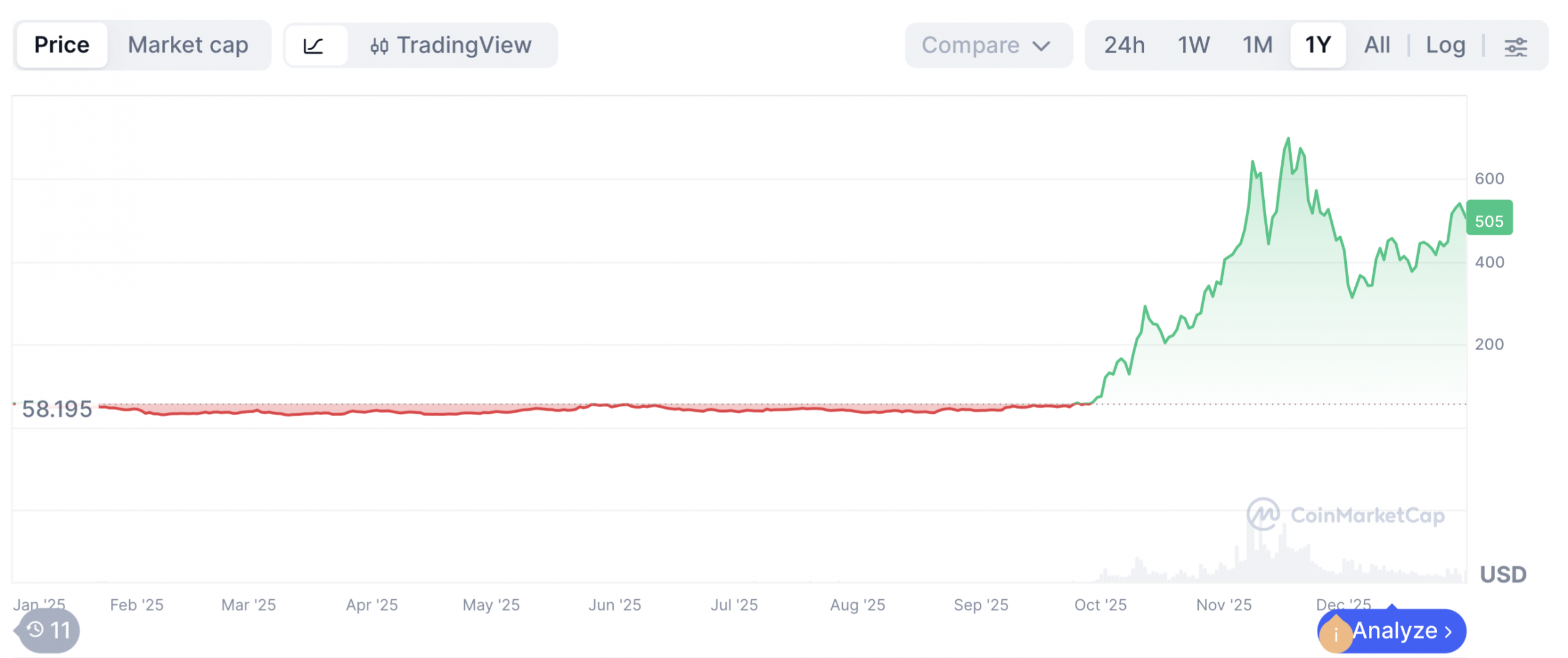
At the same time, new projects continue to emerge, and some established coins saw renewed interest. One of the most notable examples is Zcash. In 2025, ZEC attracted miners again as its price surged by nearly ten times compared to previous lows. This price growth made even older ASIC hardware profitable once more.
Remarkably, machines like the Antminer Z11 — originally released back in 2019 — returned to profitability thanks to improved market conditions. We will include a price and profitability chart here to illustrate this shift.
Despite all challenges, mining remains very much alive. It continues to reward those who stay informed, react quickly, and choose projects carefully.
Thank you for being with 2Miners throughout 2025. We wish you a Happy New Year, stable networks, strong uptime, and successful mining in 2026!
The 2Miners pool co-founder, businessman, miner. In 2017 started mining cryptocurrencies and built many rigs on his own. As a result, he gained lots of practical knowledge and became interested in sharing it with others.
In his articles on 2Miners, he shares useful tips that he tried and tested himself. For example, Darek gives advice on how to buy hardware components for the basic mining rig and how to connect them to each other correctly. He also explained lots of complicated terms in simple words, such as shares, mining luck, block types, and cryptocurrency wallets. After the pool was launched, he published a series of articles ‘Crypto Mythbusters’ where he explained how to protect the network against 51% attack, talked about cryptocurrency mining difficulty and difficulties of launching your own node.
How to Use the Grin Wallet: A Step-by-Step Guide for Cryptocurrency Miners
December 8, 2025
GRIN is the seventh most popular cryptocurrency on 2Miners. It was added to the mining pool in the spring of 2019, and is currently being mined by over 340 people. Given the nature of transactions on the network, difficulties may arise when interacting with the crypto asset. Here is how to avoid them and easily receive payouts for your work on the pool.
Setting up the GRIM wallet for Grin cryptocurrency
Transactions on the GRIN blockchain are of the P2P or peer-to-peer type; you can read more about this in this article on the GRIN wiki. Therefore, if your wallet is unavailable, the pool cannot send the payout.
Wallet availability can be checked using this tool. If your wallet is currently unavailable, the following message will appear:
The window of a normally functioning Grin++ wallet, ready to accept an incoming transaction, looks as follows:
in the bottom left corner of the wallet window, the internal node status must be “Running”;
the wallet must have incoming peers (indicated in the bottom right corner of the wallet window).
Also, the tor.exe process must have incoming and outgoing traffic.
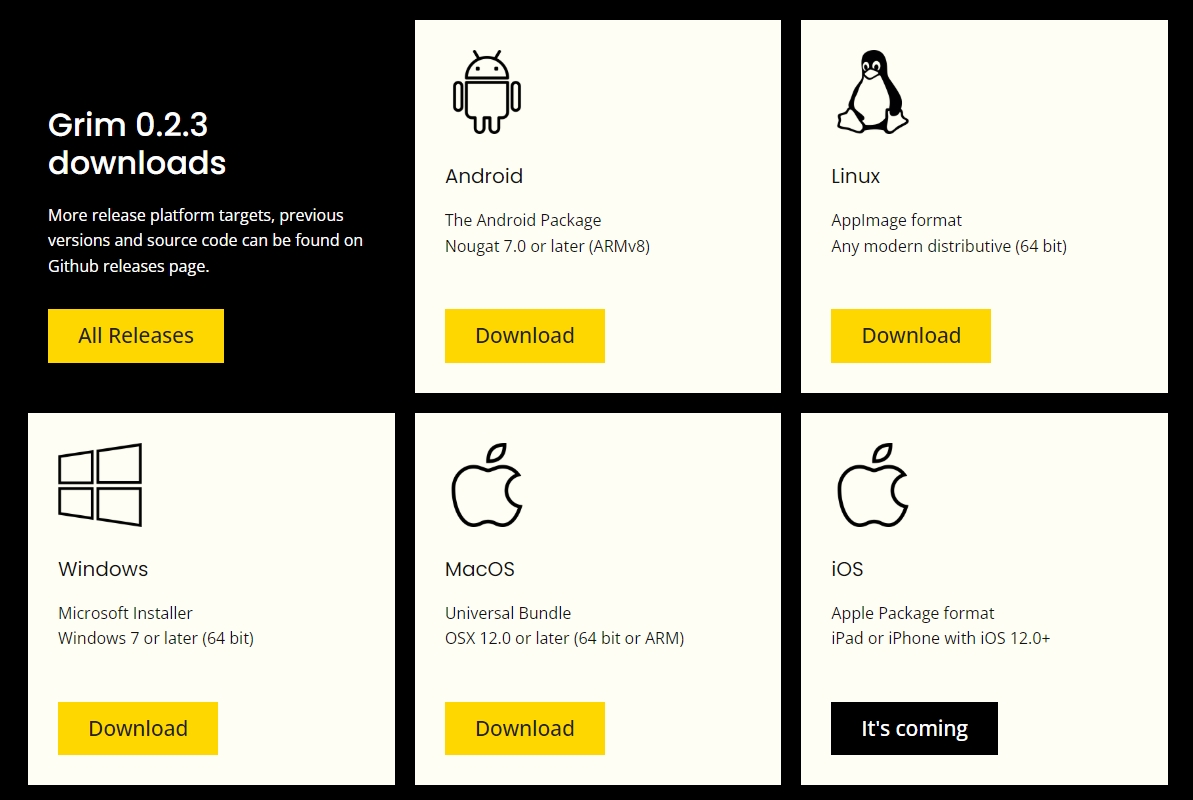
If you are unable to configure the Grin++ wallet to receive payouts from the pool, we recommend using the GRIM wallet. To download the wallet, go to the “Downloads” section and select the version for your operating system:
Next, run the downloaded file and follow the installer’s instructions.
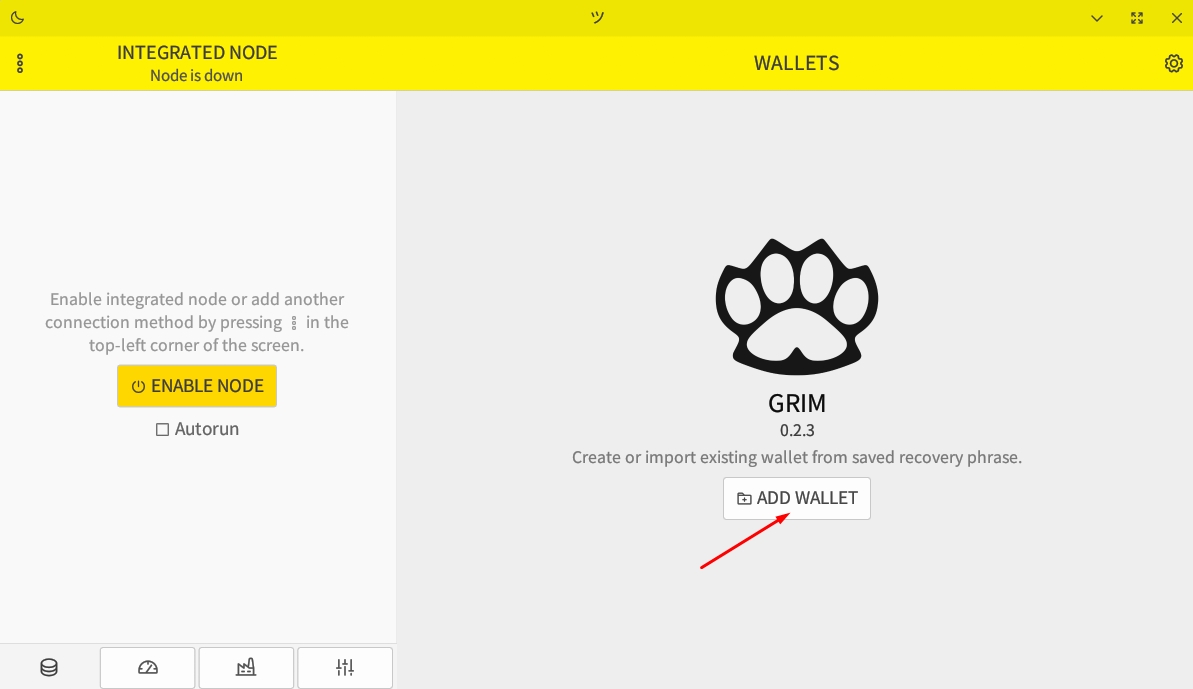
Launch the GRIM wallet. To create a new wallet or restore an existing one from a saved seed phrase, click the “Add Wallet” button.
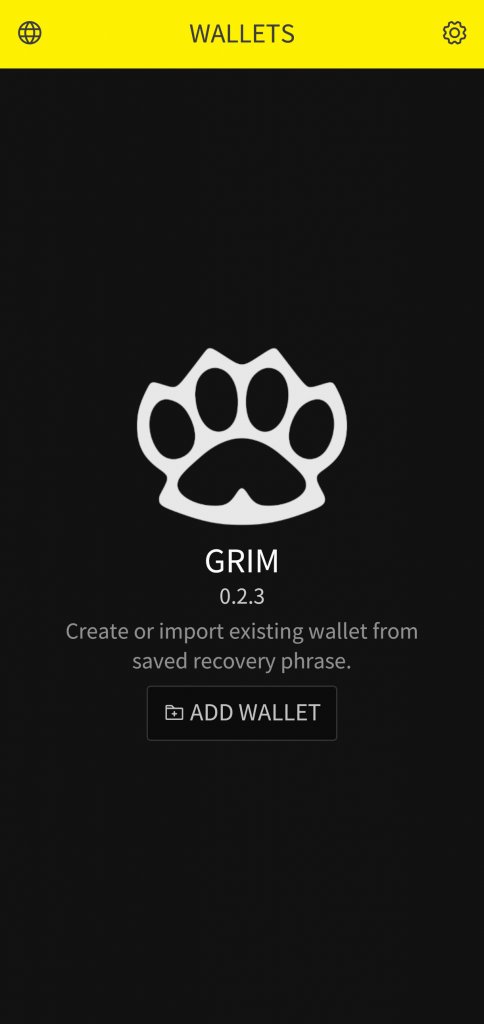
In the mobile version, it looks like this.
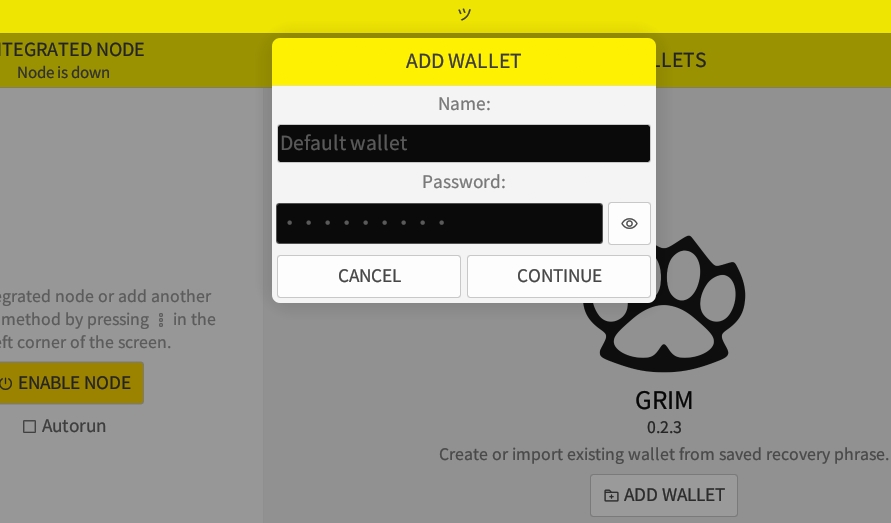
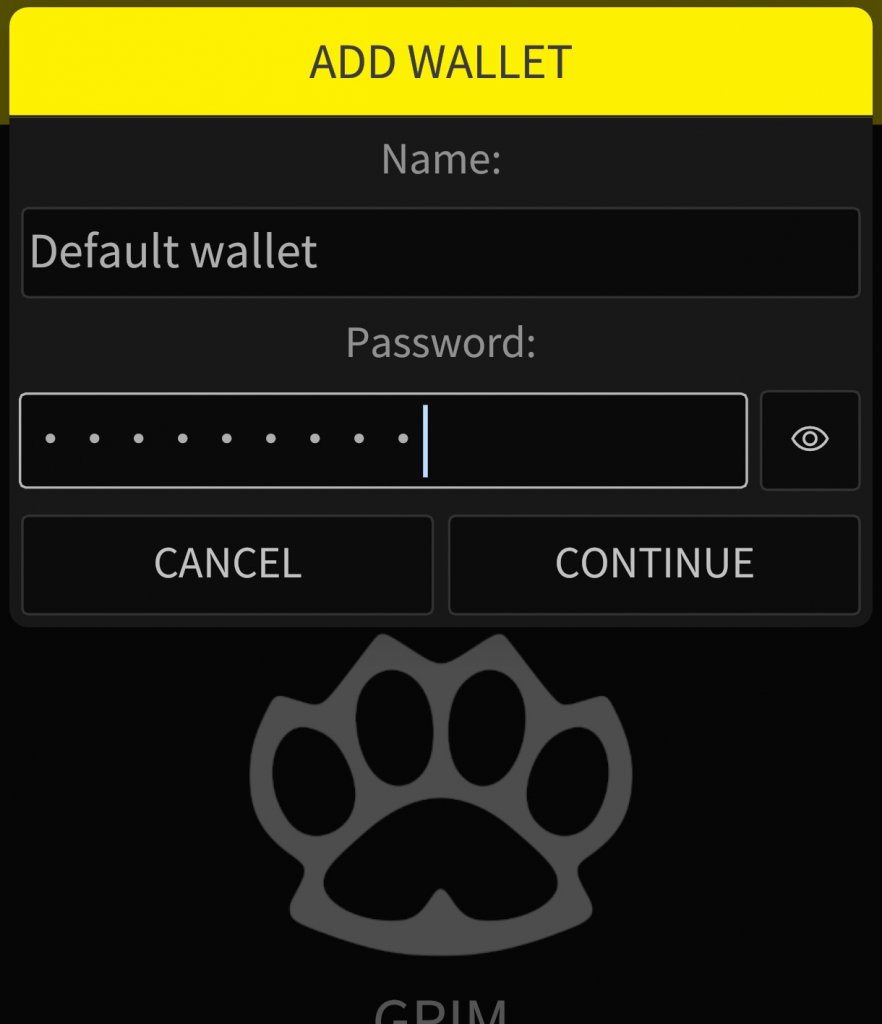
Next, enter a name for the wallet, create a password, and click “Continue”.
In the mobile version:
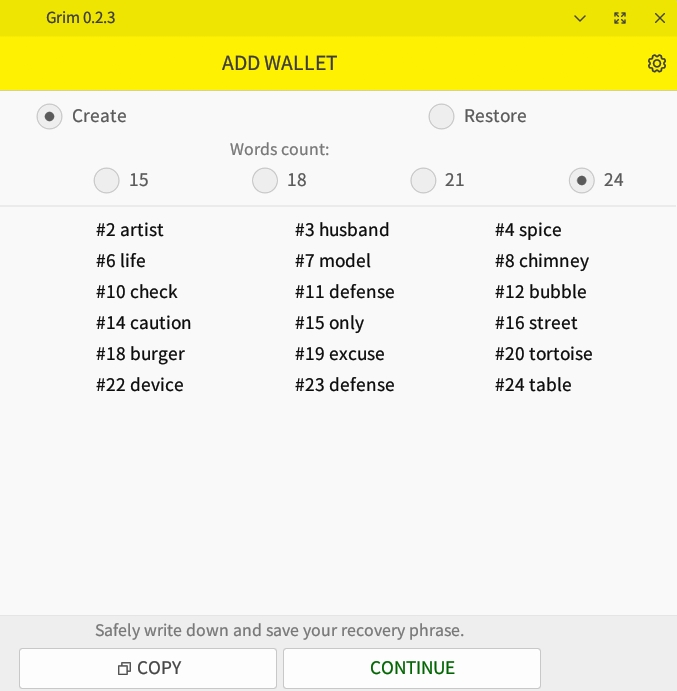
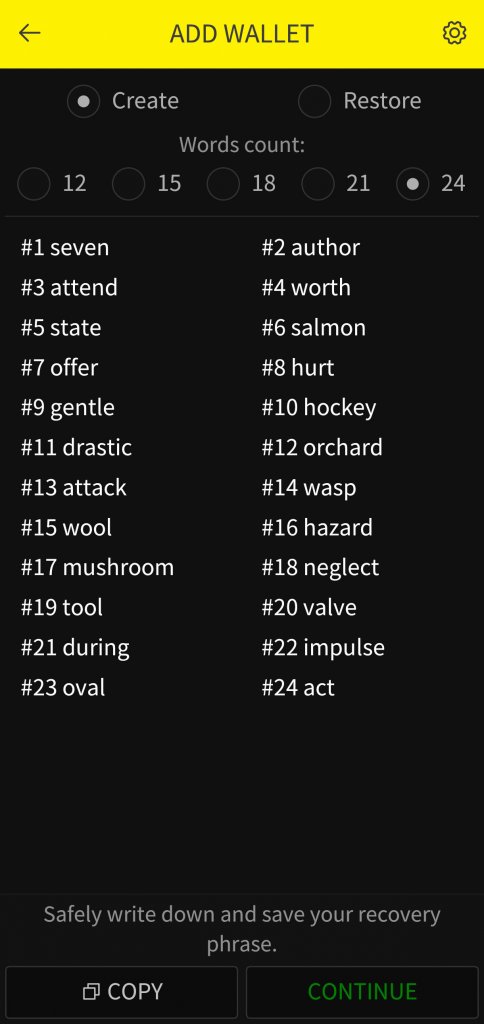
To create a new wallet, select the “Create” option, write down your seed phrase, and click “Continue”:
In the mobile version:
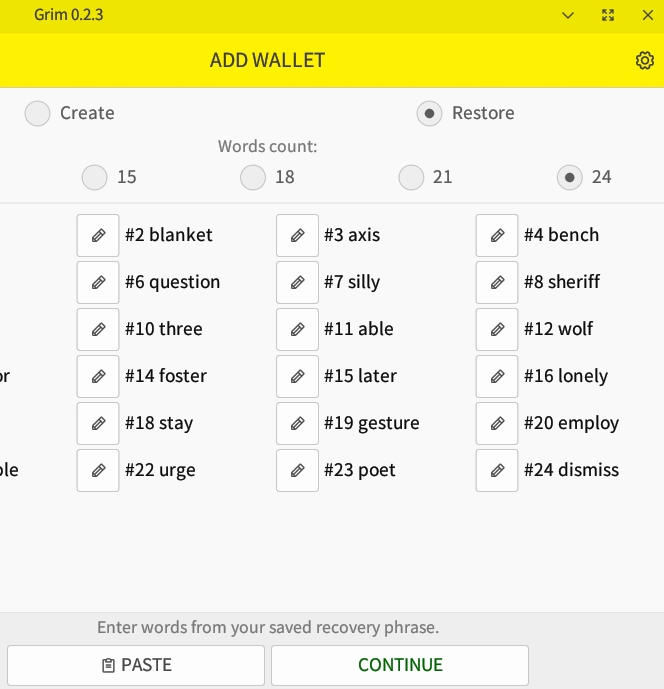
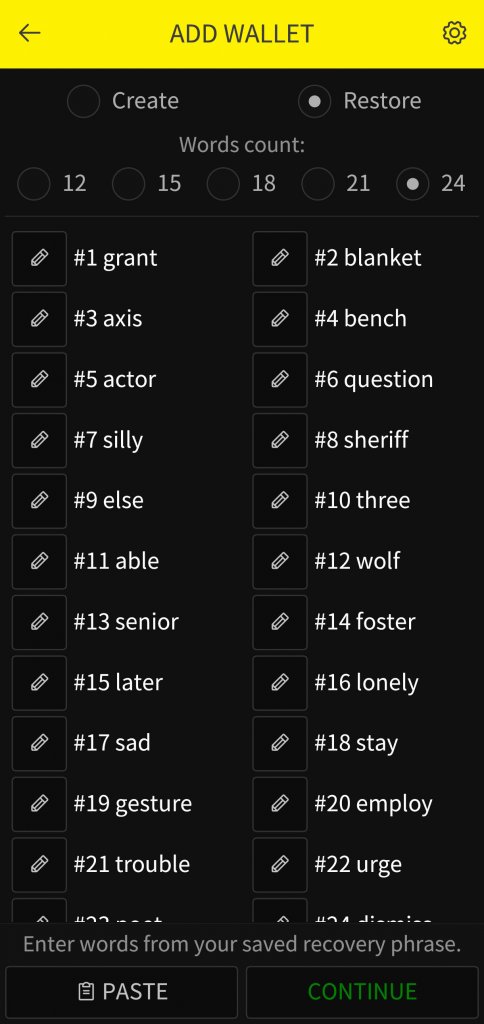
To restore an existing wallet from a saved seed phrase, select the “Restore” option, enter the seed phrase, and click “Continue”.
In the mobile version, the process is as follows:
If you used a seed phrase from the Grin++ wallet, your address in the GRIM wallet will match the address in the Grin++ wallet.
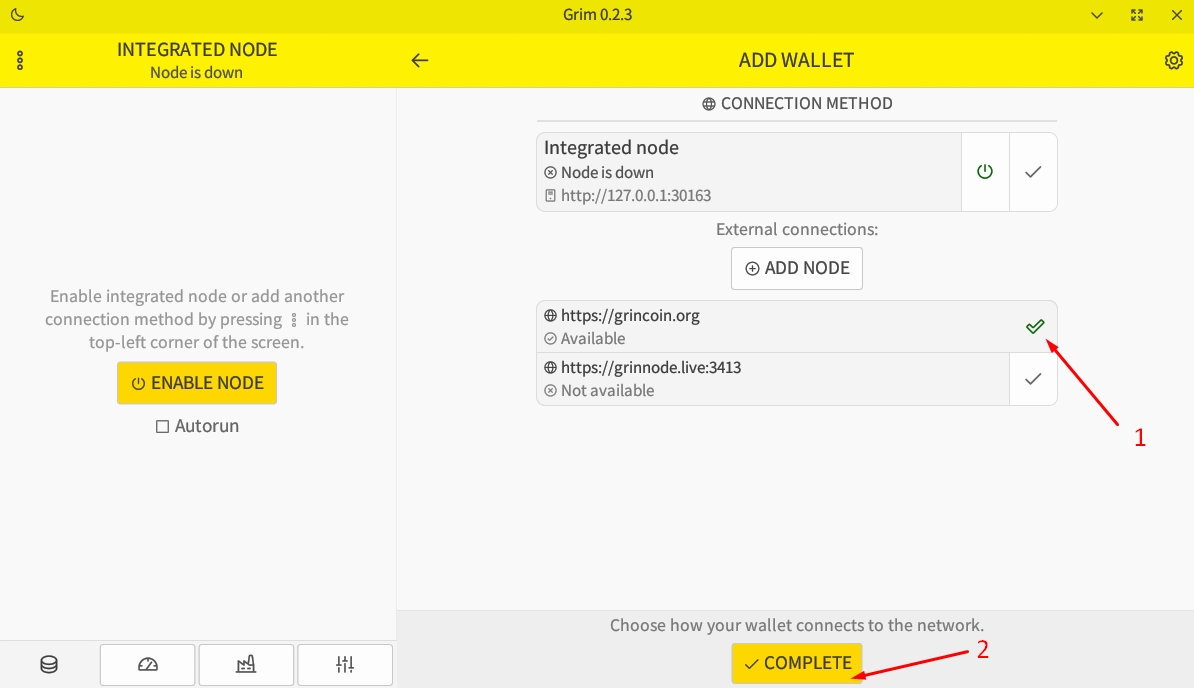
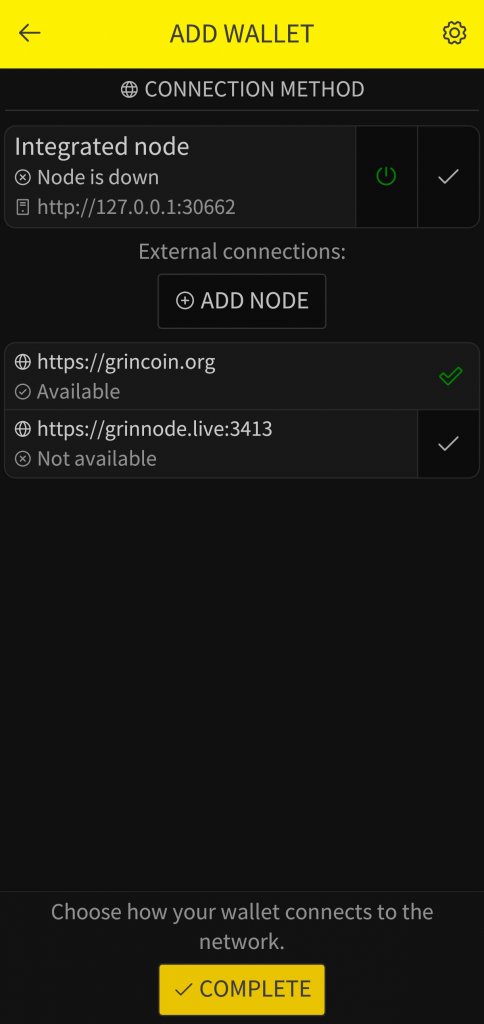
Next, you need to choose how to connect your wallet to the network. We recommend choosing the external connection grincoin.org:
In the mobile version:
Wait for the wallet to load and go to the “Transport” tab:
In the mobile version:
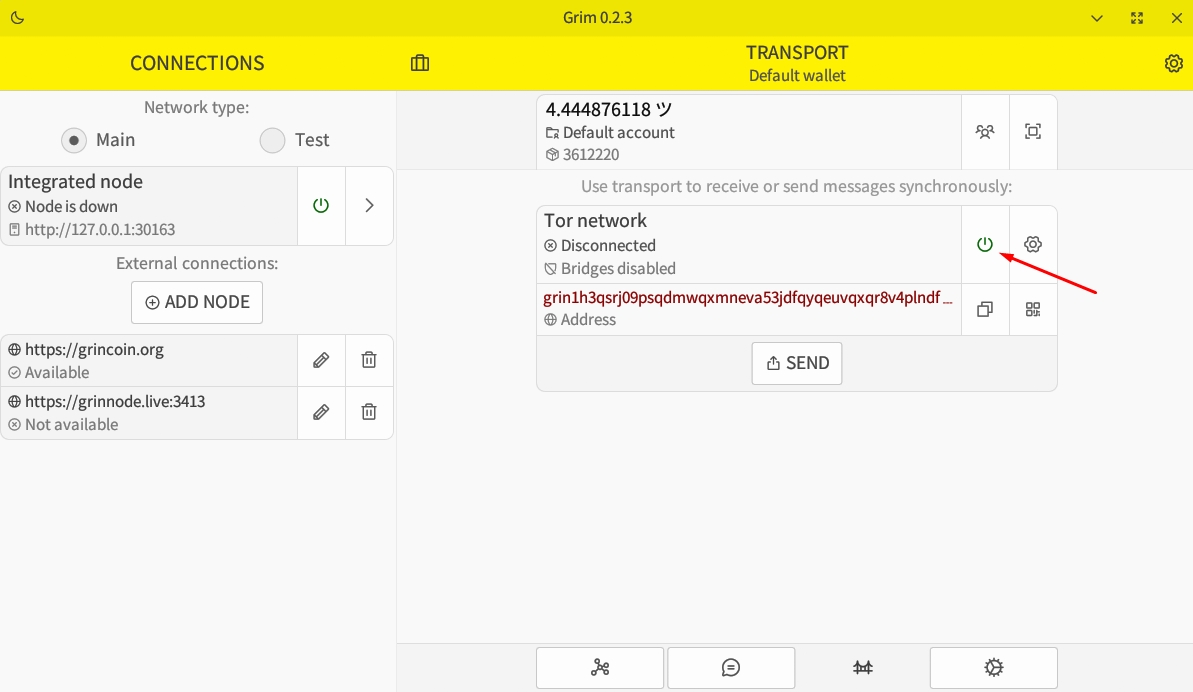
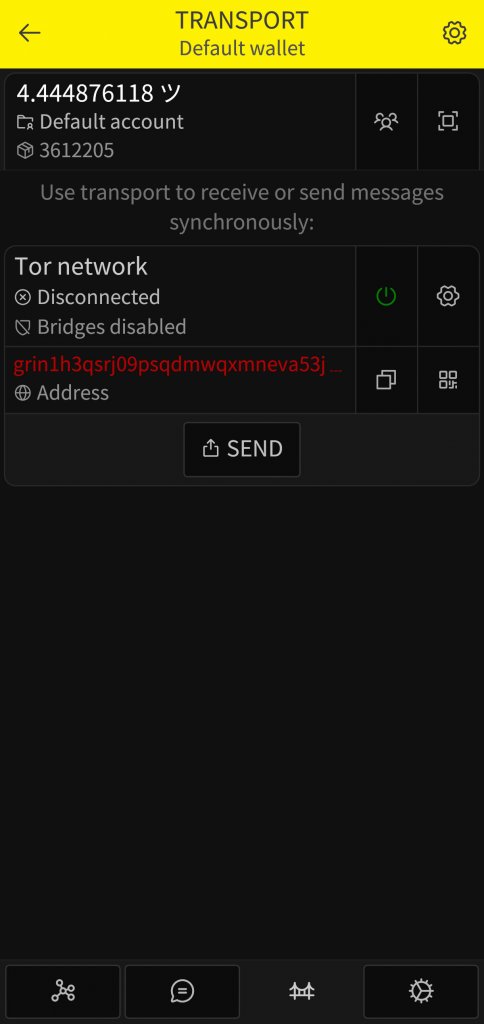
In the “Transport” tab, you must enable Tor and wait for the connection:
In the mobile version:
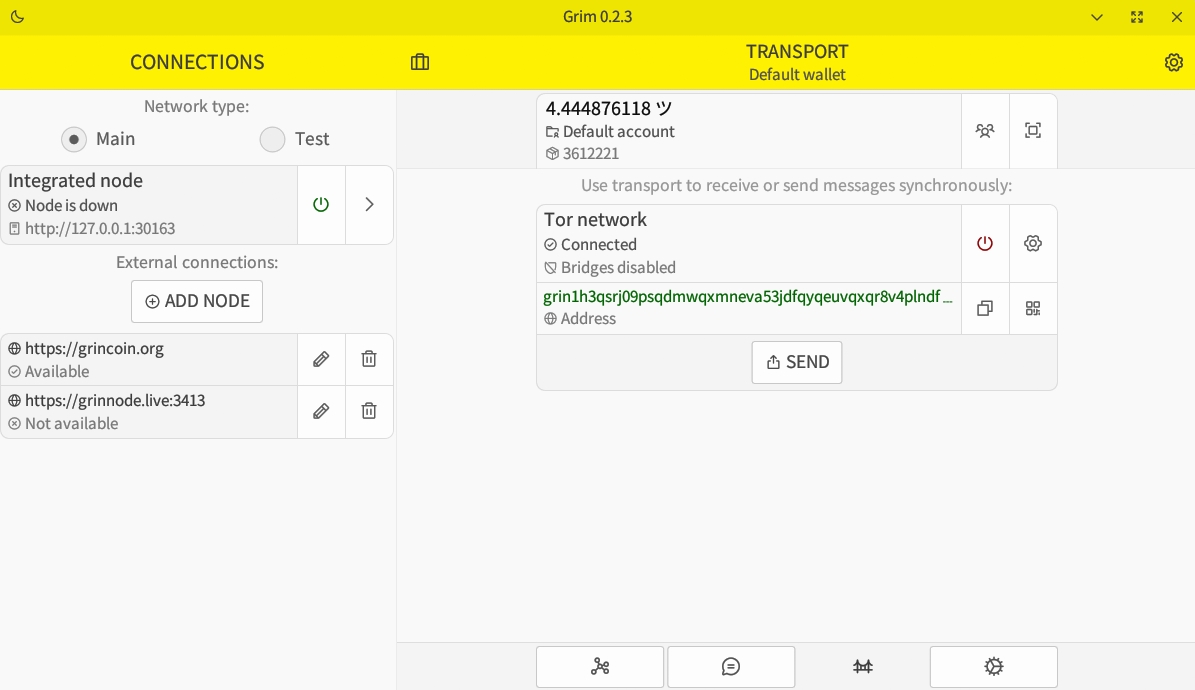
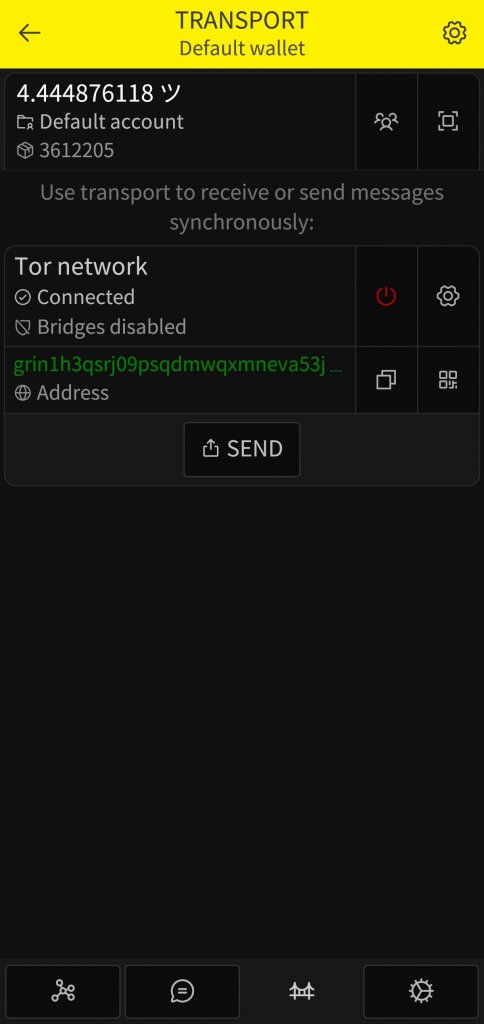
After Tor connects, its status will change to “Connected”, and your address will be highlighted in green:
In the mobile version:
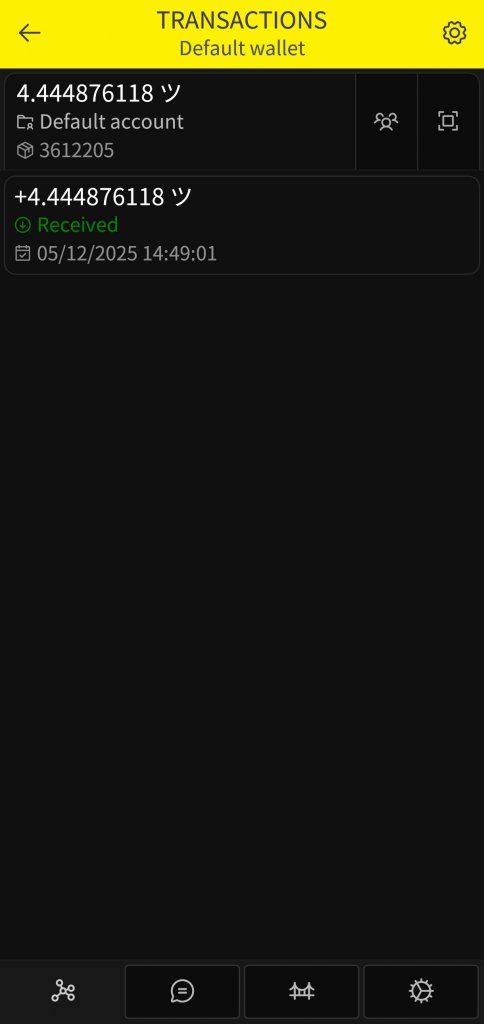
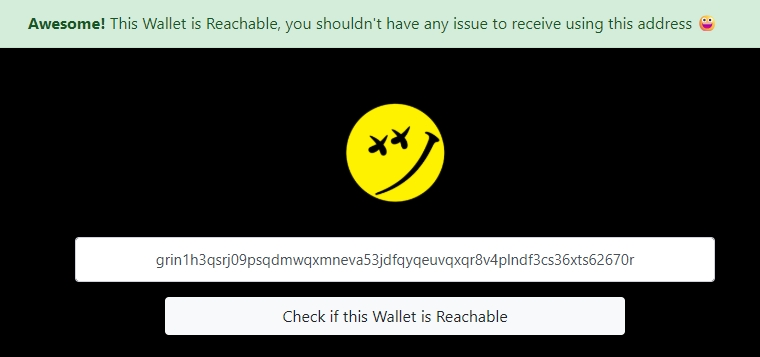
This completes the setup of the GRIM wallet for receiving GRIN payouts from the pool. Your address is now available to receive payouts. We check the availability of your wallet using this tool and see the following message:
Do not close or change your wallet settings until the payout has been received. Typically, a new payout round for the GRIN pool begins every 6 hours.
November 2025 brought several important updates for miners on the 2Miners pool. From a major Zcash network upgrade to new CKB client improvements and a scheduled Kaspa reward reduction — here is everything that happened this month.
Zcash Network Upgrade NU6.1 Activated
The Zcash network successfully activated NU6.1 in November 2025, following the release of zcashd v6.10.0. This upgrade was endorsed by both the Electric Coin Company and the Zcash Foundation and introduced a new long-term funding model that separates the roles of the Community and ZEC coinholders.
The new funding structure allocates:
8% of all block rewards to Zcash Community Grants (ZCG), supporting community-driven initiatives.
12% of block rewards to a new Coinholder-Controlled Fund. This fund is governed directly by ZEC coinholders and may be used to distribute grants to ecosystem contributors or remain untouched for future decisions.
This model will remain active until the 3rd Zcash halving, allowing the community to evaluate whether it should be extended or revised.
NU6.1 also included several protocol updates and ZIP changes:
New ZIPs
ZIP 255: Deployment of the NU6.1 Network Upgrade
ZIP 271: Dev Fund Extension and One-Time Disbursement
ZIP 1016: Community and Coinholder Funding Model
Updated ZIPs
ZIP 214: Consensus rules for a Zcash Development Fund
Alongside funding changes, NU6.1 also improved RPC balance reporting for shielded transactions and introduced transaction version v5 as the new default format.
CKB Client Update: Version 0.203.0 Released
The Nervos CKB team released CKB 0.203.0 (commit 88d1126, dated 2025-10-22), bringing a series of new features, bug fixes, and performance improvements. This update enhanced network stability and optimized several internal components used by full nodes and light clients.
Key Features
#4891: Added hole punching protocol metrics
#4888: Introduced two outbound block-relay-only connections for improved network propagation
#4910: Implemented from/into conversions for gen-type
#4895: Corrected error handling in add_node and remove_node calls within NetRpcImpl
Improvements
#4970: Disabled default features for strum dependency
#4946: Improved rich-indexer stability by ensuring RocksDB SecondaryDB stays synchronized before read operations
#4972: Limited the size of the filters field in BlockFilters messages to 1.8 MB to prevent node disconnects caused by oversized frames
These changes improve overall network reliability and reduce the likelihood of full nodes disconnecting light clients due to oversized filter messages.
Please pay attention! Mining profitability for Kaspa has changed. We have already updated 2CryptoCalc to reflect the new reward values.
Stay Updated
That concludes the November 2025 updates. Follow us on X (Twitter) and join the discussion on Telegram to stay informed about new developments, miner alerts, and network upgrades.
The 2Miners pool co-founder, businessman, miner. In 2017 started mining cryptocurrencies and built many rigs on his own. As a result, he gained lots of practical knowledge and became interested in sharing it with others.
In his articles on 2Miners, he shares useful tips that he tried and tested himself. For example, Darek gives advice on how to buy hardware components for the basic mining rig and how to connect them to each other correctly. He also explained lots of complicated terms in simple words, such as shares, mining luck, block types, and cryptocurrency wallets. After the pool was launched, he published a series of articles ‘Crypto Mythbusters’ where he explained how to protect the network against 51% attack, talked about cryptocurrency mining difficulty and difficulties of launching your own node.
October 2025 Work Progress: The End of Flux Mining
November 3, 2025
October 2025 brought a mix of endings and new opportunities in the mining space. While we said goodbye to Flux mining, Zcash received a major upgrade, and several coins underwent scheduled reward reductions. Read on for all the updates from the 2Miners team this month.
Flux (ZelCash) Mining Ends – Pool Shutdown Completed
On October 20, 2025, mining for Flux (formerly ZelCash) officially ended on 2Miners. This was due to Flux migrating away from traditional Proof-of-Work (PoW) mining to the new Proof-of-Useful-Work v2 (PoUW v2) model via Proof of Nodes (PON).
Our Flux mining pools were shut down at 19:00 UTC on October 20 to ensure that all final payouts could be processed before block 2,020,000, at which point the chain hard-forked and traditional mining stopped entirely.
All balances above the minimum threshold of 10 FLUX were successfully paid out.
We’re sad to see Flux go, but if you’re looking for a new coin to mine, use 2CryptoCalc to find the most profitable options for your hardware.
Zcash (ZEC) Node Update – v6.10.0
The Zcash 6.10.0 release brings support for the upcoming NU6.1 network upgrade, which is scheduled to activate at block height 3,146,400 — expected around November 23, 2025.
All node operators must upgrade to v6.10.0 or later to remain compatible with the mainnet after the activation of NU6.1.
Included ZIPs (Zcash Improvement Proposals):
ZIP 271 – Deferred Dev Fund Lockbox Disbursement:
This proposal creates a new Zcash Development Fund, managed through a lockbox system. The lockbox contains funds reserved for future network development, ensuring a consistent, transparent, and long-term funding mechanism for Zcash’s ongoing improvements. The fund includes all existing resources from the earlier Deferred Development Fund Lockbox (ZIP 1015) and future allocations that may accrue over time.
ZIP 1016 – Community and Coinholder Funding Model (partial):
This proposal focuses on decentralizing decision-making and strengthening the governance model around Zcash funding. It aims to increase transparency and give coinholders a more direct voice in how development funds are used. Without this update, block subsidies for the Zcash Community Grants and the Deferred Development Fund Lockbox (ZIP 2001) would have expired in November 2025, risking a funding gap for Zcash development organizations.
The changes introduced ensure funding continuity, clarify governance structures, and make the process more dynamic and accountable to the Zcash community.
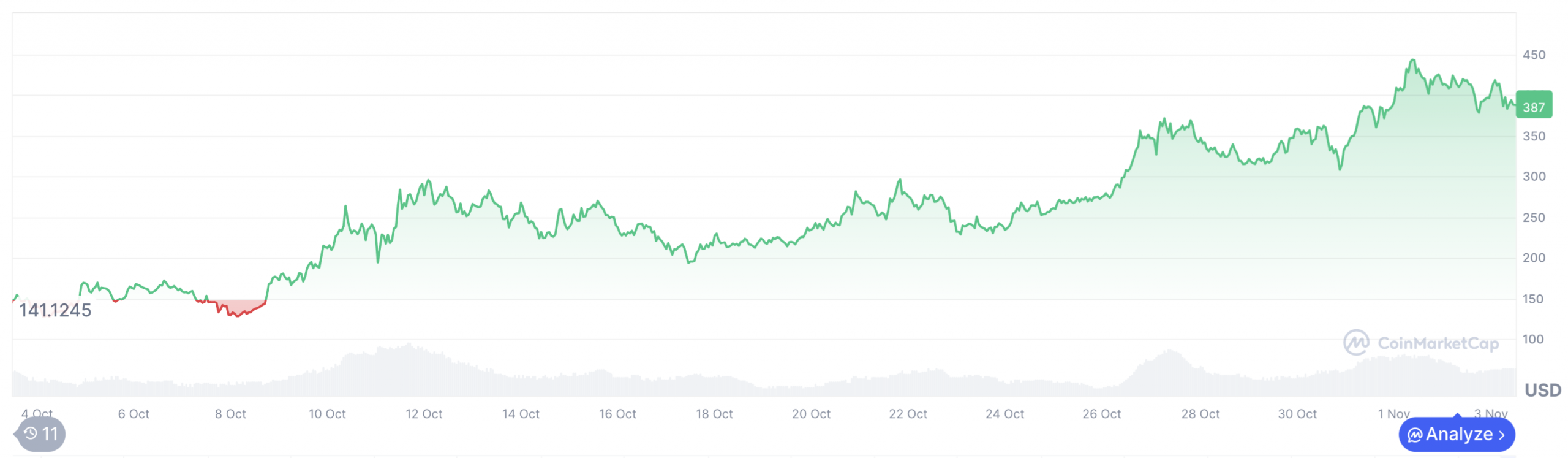
These updates are critical for maintaining long-term project sustainability and restoring investor confidence. As a result of the NU6.1 upgrade announcement, ZEC saw a significant price increase — rising from roughly $130 to $443 within one month — making Zcash mining more profitable than it has been in years.
Reward Reductions Across Coins
Heads up! Several coins experienced scheduled block reward reductions in October. We’ve updated 2CryptoCalc to reflect the new values so you can calculate your mining returns accurately.
KASPA (KAS) Block Reward Reduction
As part of the Kaspa Crescendo Hard Fork and emission schedule, the KAS block reward has been reduced:
Previous reward: 4.37 KAS
New reward: 4.12 KAS
ERGO (ERG) Block Reward Reduction
Following the Ergo Tokenomics and Emission Schedule, ERG mining rewards have decreased:
Previous reward: 12 ERG
New reward: 9 ERG
As always, check 2CryptoCalc to see the updated profitability for your mining rigs.
That wraps up October 2025. Stay connected with us via X (Twitter) and our Telegram miner community for all the latest news and support. Happy mining!
The 2Miners pool co-founder, businessman, miner. In 2017 started mining cryptocurrencies and built many rigs on his own. As a result, he gained lots of practical knowledge and became interested in sharing it with others.
In his articles on 2Miners, he shares useful tips that he tried and tested himself. For example, Darek gives advice on how to buy hardware components for the basic mining rig and how to connect them to each other correctly. He also explained lots of complicated terms in simple words, such as shares, mining luck, block types, and cryptocurrency wallets. After the pool was launched, he published a series of articles ‘Crypto Mythbusters’ where he explained how to protect the network against 51% attack, talked about cryptocurrency mining difficulty and difficulties of launching your own node.