November 2023 Work Progress Report: Crypto Node Updates
December 1, 2023
In November, 2Miners continued to adapt and evolve with the dynamic world of cryptocurrency. We witnessed important updates in KASPA rewards, several node updates, and are excitedly preparing for the new CLORE coin mining pool. Let’s dive into these updates.
KASPA (KAS) Reward Reduction
A significant change occurred in the KASPA ecosystem as per the KASPA EMISSION SCHEDULE. The block reward for miners has been reduced from 164.81 KAS to 155.56 KAS. This adjustment reflects the ongoing evolution of the KASPA network and its economic model. Miners are encouraged to stay updated with these changes to plan their mining activities accordingly. For the latest in mining profitability, visit 2CryptoCalc.
Node Updates
Several critical updates have been made to cryptocurrency nodes in November, ensuring enhanced security and functionality:
Neoxa v5.1.1.4-ec8b257-dirty
This is a mandatory update required for Neoxa miners, enhancing overall network stability and performance.
Zen 4.1.1
Zen has introduced proof verifier logging and other significant improvements, such as an updated libzendoo version and enhanced mempool mechanisms. This update ensures more robust and efficient network operations.
Firo v0.14.13.0-g39c41e5e7
Firo’s latest update introduces Lelantus Spark, a new privacy protocol that enhances user privacy with features like Spark Addresses and Exchange Addresses. It’s a substantial step forward in maintaining user anonymity and data security.
CTXC v1.10.51-stable-3289ad0
CTXC has also received updates, though specific details have not been disclosed at this time.
Preparations for New CLORE Coin Mining Pool
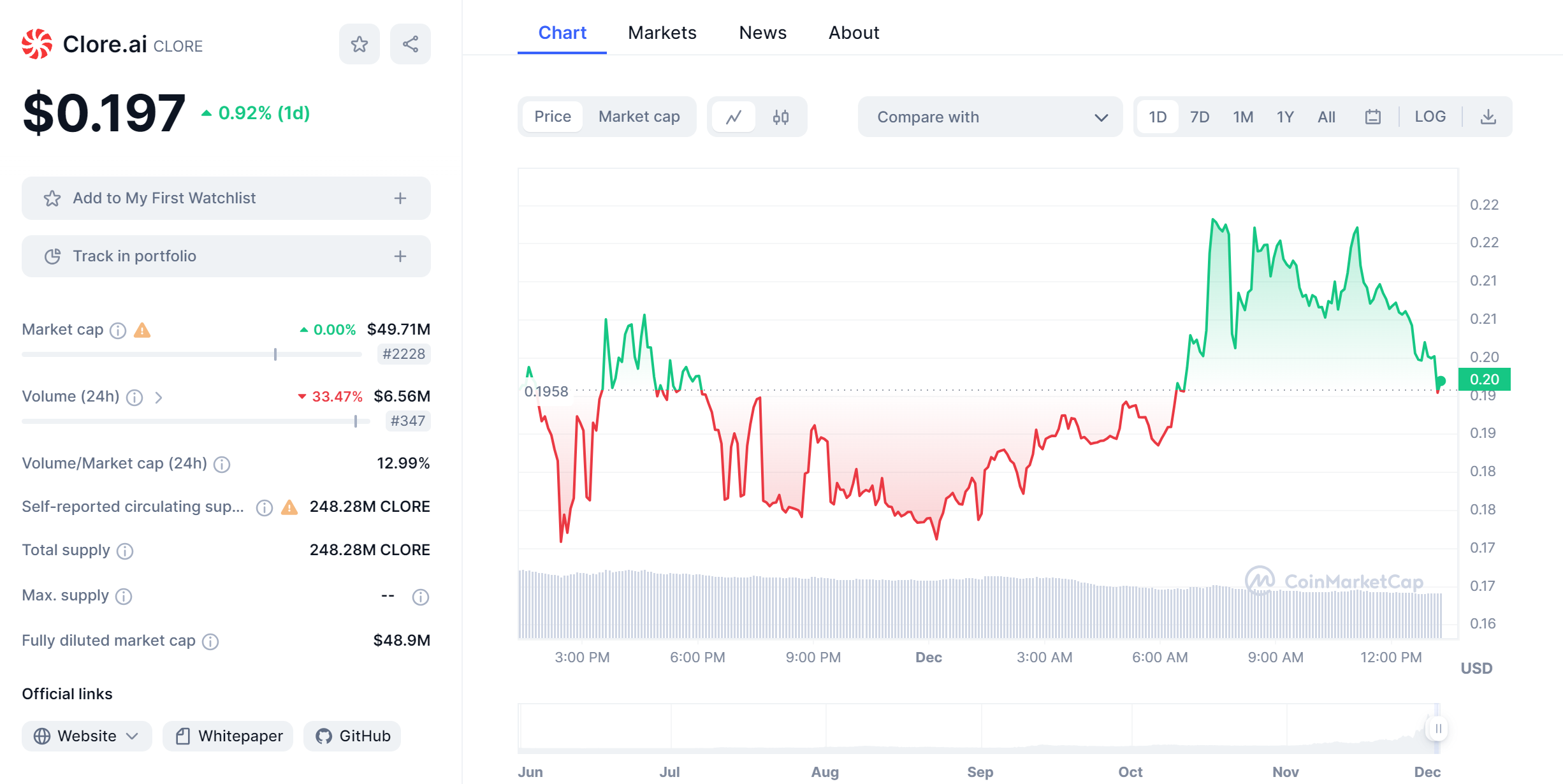
2Miners is gearing up to launch a new mining pool for the CLORE coin, using the KAWPOW algorithm similar to Ravencoin (RVN). Clore.ai is a groundbreaking platform that connects users with high-performance GPUs for various tasks, including AI training, video rendering, and cryptocurrency mining. With its user-friendly marketplace, Clore.ai offers accessible and affordable high-power computing resources.
The 2Miners pool co-founder, businessman, miner. In 2017 started mining cryptocurrencies and built many rigs on his own. As a result, he gained lots of practical knowledge and became interested in sharing it with others.
In his articles on 2Miners, he shares useful tips that he tried and tested himself. For example, Darek gives advice on how to buy hardware components for the basic mining rig and how to connect them to each other correctly. He also explained lots of complicated terms in simple words, such as shares, mining luck, block types, and cryptocurrency wallets. After the pool was launched, he published a series of articles ‘Crypto Mythbusters’ where he explained how to protect the network against 51% attack, talked about cryptocurrency mining difficulty and difficulties of launching your own node.
October 2023 Work Progress Report: Node Updates, KAS and ERG Reward Reduction
November 1, 2023
In October, 2Miners was focused on adapting to key changes in the cryptocurrency space, ensuring our miners have access to the latest updates. From reward reductions to multiple cryptocurrency node upgrades, we’ve been diligently refining our services to provide the best mining experience. Below are the critical updates from the past month.
Reward Reduction Updates
ERGO (ERG) Reward Reduction
In line with the ERGO EMISSION SCHEDULE, the ERGO block experienced a reward reduction this month. Miners should note that the block reward has decreased from 36 ERG to 33 ERG. As always, stay updated and calculate profitability using 2CryptoCalc, which reflects the latest changes.
KASPA (KAS) Reward Reduction
Similarly, KASPA also underwent a reward reduction, in line with the KASPA EMISSION SCHEDULE. The block reward for miners has been adjusted from 174.61 KAS to 164.81 KAS. Ensure you’re up-to-date with these changes by using the 2CryptoCalc for Kaspa mining profitability calculation.
Cryptocurrency Node Updates
This month, several cryptocurrency nodes were updated to better serve our community. Here are the latest versions and highlights of the changes:
Zcash (ZEC) 5.7.0
Deprecation of `fetch-params.sh`: The `zcashd` binary now comes with zk-SNARK parameters bundled directly, eliminating the need for separate downloads or storage.
Enhanced Mempool metrics: Metrics now include `zcash.mempool.actions` and a weight-bucketed version called `zcash.mempool.size.weighted`.
Nervos (CKB) 0.111.0
Highlights: This version activates the `ckb2023` hardfork in the dev chains. Moreover, an ongoing softfork activation began with v0.110.2.
Major Changes: Numerous consensus changes and RPC changes have been implemented. For instance, the `epoch_duration_target` now impacts the epoch length in Dummy mode.
Horizen (ZEN) 4.1.0
Upcoming network upgrade: The hard fork for the Horizen mainnet will happen at block #1426200 on Sep 26th, 2023.
ZenIP-42204 Implementation: Shielded transactions with transparent inputs will be removed from the Horizen Mainchain. This means Coinbase transactions will continue maturing after 100 block confirmations but will not be shielded anymore.
Kaspa (KAS) v0.12.14
The major highlight for this version is the Anti-spam patch. It introduces measures against dust attacks to bolster security.
Flux 6.2.0
This optional release focuses on improvements and bug fixes.
Release Highlights: The release includes a series of improvements, such as optimized Flux nodes RPC calls, rate limiters, better DOS protection, and several bug fixes.
Stay connected with 2Miners and be the first to get our updates by following us on Twitter. Join our vibrant Telegram miner community and engage with peers from across the globe in our dedicated local chats in Russian, Turkish, Spanish, and Chinese. Your commitment to mining inspires us to continually enhance our services for your success.
The 2Miners pool co-founder, businessman, miner. In 2017 started mining cryptocurrencies and built many rigs on his own. As a result, he gained lots of practical knowledge and became interested in sharing it with others.
In his articles on 2Miners, he shares useful tips that he tried and tested himself. For example, Darek gives advice on how to buy hardware components for the basic mining rig and how to connect them to each other correctly. He also explained lots of complicated terms in simple words, such as shares, mining luck, block types, and cryptocurrency wallets. After the pool was launched, he published a series of articles ‘Crypto Mythbusters’ where he explained how to protect the network against 51% attack, talked about cryptocurrency mining difficulty and difficulties of launching your own node.
September 2023 Work Progress Report: Bitcoin Cash and Neurai, New Firmware for Ice River Kaspa Miners
October 2, 2023
In September 2023, our team at 2Miners worked hard to bring some key updates to our users. We proudly added two significant coins, Bitcoin Cash and Neurai (XNA), while making the decision to remove Callisto (CLO). Moreover, we made sure our Kaspa pool is up-to-date by supporting the Bitmain KS3 ASIC device, and we diligently tested the latest firmware for the Ice River Kaspa miners. These changes are vital in ensuring our pool remains competitive and user-friendly.
Bitcoin Cash Mining
Bitcoin Cash, commonly known as BCH, came into existence as a result of a hard fork from Bitcoin in August 2017. It emerged as a response to Bitcoin’s scalability concerns, aiming to offer a larger block size for accommodating more transactions at speed. Like Bitcoin, BCH uses the SHA-256 mining algorithm and maintains a block time of approximately 10 minutes.
Given the importance of Bitcoin Cash in the cryptocurrency market, with its current price at $242.73 and its position as the 16th top cryptocurrency globally, 2Miners decided to offer Bitcoin Cash mining services to the community. We offer both POOL and SOLO mining options for BCH miners. For those wanting to pool their resources, all necessary settings can be found at 2Miners BCH Pool Help. Solo miners, on the other hand, can access configurations at Solo BCH 2Miners Help.
One of the standout features of mining BCH on 2Miners is the flexibility in payouts. Miners can choose between BTC or BCH for their rewards. Specifically, payouts in Bitcoin (BTC) are directed to “bc..” addresses, while for Bitcoin Cash (BCH), they can be sent to either “bitcoincash:..” or “q..” addresses. If your exchange provides a “1..” address format, simply use the official Bitcoin Cash Address Converter to adapt it to the “bitcoincash:..” format. And here’s the best part: while there’s a minimal charge for BTC payouts (less than $0.2), receiving your rewards in BCH is completely free of charge.
New Coin – Neurai
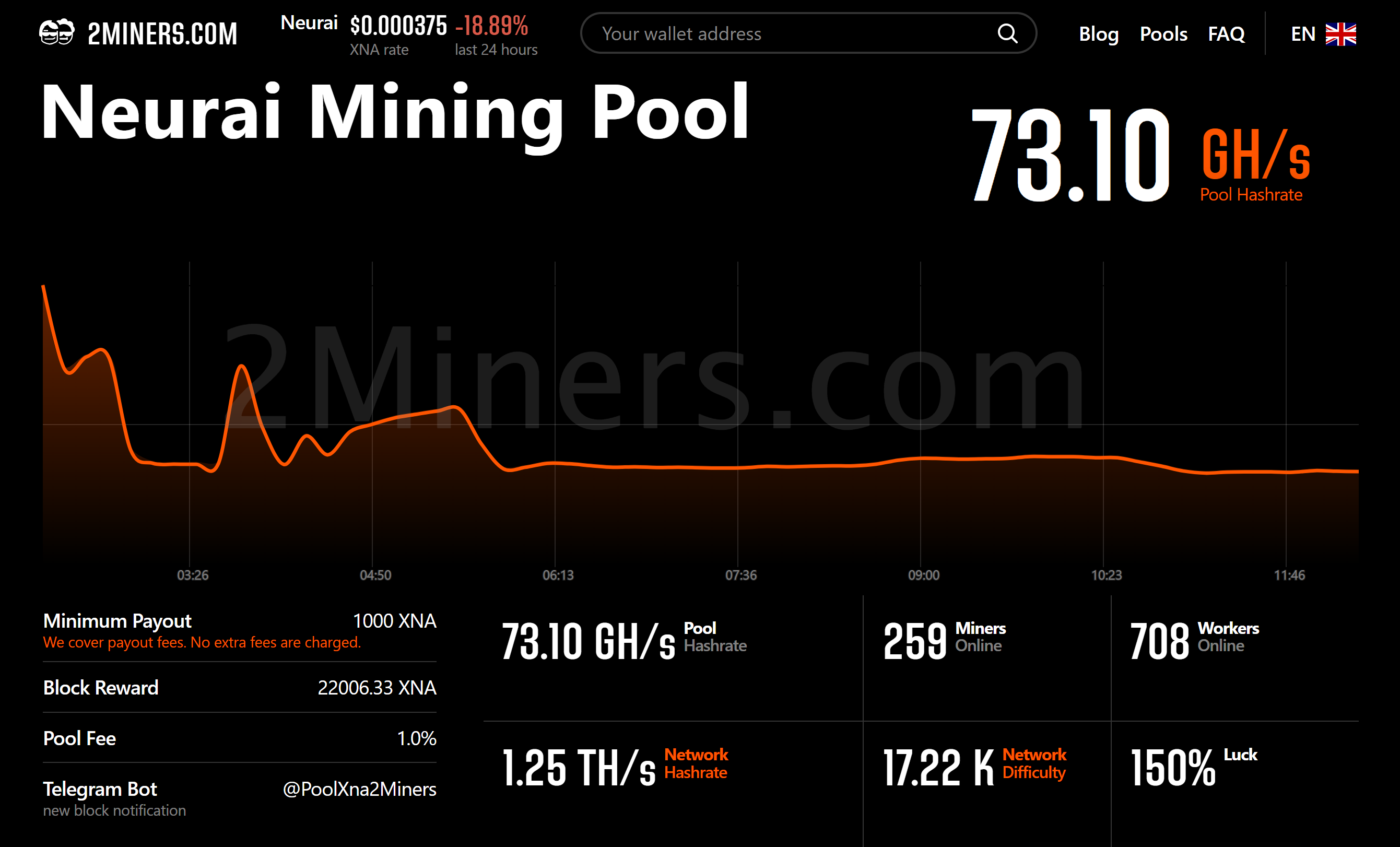
In September, 2Miners continued its tradition of expanding the list of supported cryptocurrencies by adding Neurai (XNA). This addition has allowed miners to tap into the potential of Neurai, both in regular pooling and solo modes. The coin operates on the KAWPOW algorithm, which has been gaining traction among various cryptocurrencies. The most prominent coin using the KAWPOW algorithm is Ravencoin (RVN), which is also available on 2Miners.
For those interested in the technical aspects of mining XNA, every detailed specification, miner setup guide, and profitability assessment can be found in our comprehensive post titled How to Mine Neurai with GPU: Specs, Miner Setup, and Profitability. We always strive to provide the mining community with the latest and most profitable options, and Neurai is just the latest addition in our commitment to this.
Callisto Delisting
In our continuous effort to provide only the most profitable and popular mining options to our users, we made the decision to delist Callisto (CLO) mining pools from 2Miners. This change took effect on September 11th at 06:00 UTC. For those seeking alternatives, we recommend using 2CryptoCalc.com to discover the best coins to mine, ensuring you get the most from your mining efforts.
Bitmain Antminer KS3 Settings
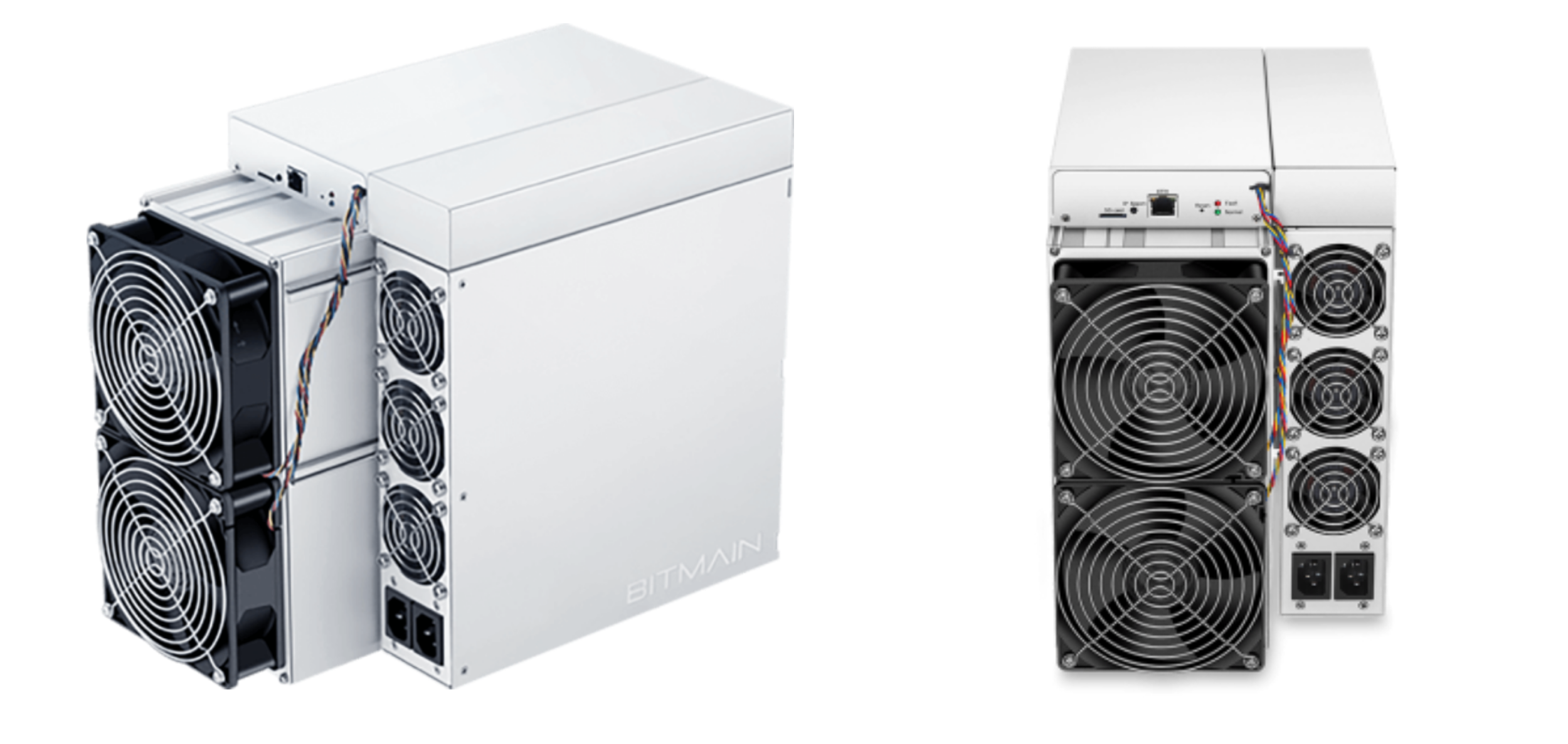
The ever-advancing world of cryptocurrency mining has seen the introduction of the Antminer KS3 ASIC Miner by Bitmain, a powerhouse in the mining world. Boasting an impressive hashrate of up to 9.4 TH/s, this machine draws 3500W to deliver its exceptional performance. Recognized as the priciest KAS miner in the market, the potential rewards justify its cost, with daily earnings exceeding $200 according to 2CryptoCalc.com.
For those utilizing the Antminer KS3 on 2Miners, we recommend using the high difficulty port.
For the pool, connect to:
stratum+tcp://kas.2miners.com:2323
For solo mining, use:
stratum+tcp://solo-kas.2miners.com:3535
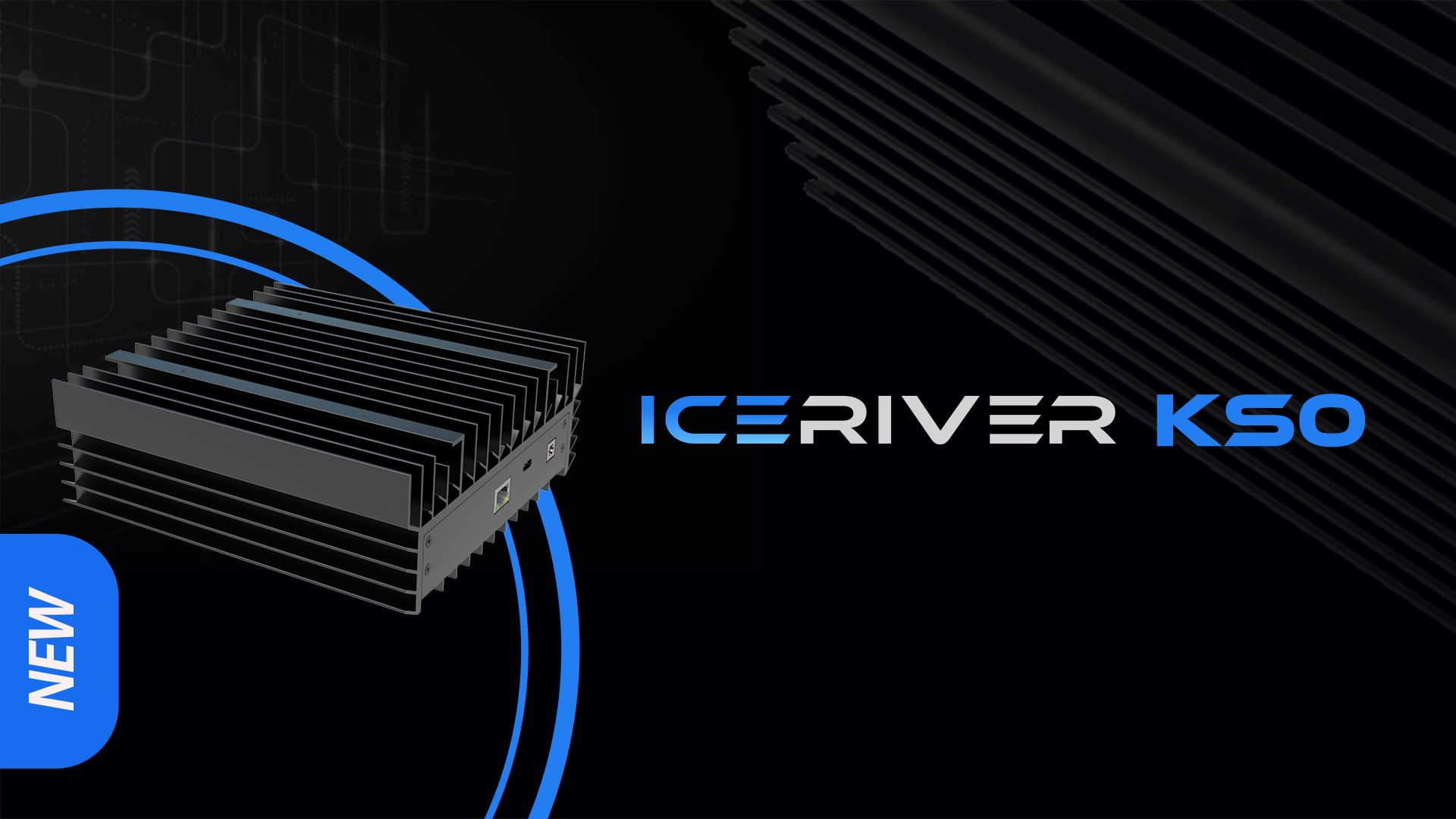
Kaspa maintains its position as one of the top coins to mine, making advancements in its hashrate crucial for miners aiming for maximum profitability. In line with this, a notable update has been launched for KS0, KS1, and KS2 Ice River Kaspa ASIC Miners: a new firmware that can boost the hashrate by an impressive 25%. However, miners should be aware that with increased performance comes heightened demands. Upgrading may necessitate enhanced cooling solutions and potentially a superior power supply unit, so it’s vital to approach the installation with caution.
For those ready to take the leap, the installation is straightforward. Users simply need to save the .bgz file and then upload it via the “Firmware Upgrade” section found on the dashboard. A quick reboot post-upload ensures smooth operations. The necessary firmware files are conveniently located in our Telegram Channel for each specific model:
To further optimize mining efforts, 2Miners has established specialized difficulty ports tailored to each miner:
KS0: stratum+tcp://kas.2miners.com:2121
KS1/KS2: stratum+tcp://kas.2miners.com:2222
Stay updated with our latest enhancements by following us on Twitter. We also invite you to be a part of our vibrant Telegram miner community. For our global audience, we have local chats available in Russian, Turkish, Spanish, and Chinese. Remember, we are always working to ensure your mining endeavors are successful.
The 2Miners pool co-founder, businessman, miner. In 2017 started mining cryptocurrencies and built many rigs on his own. As a result, he gained lots of practical knowledge and became interested in sharing it with others.
In his articles on 2Miners, he shares useful tips that he tried and tested himself. For example, Darek gives advice on how to buy hardware components for the basic mining rig and how to connect them to each other correctly. He also explained lots of complicated terms in simple words, such as shares, mining luck, block types, and cryptocurrency wallets. After the pool was launched, he published a series of articles ‘Crypto Mythbusters’ where he explained how to protect the network against 51% attack, talked about cryptocurrency mining difficulty and difficulties of launching your own node.
How to Mine Neurai with GPU: Specs, Miner Setup, and Profitability
September 4, 2023
Welcome to 2Miners’ latest addition: Neurai, also known as XNA. At 2Miners, we’re always on the lookout for promising cryptocurrencies that bring value to our community. Neurai is one such coin that has caught our attention.
What is Neurai (XNA)?
Neurai (XNA) represents the next wave of digital cryptocurrencies designed to enhance and simplify the transaction experience. At its core, Neurai is built upon principles of decentralization, ensuring that users are provided a platform that’s beyond the control of any single entity. But what truly makes Neurai stand out is its commitment to speed, efficiency, and scalability.
Neurai employs the ASIC-resistant KAWPOW mining algorithm, a move that upholds the spirit of fairness in the crypto world. This choice of algorithm ensures that both individual miners and large mining operations have an even playing field, preventing any monopolization of mining power. Neurai claims to be not just another cryptocurrency but a thoughtful response to the needs of today’s crypto enthusiasts. More information about Neurai could be found on their official website.
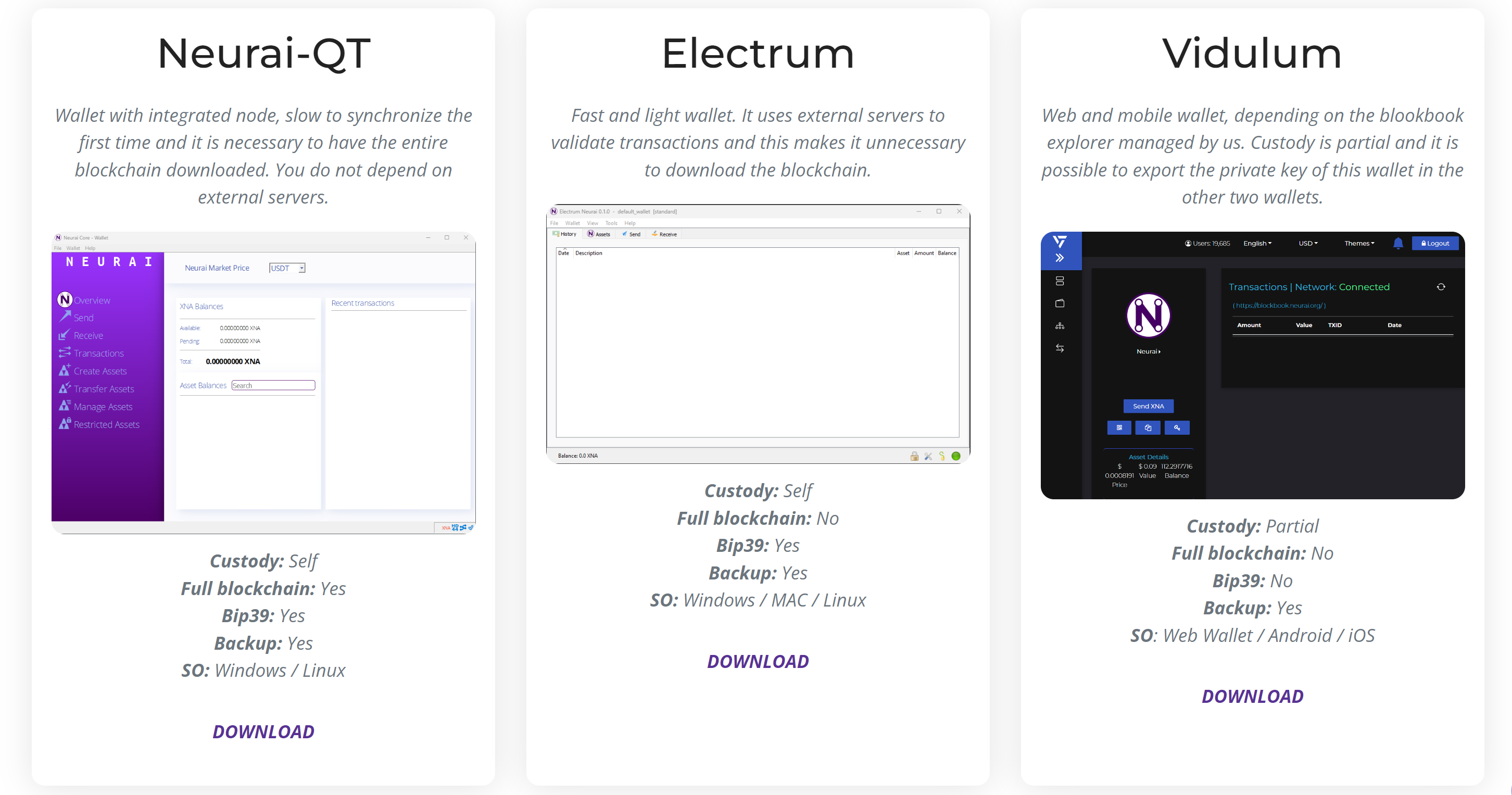
Keep Your XNA Safe: Neurai Wallet Choices
Before you start mining, you need to have a place to store your XNA. Here are your options:
Official Neurai Wallet: This is the recommended choice for storing XNA. Designed specifically for Neurai, this wallet offers you maximum security.
Electrum:This wallet is less secure but you do not need to download the complete Neurai blockchain.
Exchanges or Vidulum Wallet: With Neurai gaining traction, many exchanges are now supporting it. One notable example is CoinEx, where you can easily generate an XNA address.
Trading Neurai: Exchanges and Price Info
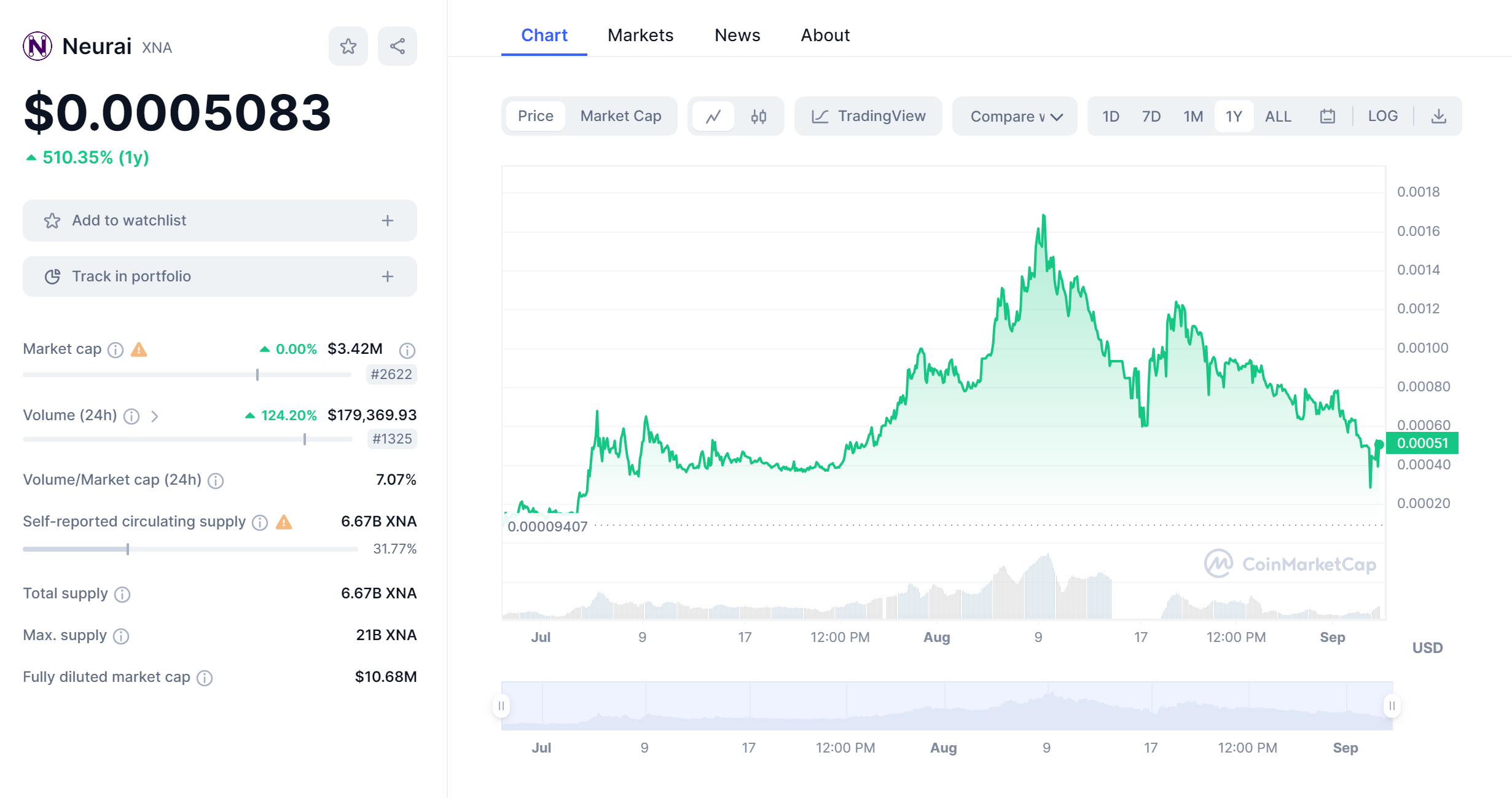
The value of any cryptocurrency changes based on market conditions, demand, and several other factors. For updated info on Neurai’s price and market performance, websites like CoinMarketCap are a great resource.
Current Price: As of now, 1 XNA is valued at $0.0005083.
Total Supply: The circulating amount of Neurai is 6.67B XNA.
Maximum Supply: Neurai has a capped supply of 21B XNA, ensuring scarcity and potential value appreciation in the long run.
Market Position: With its current CoinMarketCap ranking at #2639, Neurai is still in its early stages of market adoption.
Getting Started with Neurai Mining
XNA is a Proof-of-Work cryptocurrency so the new coins are created and added to the network thanks to the mining process. Neurai uses the KAWPOW algorithm, which is also used by Ravencoin. The reason for using KAWPOW is simple: it’s designed to keep mining fair. By being resistant to ASIC miners, KAWPOW ensures that everyone has an equal chance of earning XNA coins, regardless of their setup.
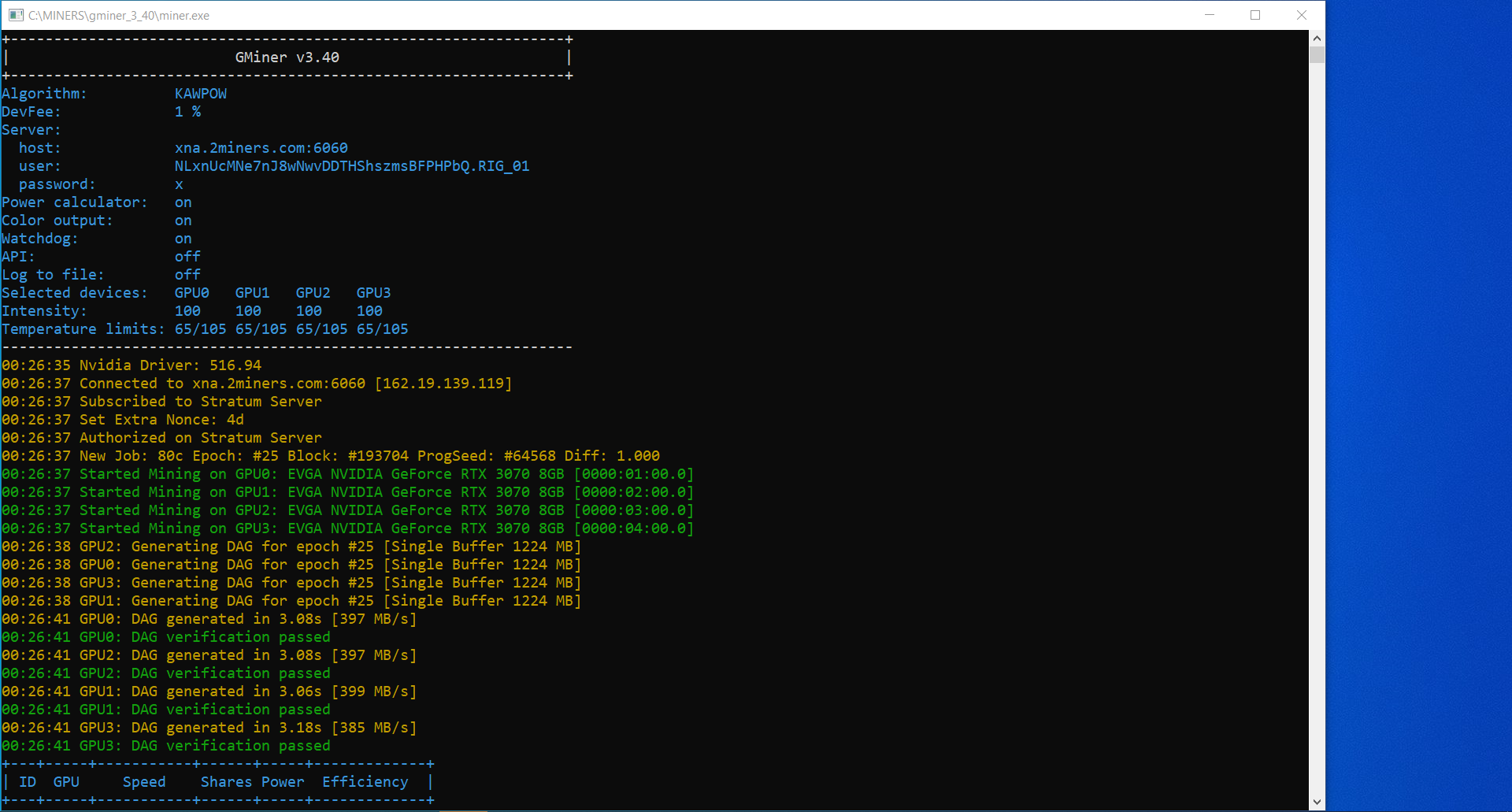
Setting up your miner to work with 2Miners is easy. Here are the details you need for GPU-mining. Use xna.2miners.com:6060 to mine in the pool with other miners and solo-xna.2miners.com:7070 to mine Solo. If in doubt always use pool mining option.
Settings for Gminer: miner.exe --algo kawpow --server xna.2miners.com:6060 --user NihAfZynHrTtYPH8ZSUEhLSCVMstLSV5qN.RIG_ID
Settings for T-Rex: t-rex.exe -a kawpow -o stratum+tcp://xna.2miners.com:6060 -u NihAfZynHrTtYPH8ZSUEhLSCVMstLSV5qN.RIG_ID -p x
When you start mining you see shares being accepted in your mining software and on 2Miners.com.
Please remember to substitute NihAfZynHrTtYPH8ZSUEhLSCVMstLSV5qN with your wallet address. RIG_ID is the arbitrary name of your mining rig. It is used only to show your statistics on 2Miners website.
XNA Nicehash Mining
Neurai uses KAWPOW mining algorithm supported by Nicehash mining rental service. These are the XNA mining settings if you rent the Nicehash hashrate. Please remember that you could always double-check the settings on XNA Help Page.
Custom pool name: 2Miners XNA
Algorithm: KAWPOW
Stratum hostname or IP: xna.2miners.com
Port: 6161
Username: YOUR_WALLET_ADDRESS
Password: x
For SOLO mining use
Stratum hostname or IP: solo-xna.2miners.com
Port: 7171
XNA Mining on HiveOS and RaveOS
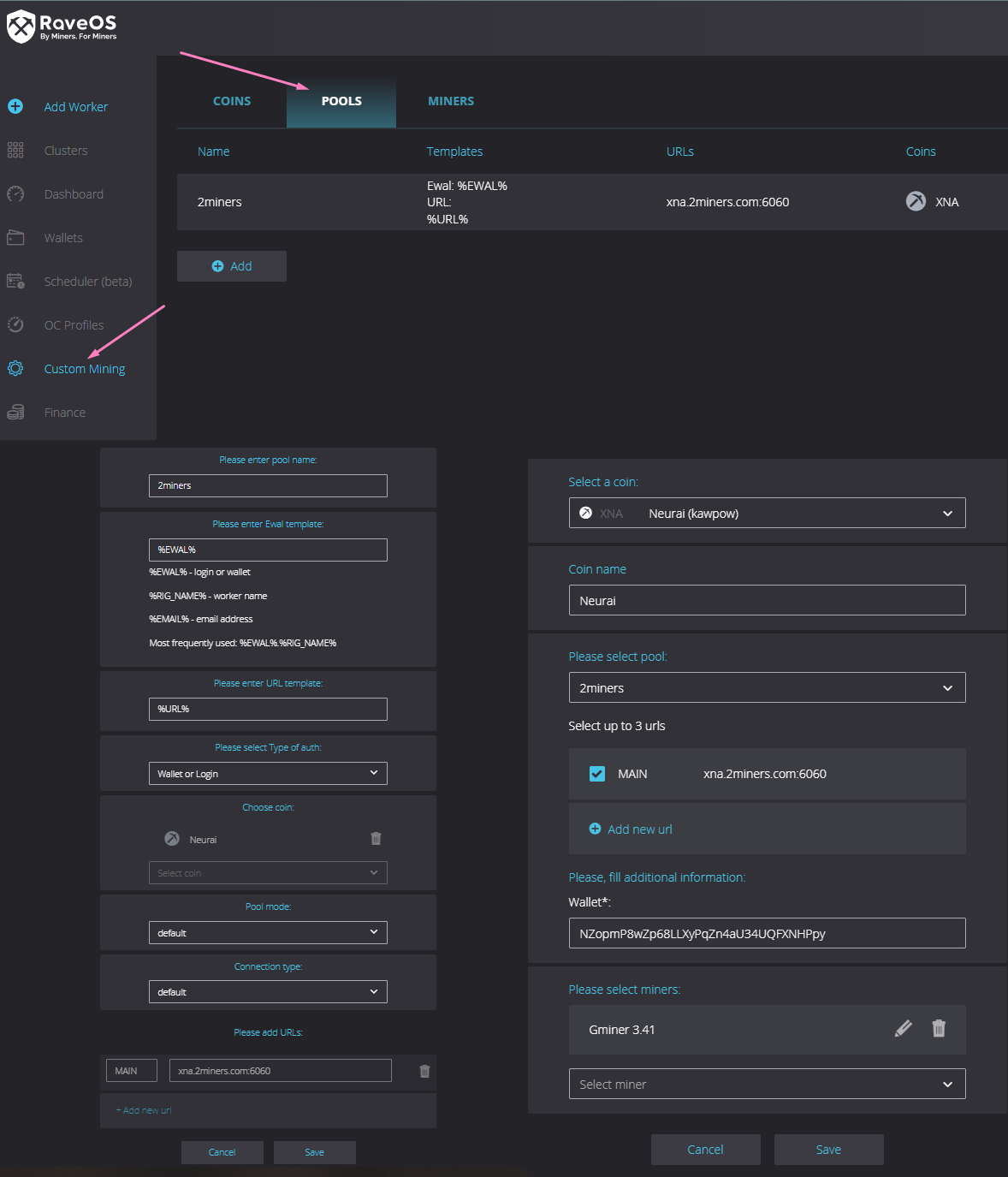
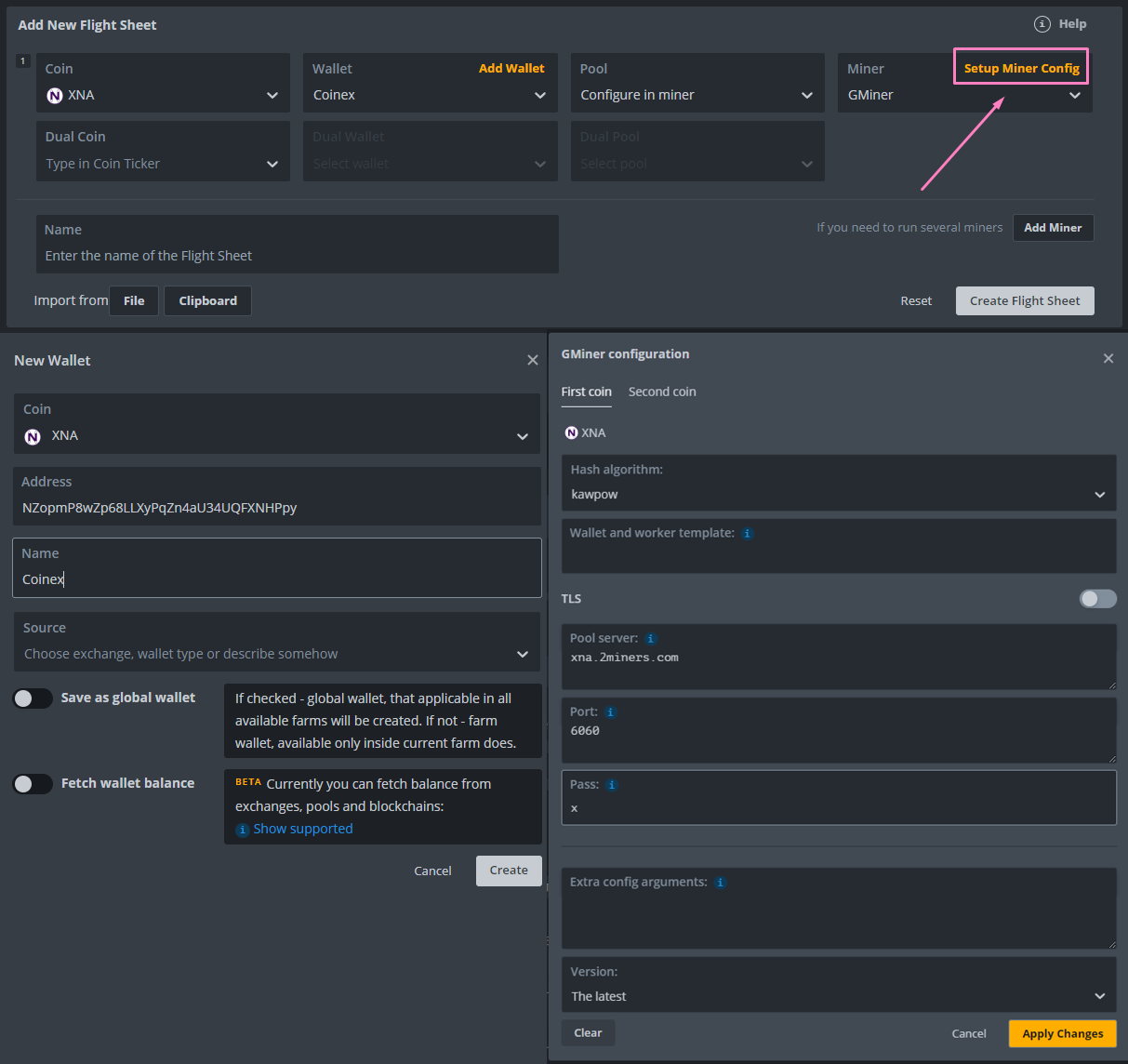
HiveOS and RaveOS are specialized operating systems tailored for the needs of cryptocurrency miners. HiveOS, a Linux-based platform, offers a central dashboard with robust capabilities like overclocking tools and remote management, making it one of the community favorites for managing multiple mining rigs.
On the other hand, RaveOS delivers an intuitive interface suitable for both newcomers and seasoned miners, facilitating smooth rig monitoring and management. For enthusiasts looking to mine Neurai (XNA), the good news is that both of these platforms support XNA mining, making the process streamlined and efficient. Whether you’re using HiveOS or RaveOS, you can take advantage of their features to optimize your XNA mining operations.
Check the screenshot below for RaveOS Setup.
Check the screenshot below for HiveOS Setup.
Neurai (XNA) Mining Profitability
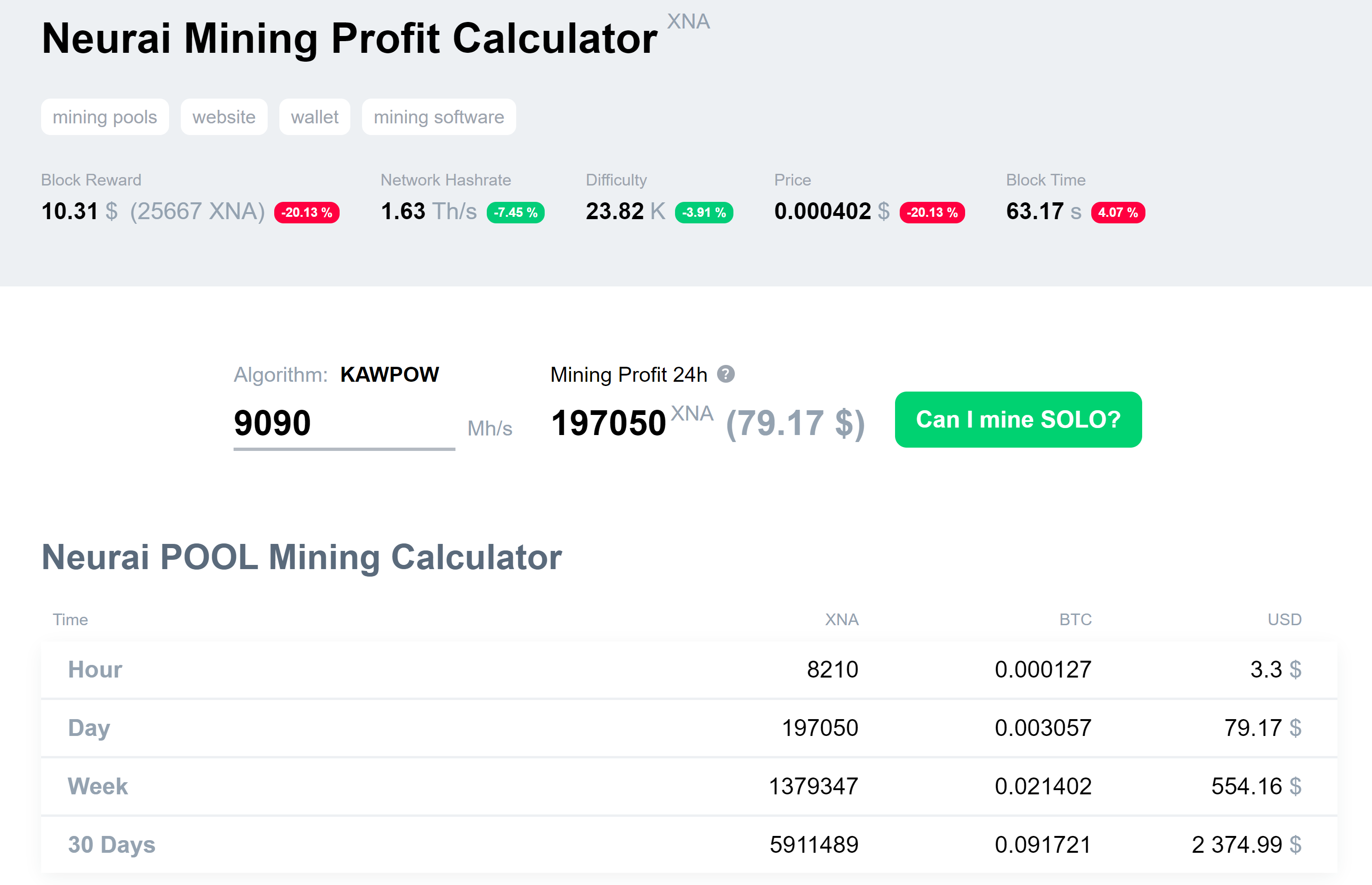
Mining profitability is a crucial aspect to consider for any miner, and when it comes to Neurai (XNA), the potential returns can vary based on factors like hardware efficiency, electricity costs, and market prices. To get a comprehensive and up-to-date understanding of XNA mining profitability use 2CryptoCalc. This profitability calculator allows users to input their specific rig details and calculate potential returns, providing a clearer picture of potential earnings.
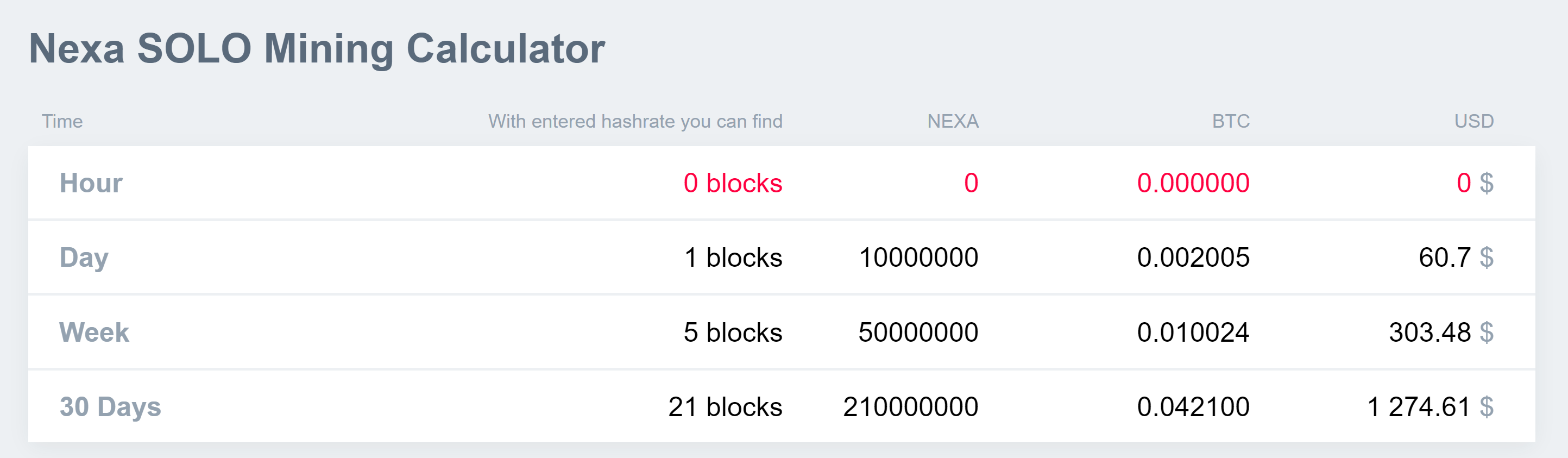
If you want to check you chances in XNA SOLO mining visit the Neurai page on 2CryptoCalc. Enter your hashrate and check how many Neurai blocks you could get daily. If the estimation is less than 1-2 blocks, we do not recommend you SOLO mining.
When it comes to payouts, 2Miners supports only XNA coins for Neurai mining. This means you can’t get payouts in BTC or other coins. Make sure your wallet is set up to receive XNA.
Adding Neurai to 2Miners is a step forward in our mission to offer the best mining opportunities to our community. We believe in the potential of Neurai and encourage our miners to explore this new opportunity. As always, we’re here to help if you have questions or need support. Follow us on Twitter or join our Telegram Chat. Happy mining!
The 2Miners pool co-founder, businessman, miner. In 2017 started mining cryptocurrencies and built many rigs on his own. As a result, he gained lots of practical knowledge and became interested in sharing it with others.
In his articles on 2Miners, he shares useful tips that he tried and tested himself. For example, Darek gives advice on how to buy hardware components for the basic mining rig and how to connect them to each other correctly. He also explained lots of complicated terms in simple words, such as shares, mining luck, block types, and cryptocurrency wallets. After the pool was launched, he published a series of articles ‘Crypto Mythbusters’ where he explained how to protect the network against 51% attack, talked about cryptocurrency mining difficulty and difficulties of launching your own node.
August 2023 Work Progress Report: Enhanced KASPA Pool Optimization, BTC Payouts for Nexa
September 1, 2023
In August, the 2Miners team continued to innovate, focusing on optimizing the mining experience for our users. We are delighted to share the significant advancements we’ve made, from the expansion of our payout options for Nexa to further improvements in our Kaspa mining operations.
Introducing Bitcoin Payouts for Nexa
In our commitment to offering flexible and versatile solutions for our miners, we’ve enabled Bitcoin payouts for those mining Nexa. Instead of using your Nexa wallet address, simply use your Bitcoin address to receive rewards in BTC. We’re pleased to confirm that any Bitcoin address format, be it SegWit, Compatibility, or Legacy, is compatible. Even a BTC address created on a cryptocurrency exchange will work seamlessly.
Both our Pool and Solo mining options support this new payout method. Detailed instructions and examples, including the miner setup, can be found on our help pages:
For instance, here’s a sample configuration for lolMiner: lolMiner.exe --algo NEXA --pool nexa.2miners.com:5050 --user bc1qnkyhslv83yyp0q0suxw0uj3lg9drgqq9c0auzc
Update on KASPA (KAS) Mining Rewards
Staying in line with the KASPA Emission Schedule, the KASPA block mining reward has undergone a change. Previously set at 195.99 KAS per block, the reward is now adjusted to 184.99 KAS. We urge all our miners to take note of this important development. To make informed decisions, you can always refer to the updated 2CryptoCalc Mining Profitability Calculator.
Major Kaspa Mining Enhancements
Optimized Performance for All Kaspa Miners
We’ve made substantial improvements to our Kaspa mining infrastructure, with a focus on enhanced performance and minimizing rejected shares. For miners using the Ice River and Bitmain Kaspa ASIC devices, the rejection rates have been reduced to almost zero, down from the earlier 2-3%. This refinement benefits both premium and standard ASICs, ensuring that mining on 2Miners provides optimal results.
Specific Ports Designed for Each Miner
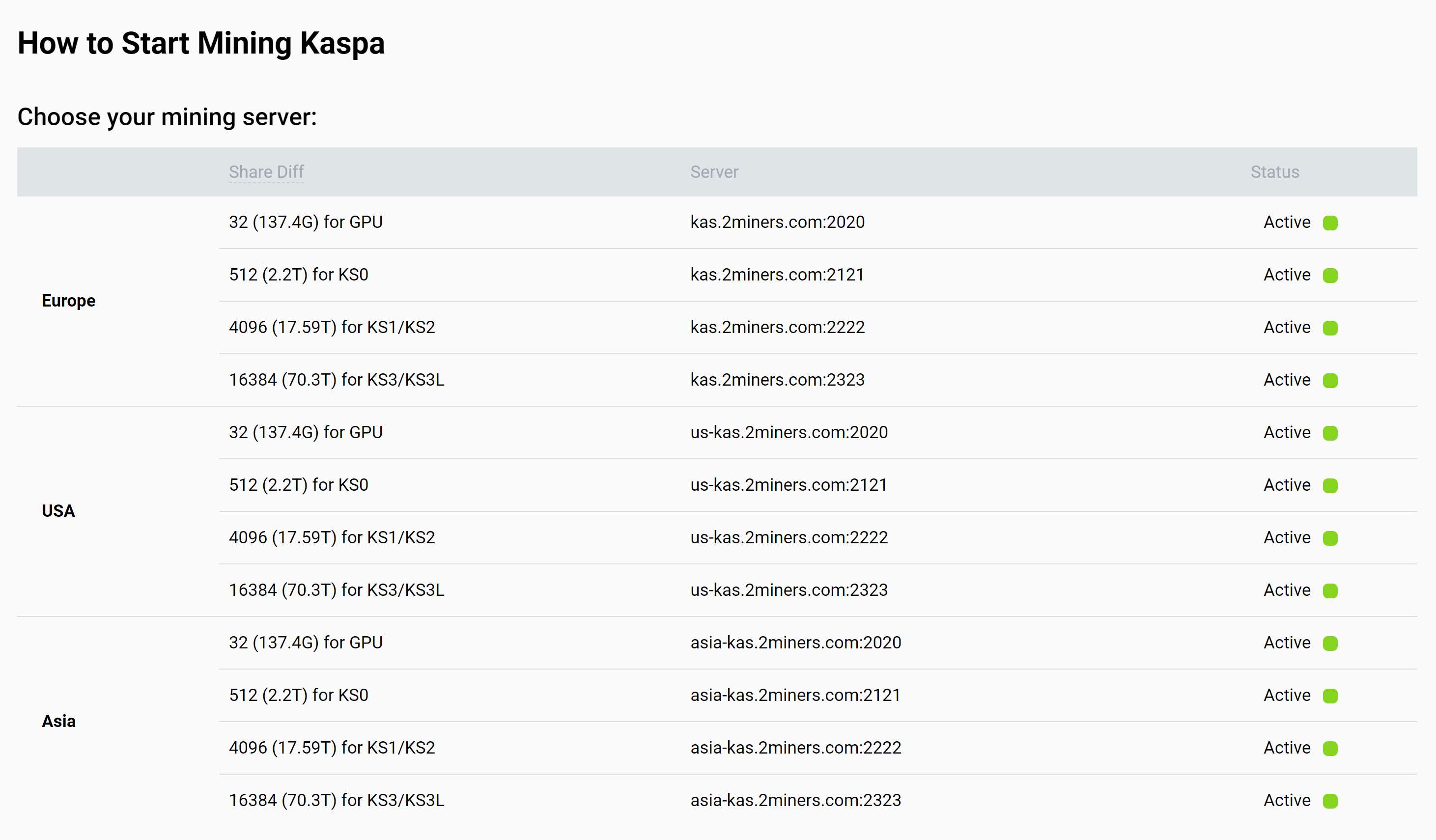
Understanding the unique requirements of different mining setups, we’ve launched multiple dedicated ports to cater to GPUs and various Ice River ASIC models (including KS0, KS1/KS2, and KS3) and Bitmain KS3. Here’s a breakdown of our optimized configuration:
32 (137.4G) for GPU miners
512 (2.2T) for Ice River KS0 devices
4096 (17.59T) for Ice River KS1 and KS2 devices
16384 (70.3T) for Ice River KS3 and KS3L, and Bitmain KS3
This dedicated approach ensures every miner gets the best out of their equipment, maximizing profitability. And the best part? These configurations are available across all our global server locations: Europe, the USA, and Asia. For a deeper dive into these updates, visit our comprehensive Kaspa Help Page.
Continue to stay engaged with our updates and innovations by following us on Twitter. We also welcome you to join our miner community in Telegram or one of the local chats in Russian, Turkish, Spanish, and Chinese. Your success as a miner is always at the forefront of our efforts.
The 2Miners pool co-founder, businessman, miner. In 2017 started mining cryptocurrencies and built many rigs on his own. As a result, he gained lots of practical knowledge and became interested in sharing it with others.
In his articles on 2Miners, he shares useful tips that he tried and tested himself. For example, Darek gives advice on how to buy hardware components for the basic mining rig and how to connect them to each other correctly. He also explained lots of complicated terms in simple words, such as shares, mining luck, block types, and cryptocurrency wallets. After the pool was launched, he published a series of articles ‘Crypto Mythbusters’ where he explained how to protect the network against 51% attack, talked about cryptocurrency mining difficulty and difficulties of launching your own node.
July 2023 Work Progress Report: New Coin Nexa, Kaspa Geo Servers
August 1, 2023
Nexa coin pool released, multiple updates for Kaspa pool to improve the miners’ performance, mining software updates.
Nexa in 2Miners
In July, we expanded our mining pool options at 2Miners by introducing Nexa. This innovative cryptocurrency quickly became popular among miners, consistently ranking as one of the top profitable coins according to our mining profitability calculator at 2CryptoCalc.com.
At 2Miners, we aim to provide the best mining experience, offering both PPLNS and SOLO mining options for Nexa. As of now, payouts are exclusively available in NEXA, but we’re excited to announce that we’re gearing up to launch BTC payouts for NEXA miners in the upcoming weeks. This step aims to increase flexibility for our miners, catering to diverse payout preferences.
For additional details on mining Nexa, we’ve curated a comprehensive guide – How to Mine Nexa with GPU: Mining Settings and Profitability. This blog post gives you all the information you need about Nexa mining, covering everything from mining settings to how profitable it can be.
Kaspa Mining Updates
US and Asia Kaspa Servers
In our continuous efforts to enhance your mining experience on 2Miners, we’ve made several significant updates to our Kaspa (KAS) mining operations this month.
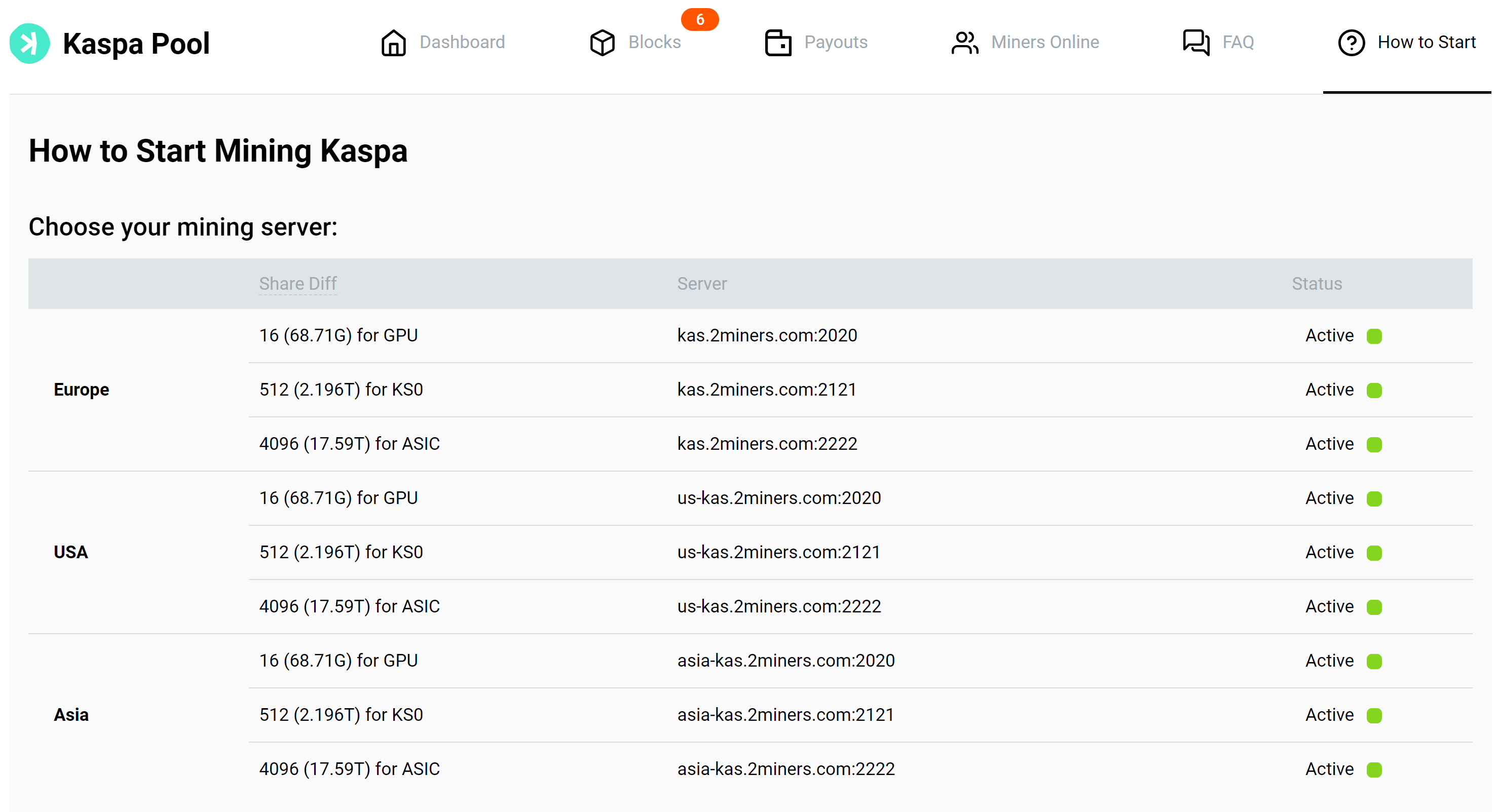
We expanded our global presence by launching servers in Asia and the US. Now, no matter where you are in the world – Europe, America, or Asia, we’ve got you covered. All our server locations are easily accessible and listed on both Kaspa mining pool main page and the Help page.
Best Mining Pool for Ice River KS0
We deployed a specific port tailored for Ice River KS0 miners. The dedicated server addresses are:
Europe: kas.2miners.com:2121
US: us-kas.2miners.com:2121
Asia: asia-kas.2miners.com:2121
This upgrade meets the specific needs of Ice River KS0 miners, ensuring optimal performance and efficiency. Miners in our Telegram chat have noted that with the new port, they see as low as 1% invalid shares. This is beneficial as it results in higher rewards due to the improved operation of their mining devices.
We also remind KS0 owners that 2Miners offers a unique advantage as we provide the flexibility to choose your preferred payment method. You can opt for payouts in either KAS or BTC while mining Kaspa. Start mining Kaspa.
KAS Block Reward Reduction
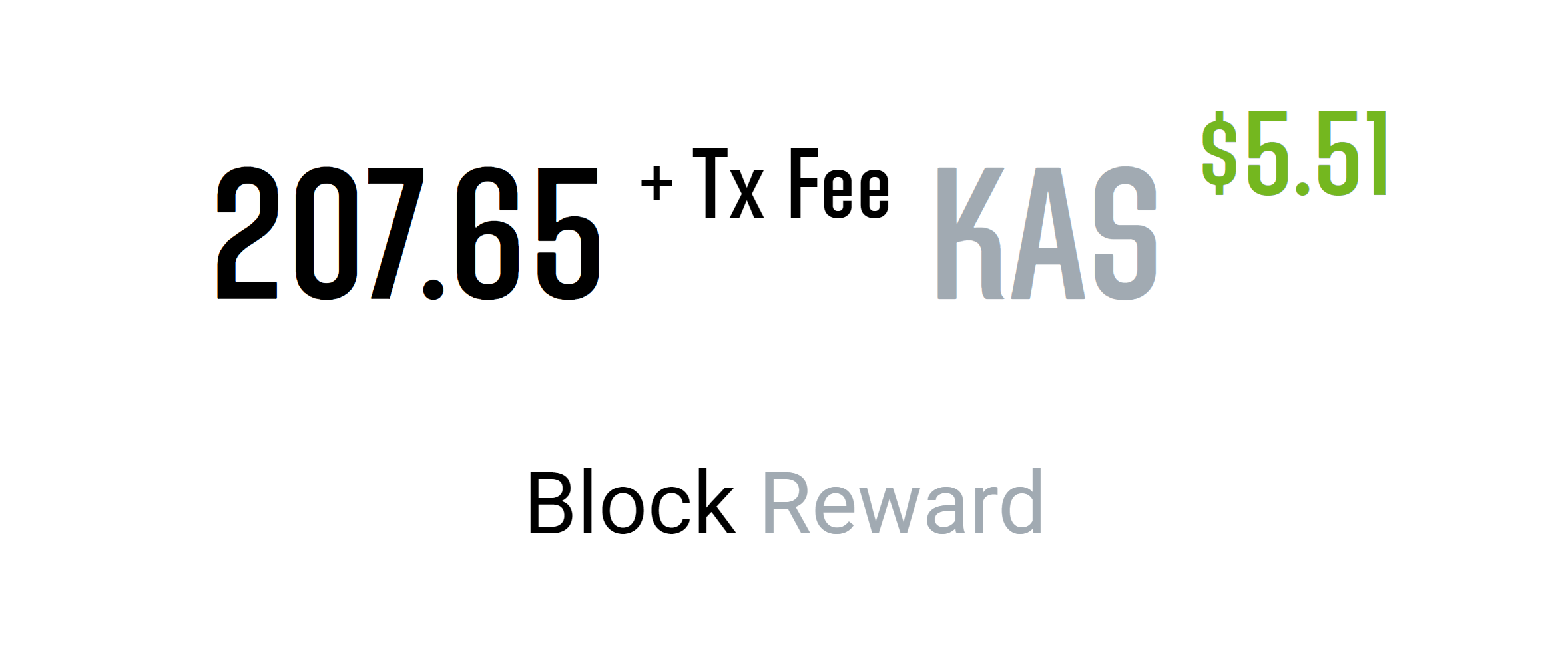
KASPA block reward decreased again in July, as planned in the KASPA Emission Schedule. The block reward has been reduced from 207.65 KAS to 195.99 KAS per block. We’ve updated the 2CryptoCalc mining profitability calculator accordingly, so you can plan your mining activities with the most recent data.
ERG and NEOX Reward Reduction
The ERGO (ERG) reward underwent a reduction recently. As per the Ergo emission schedule, the block reward for miners has been decreased from 39 ERG to 36 ERG. We advise miners to stay updated with these changes.
In the same vein, NEOXA (NEOX) has also experienced a reward reduction. With the activation of Smartnodes in the NEOXA network starting from block 622500, the block reward has been distributed between miners and smartnodes. As a result, the miner’s reward per block has been reduced to 2250 NEOX. More information regarding this change can be found on their Twitter. Please take note of these changes!
The 2CryptoCalc mining profitability calculator has been updated to reflect the new NEOX and ERG rewards.
New Mining Software
Our Quick Start Archive on 2Miners, which hosts all the necessary mining software for coins available in 2Miners pools along with ready-to-use bat-files, has received some updates. Users only have to change these bat-files by adding their personal wallet address. This makes the whole setup process much easier and faster.
The 2Miners pool co-founder, businessman, miner. In 2017 started mining cryptocurrencies and built many rigs on his own. As a result, he gained lots of practical knowledge and became interested in sharing it with others.
In his articles on 2Miners, he shares useful tips that he tried and tested himself. For example, Darek gives advice on how to buy hardware components for the basic mining rig and how to connect them to each other correctly. He also explained lots of complicated terms in simple words, such as shares, mining luck, block types, and cryptocurrency wallets. After the pool was launched, he published a series of articles ‘Crypto Mythbusters’ where he explained how to protect the network against 51% attack, talked about cryptocurrency mining difficulty and difficulties of launching your own node.
How to Mine Nexa with GPU: Mining Settings and Profitability
July 10, 2023
This article is about Nexa mining and the techniques you need to know for mining this cryptocurrency using your GPU. We will look at the details of the mining process and the cryptocurrency wallets available for Nexa. We’ll also discuss the potential rewards for those who participate in mining Nexa. Whether you’re new to mining or an experienced miner, this guide can help you understand how to get the most out of Nexa mining.
Introduction to Nexa Cryptocurrency
Nexa is an emerging cryptocurrency mined on the graphics cards. Leveraging an innovative approach to the Proof of Work hashing algorithm known as NexaPoW or NexScalePoW, Nexa’s blockchain offers a unique blend of SHA256 hashing and Schnorr signature creation.
Nexa’s main focus is to significantly enhance network capacity and computational strength. One of the remarkable features of Nexa is its ASIC-resistance. This characteristic ensures a fair mining environment by reducing the risk of centralization. The NexaPoW algorithm encourages widespread participation, as individuals and entities can help secure the network with the possibility of earning NEXA tokens.
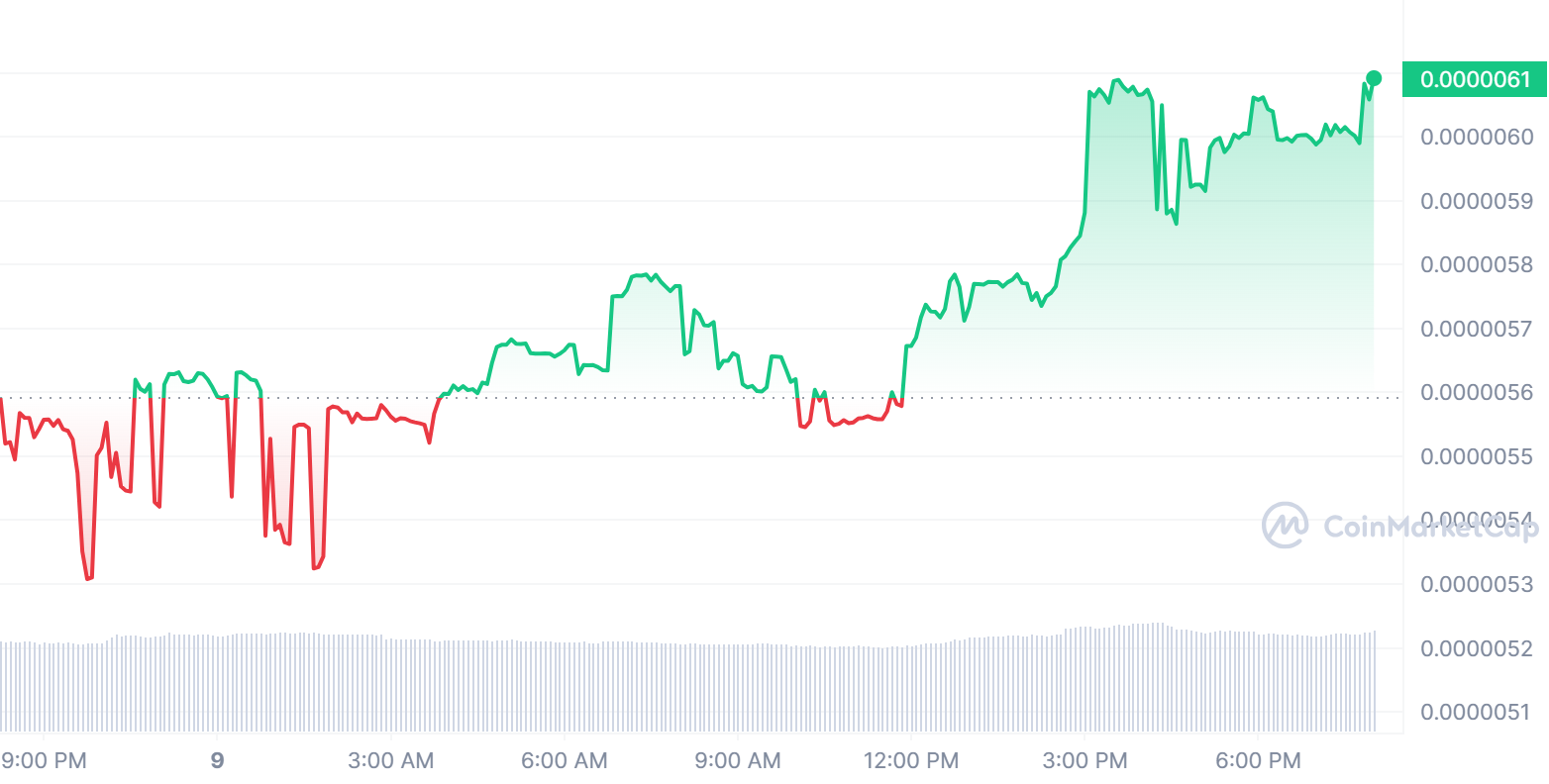
As of now, the live Nexa price stands at $0.000006 USD, with a 24-hour trading volume of $281,187 USD. Currently, Nexa ranks #704 on CoinMarketCap. It has a max. supply of 21,000,000,000,000 NEXA coins. Nexa is presented on many cryptocurrency exchange platforms including BitMart, MEXC, CoinEx, Txbit, and SafeTrade.
Which Nexa Wallet to Choose
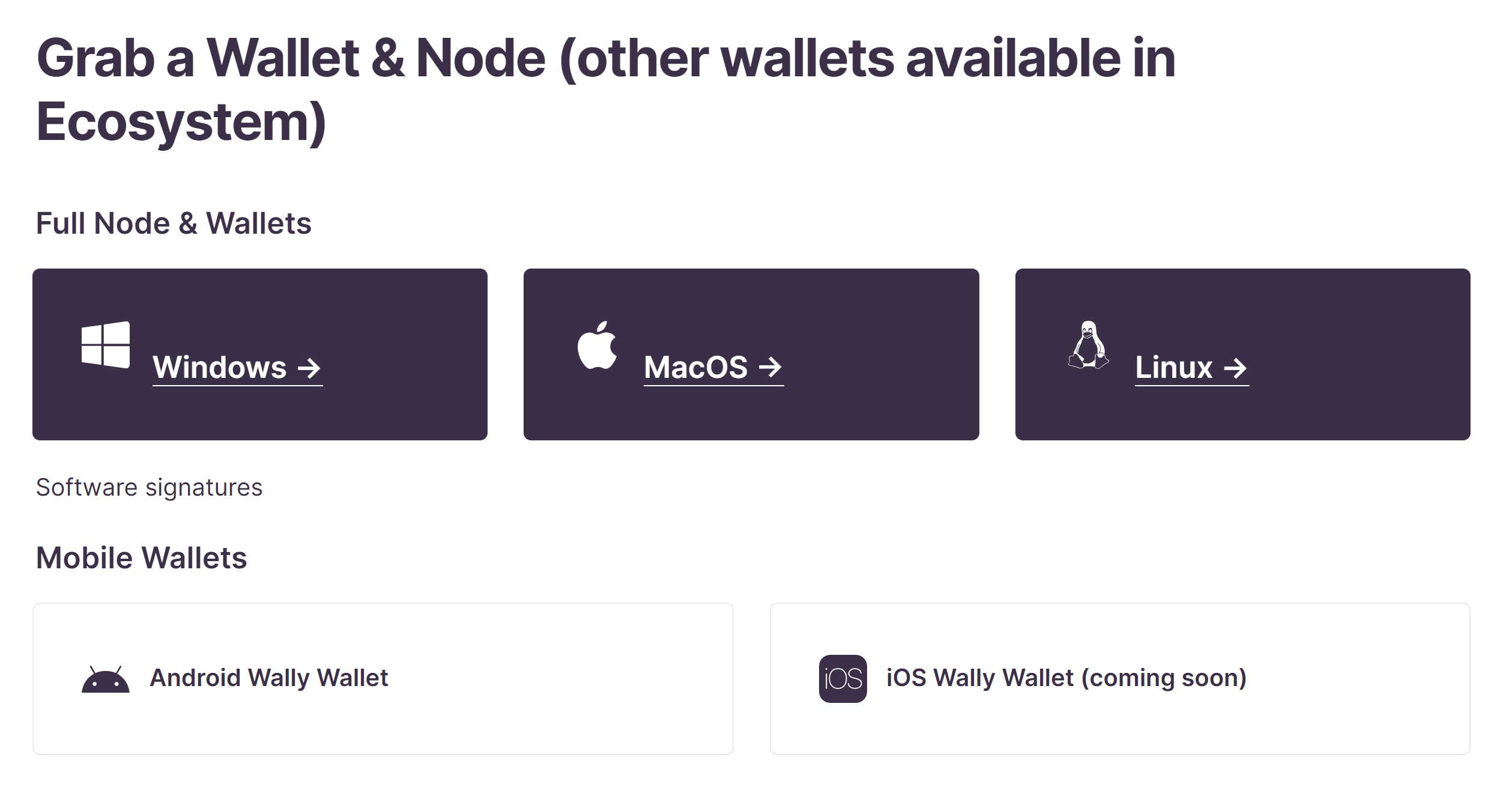
We strongly advise you to use the official Nexa wallet which includes a complete copy of the blockchain. This provides you with full control over your keys and subsequently, your Nexa coins. Having this full node wallet ensures you are directly interacting with the blockchain, providing optimal security, privacy, and trustless assurance. The rule to remember is not your keys – not your coins.
While a Nexa address can also be generated on a cryptocurrency exchange such as MEXC, keep in mind that this means your coins will be stored on the exchange’s wallet. You do not own the private keys to that wallet, and this can potentially expose your funds to risks, including the exchange being hacked or going offline.
The Android wallet for Nexa is available as well, offering mobility and accessibility for Android users. The iOS version is currently under development and will be available soon to accommodate the needs of iPhone users.
How to Set Up Nexa Mining
The Nexa mining algorithm is still protected from ASIC devices. This means that Nexa mining can be performed using only video cards. The most popular mining software for Nexa is lolMiner and rigel. You can also rent hashing power from Nicehash, as this platform supports the NexaPoW algorithm. At 2Miners, we have two ports with different share difficulties. One is for GPU mining, and the other is for Nicehash.
The ready-to-go bat-files could be always found in our Quick Start Archive. Use “2miners” as a password.
Mine Nexa and Get Paid in Bitcoin
In addition to Nexa wallets, you have the flexibility to use any Bitcoin wallet for your mining activities on the 2Miners pool. For coins such as ZEC, ETC, RVN, ERG, KAS, and NEXA, 2Miners allows miners to receive their rewards directly in BTC. To take advantage of this feature, simply provide your BTC wallet address in your mining software settings instead of the NEXA wallet address. All types of Bitcoin addresses are accepted, whether they be SegWit, Compatibility, or Legacy. Furthermore, BTC addresses created on cryptocurrency exchanges are fully compatible, enabling even more ease and versatility for your mining rewards management. Read more in our post Get Paid in Bitcoin for Altcoin Mining.
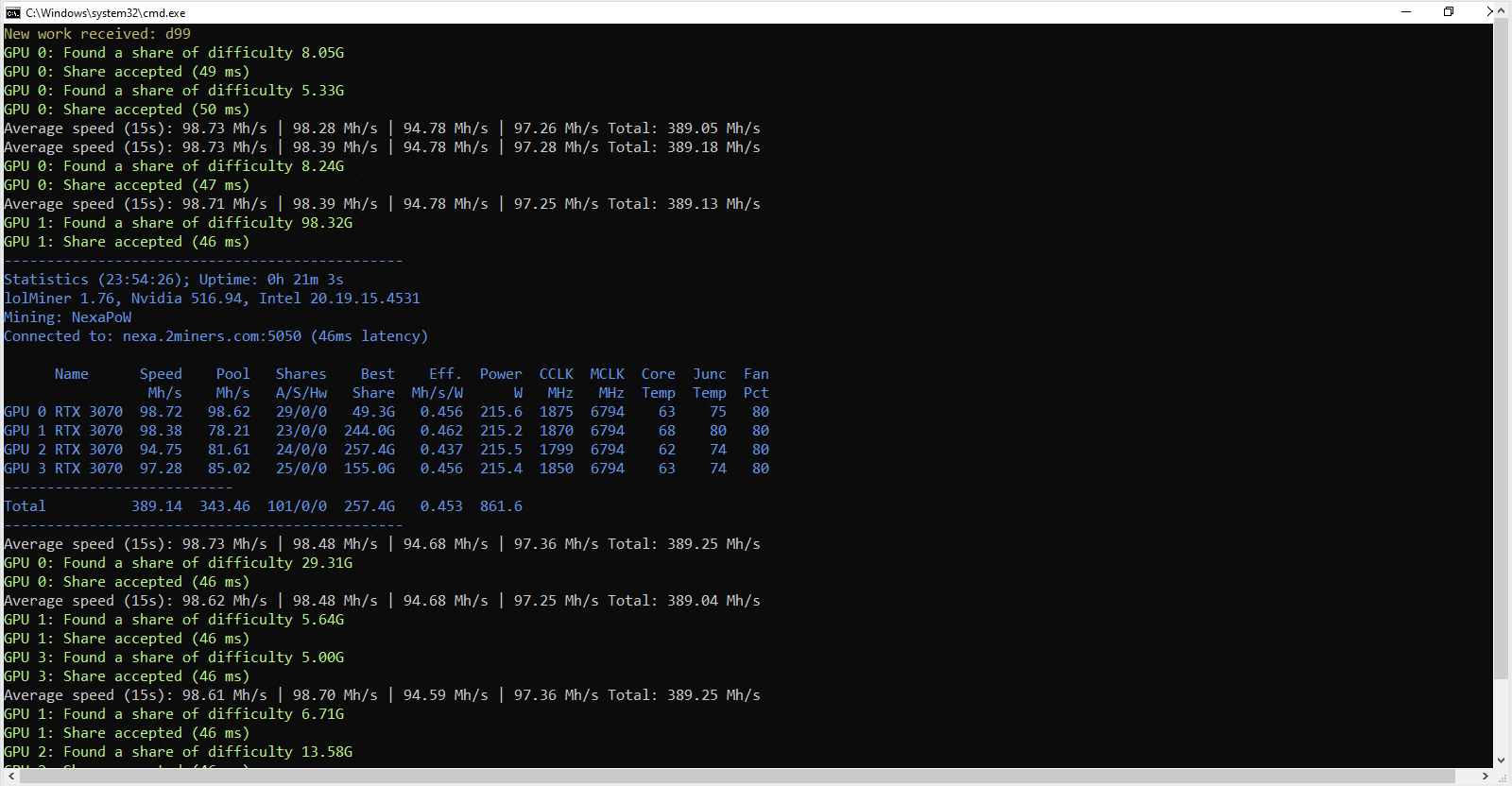
Nexa Mining with lolMiner
Use the setting below. Substitute YOUR_WALLET_ADDRESS with your Nexa or BTC wallet. For example nexa:nqtsq5g5szgc9uu9rck2vhjh2vux06ep07fscng86t03rkxd. Note that it should have the nexa: part in the front. You could also use the Bitcoin wallet address, for example bc1qnkyhslv83yyp0q0suxw0uj3lg9drgqq9c0auzc.
The RIG_ID could be substituted by any name of the rig you want. It is shown in miner’s statistics page. This field is not mandatory. You could leave it empty. Length of RIG_ID – Maximum 32 characters. Use English letters, numbers and symbols “-” and “_”.
When you run the bat-file you see the shares are being sent to the pool.
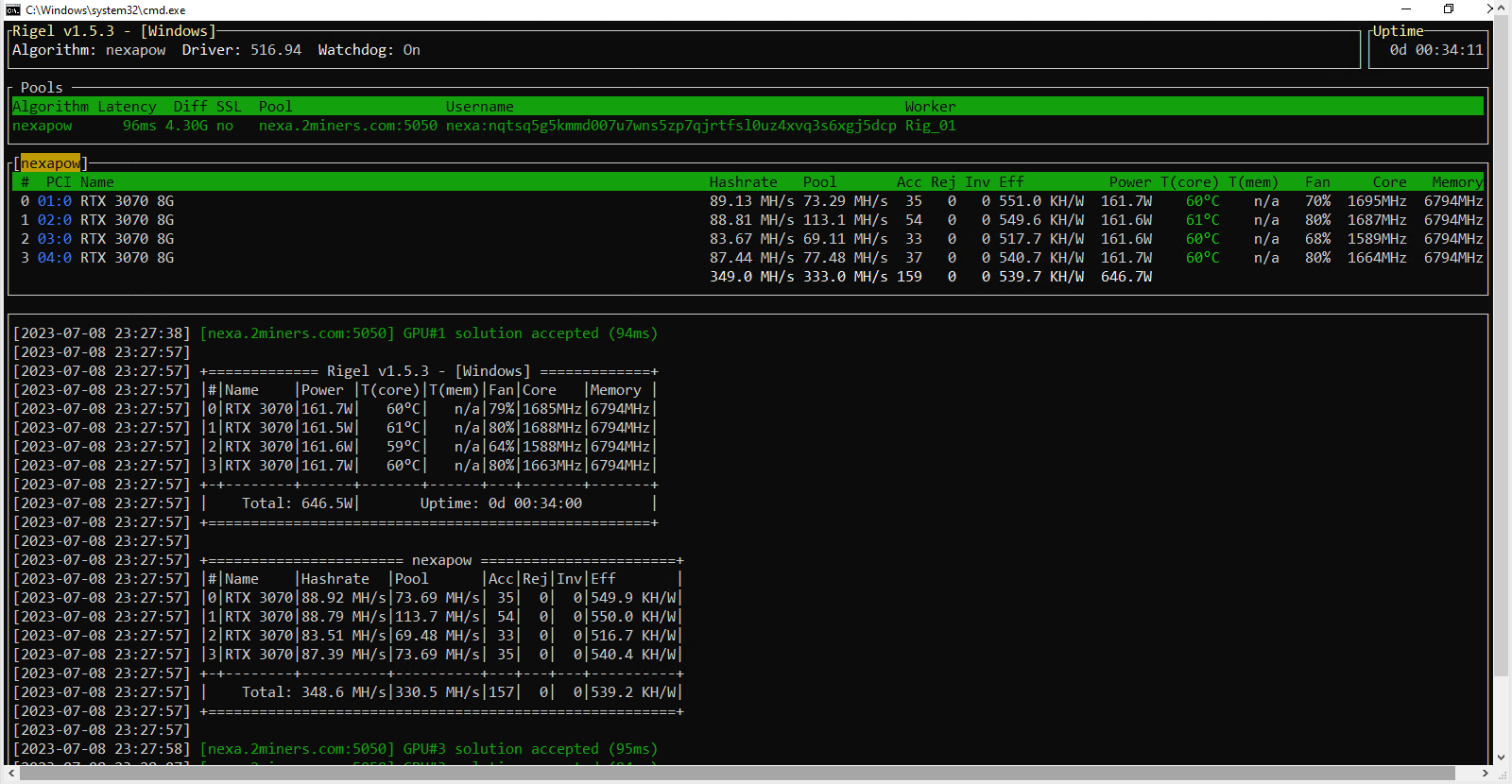
Nexa Mining with Rigel
Rigel is the young and promising mining software. It shows a great performance on NexaPoW as well. Please find the settings below and don’t forget to specify your wallet address.
rigel.exe -a nexapow -o stratum+tcp://nexa.2miners.com:5050 -u YOUR_WALLET_ADDRESS -w RIG_ID
Rigel has a slightly different interface. If all goes well you see the Solution accepted phrase.
Nexa Mining with Nicehash
Custom pool name: 2Miners NEXA

Algorithm: NexaPow

Stratum hostname or IP: nexa.2miners.com

Port: 5151

Username: YOUR_WALLET_ADDRESS

Password: x
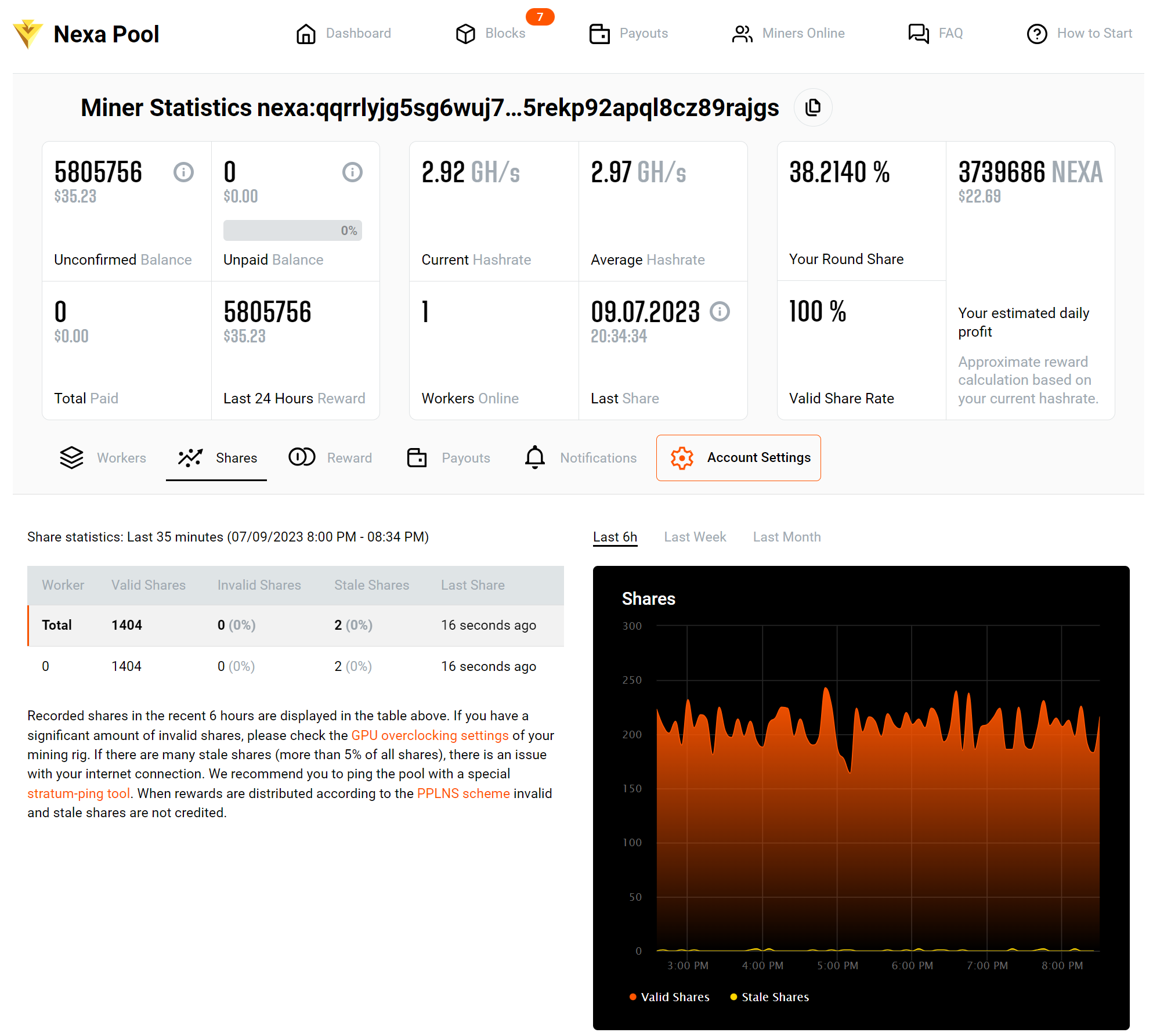
Whether you’re using GPUs or Nicehash, as soon as you start mining and send the first share to the pool, you’ll be able to see the statistics. Simply paste your wallet address in the search field at the top of the 2Miners.com website.
For Nexa we provide the detailed share statistics so you could find the number of Stale and Invalid shares and troubleshoot your mining equipment if required.
How to Set Up Solo Mining for Nexa
If you possess a high hashing power, Solo mining Nexa on 2Miners could be a great option. All the settings needed for this method can be found on our Help page.
To get started with Solo mining Nexa, you first need to choose your mining server. For GPU mining, the server is solo-nexa.2miners.com:7070If you are using Nicehash, the server to use is solo-nexa.2miners.com:7171
Remember, Solo mining is only advisable if you have a significant hash rate. Before deciding to solo mine Nexa, make sure to check the feasibility using the 2CryptoCalc mining profitability calculator. It’s worth noting that while solo mining can potentially bring larger rewards, the payout frequency might be less predictable compared to pool mining. Always take into account all your options and considerations before making a decision.
Nexa mining profitability
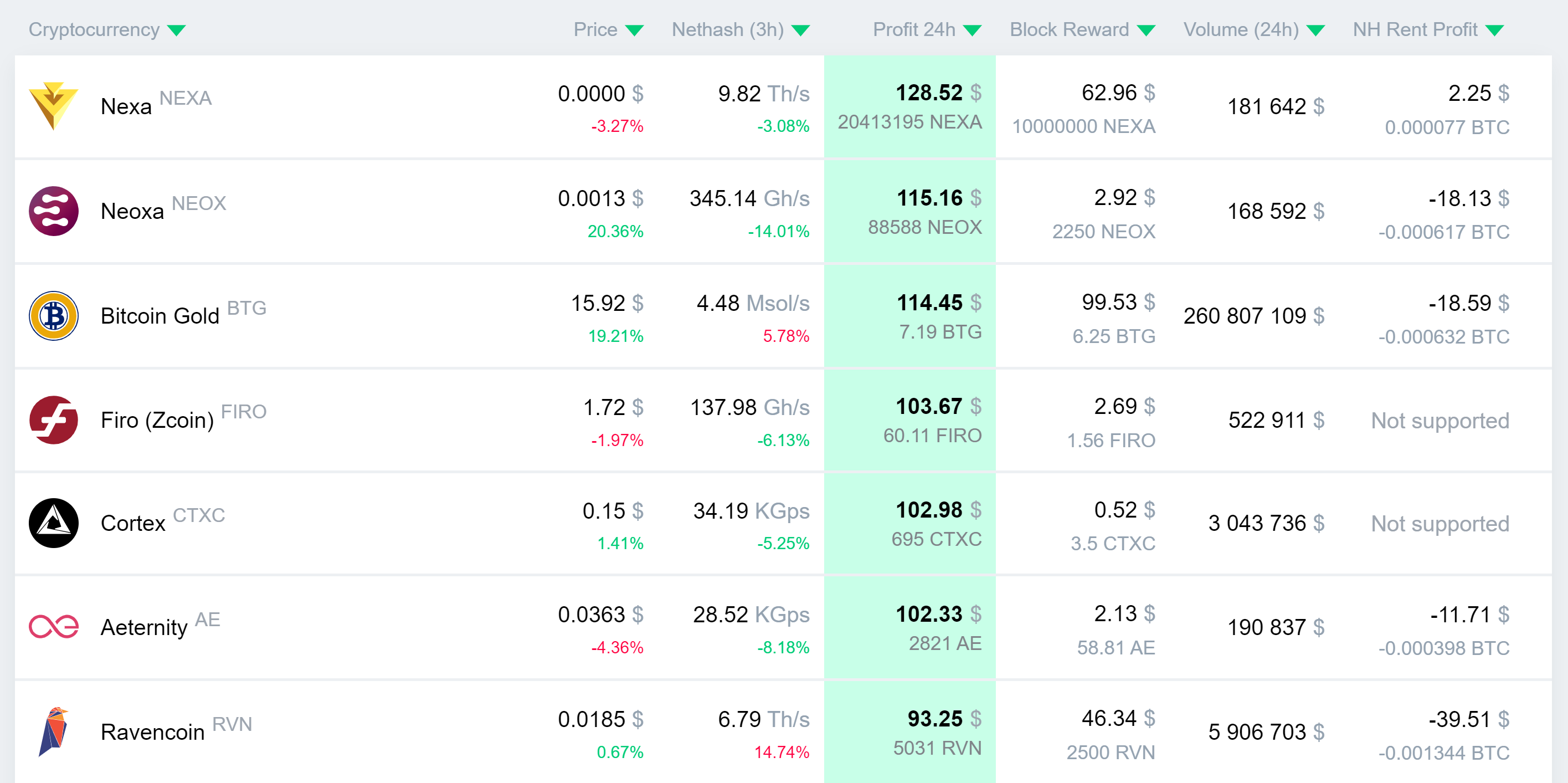
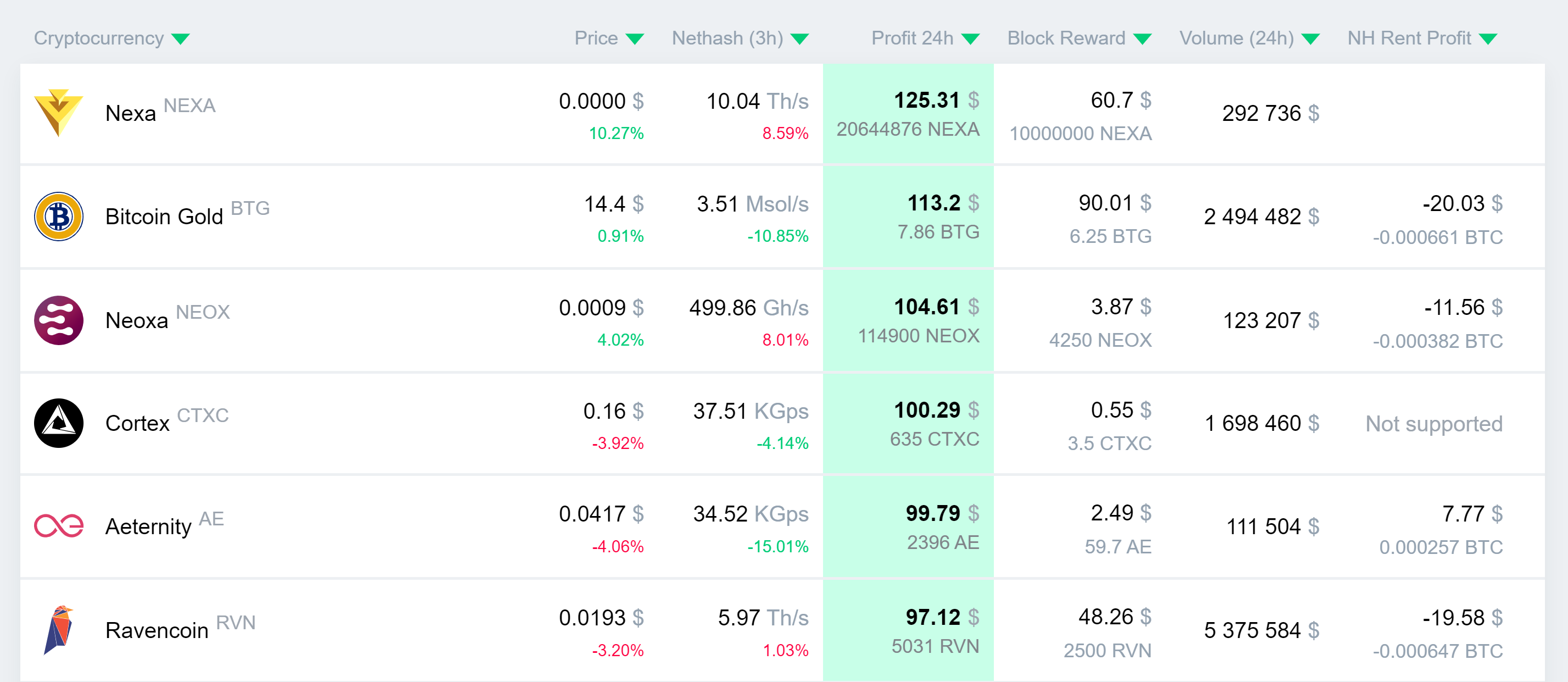
Visit 2CryptoCalc.com and select the model and number of GPUs you own. By default, the mining profit is calculated for 300 Nvidia 3070 GPUs. Currently, Nexa tops the list as the most profitable coin for this setup. However, bear in mind that profitability may vary due to changes in cryptocurrency prices and the amount of hashing power participating in the mining process. So, it’s recommended to revisit the calculator regularly to keep up with any profitability shifts.
Owning 300 Nvidia 3070 GPUs could generate a daily income of $125.31. This calculation doesn’t factor in the cost of electricity.
The Nexa Mining Profit Calculator can help you determine if solo mining with your hashrate is feasible. We advise against solo mining if you’re unlikely to mine at least 1-2 blocks according to the 2CryptoCalc projection. In other words, it’s preferable to have a minimum of 10 GH/s of NexaPoW hashing power.
Remember to follow us on Twitter to get all the news as soon as possible.
Miner since 2017, the 2Miners pool co-founder. Became interested in cryptocurrencies at the dawn of the latest bull run and bought his first graphics cards. After having built and set up a few mining rigs, he realized that existing mining pools didn’t satisfy him – that’s how the idea of creating the 2Miners pool was born.
John published a series of articles about the basics of cryptocurrency mining. He gave valuable tips on how to buy ASICs and GPUs from abroad and then shared their mining performance. On the website, you can find early articles about cryptocurrency mining, blockchain in general and mining pool operation principles. The readers gave positive feedback on John’s practical guides, such as building an Ethereum mining rig and Nvidia 1080ti overclocking.
June 2023 Work Progress Report: Kaspa Block Reward Reduction, Nexa Pool Testing
July 1, 2023
Nexa pool is ready and being tested, planned block reward reduction for Kaspa blockchain.
Kaspa Block Reward Adjustment
As part of Kaspa’s ongoing emission schedule, June marked another milestone for the mining community affiliated with Kaspa. As per the schedule, the reward for mining each block experienced a further reduction. From June onwards, the block reward was reduced from 220 KAS to 207.65 KAS, aligning with the Chromatic Phase of Kaspa’s monetary policy, which incorporates a systematic decrease in block rewards over a specific timeframe.
This shift is a key aspect of Kaspa’s distinctive monetary approach, specifically crafted to maintain a balanced distribution of KAS while supporting the network’s lasting viability. Such alterations are fundamental to the network’s development and fidelity to its established timeline. At 2Miners, our unwavering dedication is to assist miners throughout these modifications, ensuring an effective and rewarding mining platform. To keep abreast of these crucial changes, miners are encouraged to regularly check the Kaspa Emission Schedule.
Nexa Pool Testing
In June, 2Miners mining pool continued to innovate by exploring new blockchain technologies. We’ve added a new project to our portfolio, Nexa. Nexa is a cutting-edge cryptocurrency network designed to be significantly more scalable than other blockchains, targeting global capacity to support over 10 billion transactions per day. It offers unique solutions to the key bottlenecks of bandwidth, speed, and storage, aiming to make transactions nearly instantaneous and remarkably cost-effective. Nexa also features native tokens and NFTs, and employs a unique proof-of-work algorithm to boost transaction validation speed.
As we embrace this next step in our development, we’ve successfully installed Nexa node version 1.3.0.2. This installation is a fundamental process in the creation of the Nexa mining pool. Currently, the pool is in the testing phase, with our team diligently ensuring its smooth operation and performance.
2Miners is set to offer Nexa mining in both PPLNS and SOLO modes. This flexibility allows our miners to choose the mode that best suits their mining strategy. We are proud to announce that the launch is planned for the beginning of July, so get ready to join us in this exciting new endeavor.
If you want to start using 2Miners Nexa Pools straigh away without waiting for the official release, join our Telegram chats. Our admins will be more than happy to assist you.
We are always committed to offering convenience and flexibility to our community, and as such, we’re also planning to add Bitcoin (BTC) payments for Nexa later on. This move will expand the available options for receiving your mining rewards.
As the Nexa network continues to grow, we at 2Miners are excited to be part of this journey. Stay tuned for the upcoming launch and get ready to mine Nexa with 2Miners.
Remember to follow us on Twitter to get all the news as soon as possible.
The 2Miners pool co-founder, businessman, miner. In 2017 started mining cryptocurrencies and built many rigs on his own. As a result, he gained lots of practical knowledge and became interested in sharing it with others.
In his articles on 2Miners, he shares useful tips that he tried and tested himself. For example, Darek gives advice on how to buy hardware components for the basic mining rig and how to connect them to each other correctly. He also explained lots of complicated terms in simple words, such as shares, mining luck, block types, and cryptocurrency wallets. After the pool was launched, he published a series of articles ‘Crypto Mythbusters’ where he explained how to protect the network against 51% attack, talked about cryptocurrency mining difficulty and difficulties of launching your own node.
May 2023 Work Progress Report: Kaspa and Cortex Block Reward Reduction
June 1, 2023
Planned block reward reduction for Kaspa and Cortex blockchains, multiple node updates.
Kaspa Reward Reduction
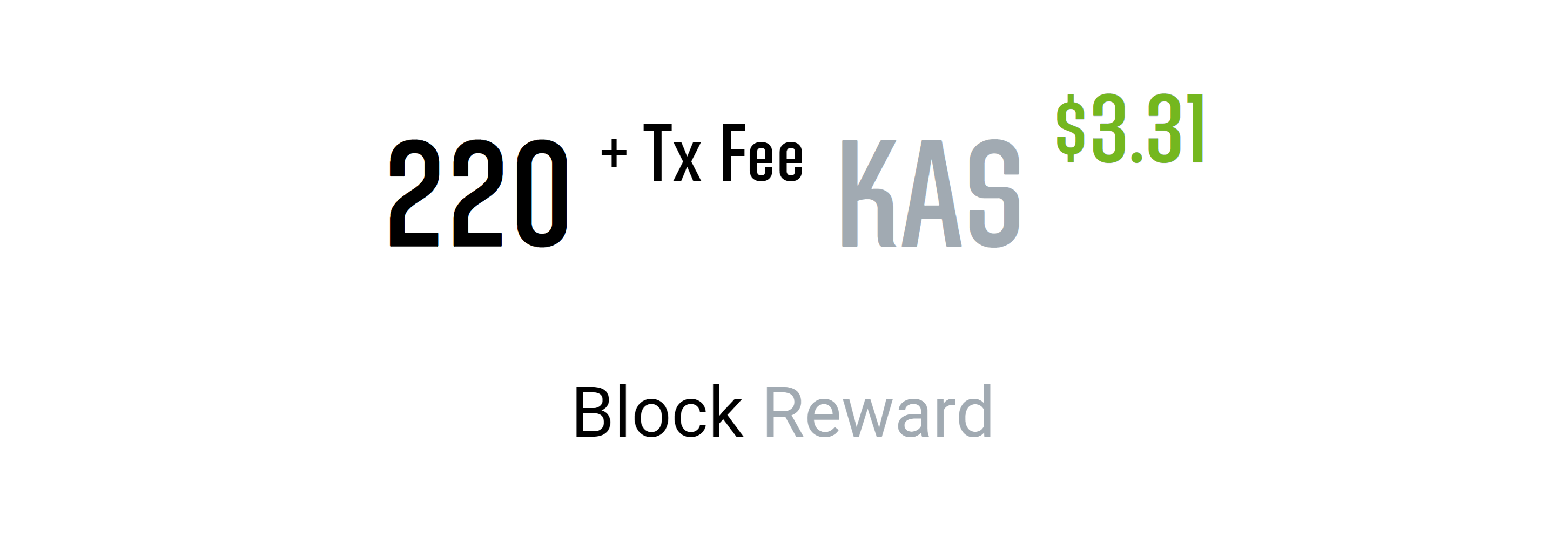
In line with the planned Kaspa emission schedule, a significant event took place on May 8, impacting the mining community associated with Kaspa. The block reward for mining was decreased from 233 KAS to 220 KAS. This change reflects the Kaspa monetary policy’s Chromatic Phase, which involves geometrically decreasing block rewards over time.
It’s crucial to note that such reductions are part of Kaspa’s unique monetary policy, designed to ensure a fair distribution of KAS and the long-term sustainability of the network. These changes are integral to the network’s progression and adherence to its predetermined roadmap. At 2Miners, we remain committed to supporting miners through these adjustments, providing an efficient and profitable mining environment. As always, we recommend miners stay informed about such changes, which can be followed via the Kaspa Emission Schedule.
Cortex Reward Reduction
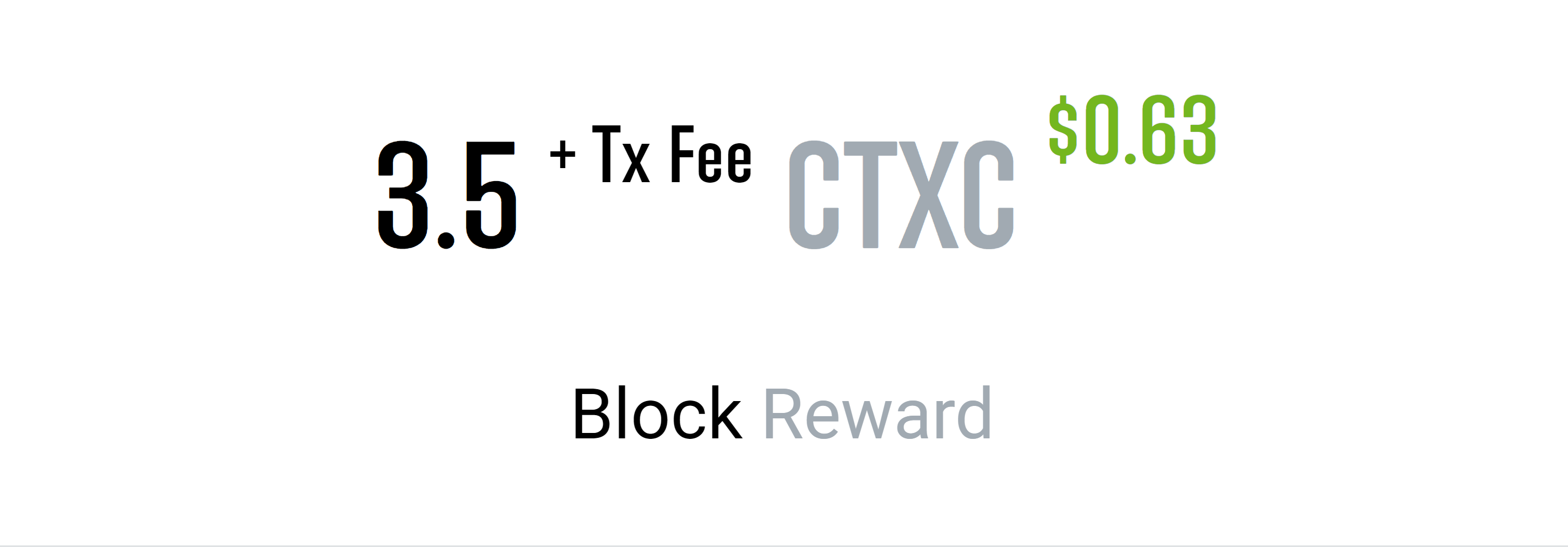
The Cortex (CTXC) blockchain underwent its halving event on May 2nd. As a result of this crucial adjustment in the network’s monetary policy, the block reward for miners was slashed from 7 CTXC to 3.5 CTXC per block. This halving process, inherent to the Cortex protocol, effectively diminishes the mining reward by 50%, thereby impacting the rate at which new CTXC tokens are created and injected into the market.
For the miners on the 2Miners pool, this implies a reduction in the amount of CTXC tokens they earn for their computational contributions. Nevertheless, while the miners’ immediate income may be lessened, such halving events historically tend to induce a scarcity effect, potentially driving up the value of the cryptocurrency over time. Thus, the impact of this event on the long-term profitability of mining Cortex remains to be seen.
Mining Pool Updates
We conducted several key updates to the cryptocurrency nodes on the 2Miners mining pool, ensuring the smooth operation and enhanced security for our miners. The updated nodes are as follows:
Zcash (ZEC) updated to 5.5.1
Horizen (ZEN) updated to 4.0.0
Monero (XMR) updated to 0.18.2.2
Beam updated to 7.3.14073
Let’s look closer at each of these updates:
Zcash (ZEC) 5.5.1 Update: This upgrade addressed an issue that could cause a node to crash when the privacy policy did not include ‘AllowRevealedRecipients’ while creating a transaction resulting in transparent change. Additionally, it corrects an underestimation of the ZIP 317 conventional fee when spending UTXOs, preventing delays or blocks in mining transactions.
Horizen (ZEN) 4.0.0 Update: This major update includes new key features and introduces a hard fork. It supports V2 sidechains and sets the upcoming deprecation date. Key enhancements include non-ceasable Sidechains and Key Rotation, making the verification process more flexible without compromising security. This release marked the end of supporting Ubuntu Bionic, limiting future releases to Ubuntu Focal or newer.
Monero (XMR) 0.18.2.2 Update: The ‘Fluorine Fermi’ release introduced several improvements such as adding a size limit for tx_extra in the transaction pool, avoiding log entries when re-blocking a subnet, and fixing an infinite loop in fake out selection. This update also enhanced the security by adding Ledger Stax support.
Beam 7.3.14073 Update: This hotfix addressed a crucial bug that led to the creation of invalid blocks, temporarily halting the generation of new blocks. It optimized block creation and listed some known limitations, such as not going offline for over 24 hours when using active laser beam channels and not offering the same offline address to multiple senders of payments.
Each of these updates is part of our continued commitment to maintaining the 2Miners pool at the forefront of technological advancements, providing the best possible service for our mining community.
The 2Miners pool co-founder, businessman, miner. In 2017 started mining cryptocurrencies and built many rigs on his own. As a result, he gained lots of practical knowledge and became interested in sharing it with others.
In his articles on 2Miners, he shares useful tips that he tried and tested himself. For example, Darek gives advice on how to buy hardware components for the basic mining rig and how to connect them to each other correctly. He also explained lots of complicated terms in simple words, such as shares, mining luck, block types, and cryptocurrency wallets. After the pool was launched, he published a series of articles ‘Crypto Mythbusters’ where he explained how to protect the network against 51% attack, talked about cryptocurrency mining difficulty and difficulties of launching your own node.