What Is Quantus (QTC)
Quantus Network is a Layer 1 blockchain for payments and long-term value storage, designed to stay secure if large quantum computers ever break today’s elliptic-curve signatures. Instead of ECDSA, every Quantus account signs transactions with ML-DSA (formerly CRYSTALS-Dilithium), the lattice-based signature scheme standardized by NIST in FIPS 204. The protection is built in from the first block, so no future migration is needed.
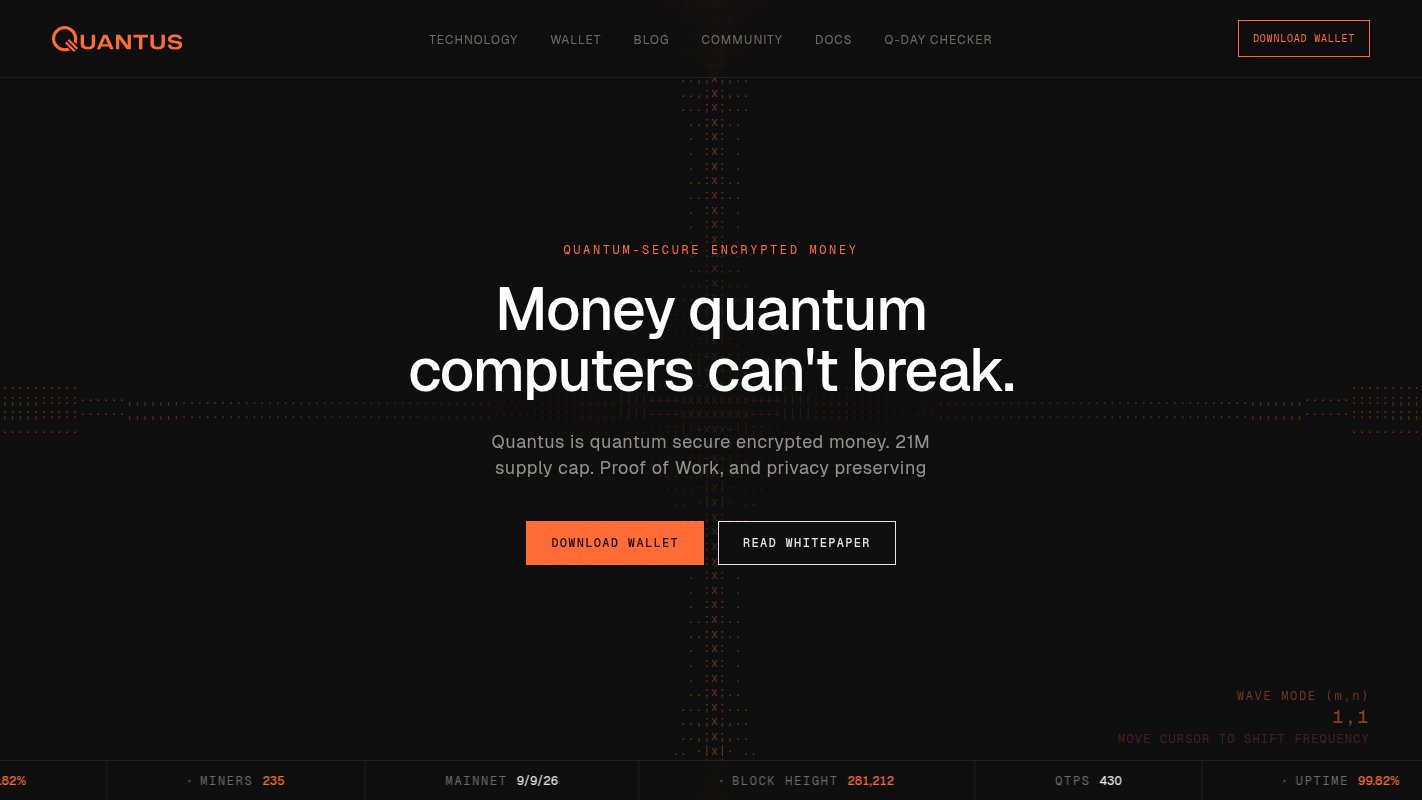
The chain is built on Substrate (Polkadot SDK) as a standalone network and secured by pure Proof-of-Work. Mainnet launched on September 9, 2026.
Important: the ticker QTC is also used by Qubitcoin, an unrelated coin on a different algorithm. Some exchanges and calculators list Quantus as QUANTUS or QUAN. Always check that you are looking at Quantus Network.
Quantus Mining Specs
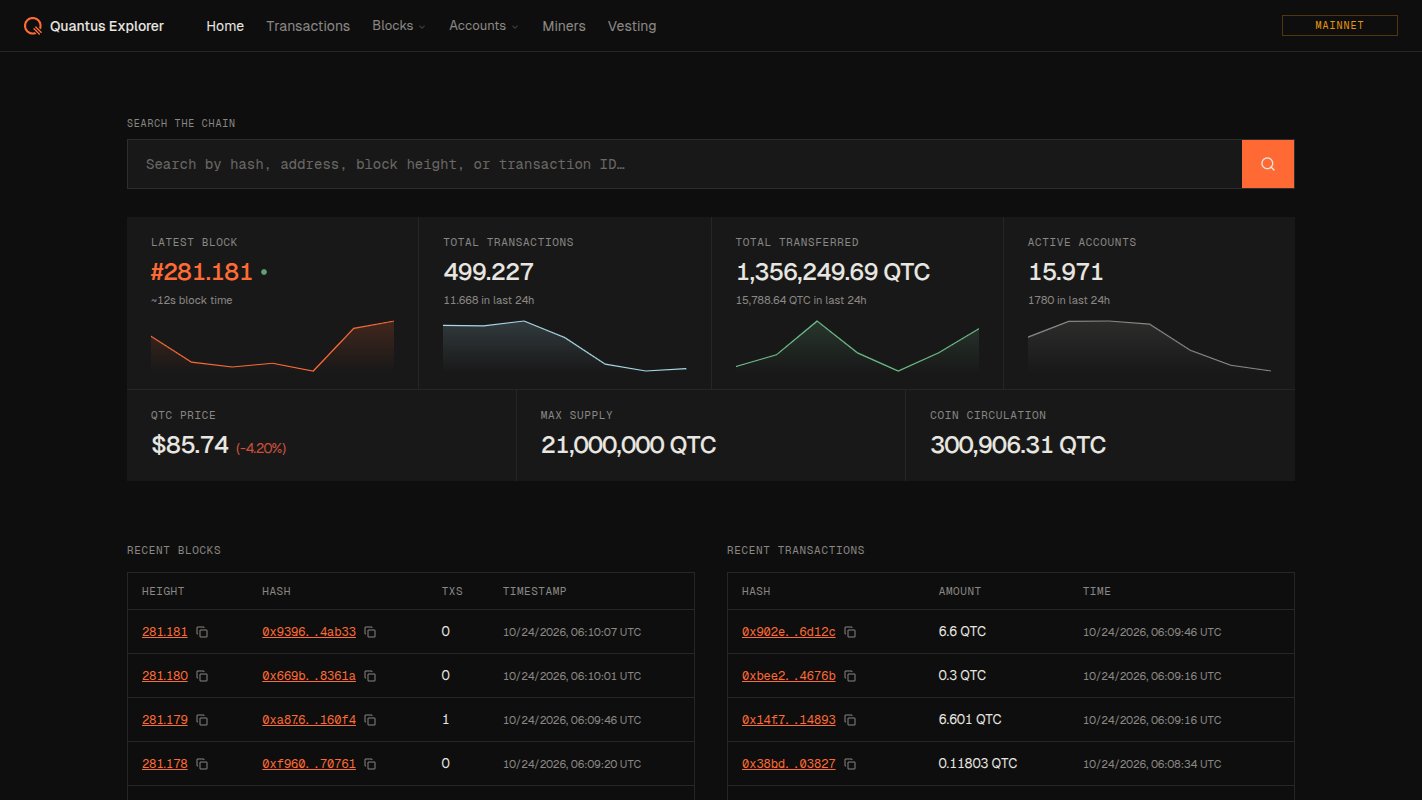
- Algorithm: Poseidon2 (over the Goldilocks field). The project calls its consensus QPoW.
- Hardware: GPUs. NVIDIA performs best; AMD and Intel Arc are supported. CPU mining is not profitable.
- Block reward: about 0.3 QTC plus transaction fees, slowly decreasing with every block.
- Block time: 12 seconds target; the real average has been around 14-15 seconds.
- Max supply: 21,000,000 QTC.
- Dev fee in block reward: none. Miners receive 100% of the subsidy.
- Explorer: explorer.quantus.com
Poseidon2 was chosen because it is cheap to verify inside zero-knowledge proofs, which Quantus uses for its optional private transfers. It was not designed to be ASIC-resistant. No Quantus ASIC or FPGA exists today, but specialized hardware may appear in the future.
Quantus Block Reward and Tokenomics
Quantus has no halvings. The block reward is recalculated every block with a simple formula:
block reward = (21,000,000 − current supply) / 50,000,000
Today this gives about 0.305 QTC per block, and the number shrinks a tiny bit with each block mined. Half of the remaining mineable supply will be issued in roughly 15 years. Explorers show rewards alternating between 0.30 and 0.31 QTC because the protocol rounds the payout and carries the remainder to the next block. This is normal.
- Mining: 73% of the max supply, 15.33 million QTC.
- Genesis allocation: 27%, 5.67 million QTC for investors, the team and the company. Most of it is locked until September 2027 and then vests linearly over 36 months.
Emission parameters are part of the runtime and can be changed by a forkless upgrade, so follow the official Quantus blog for changes.
Best GPUs for Quantus Mining
Poseidon2 is compute-bound and runs best on NVIDIA CUDA cores. Typical SRBMiner-MULTI hashrates (October 2026); to see what your card earns, enter its hashrate in 2CryptoCalc:
- RTX 5090: about 1,310 MH/s at 405 W
- RTX 4090: about 1,280 MH/s at 300 W
- RTX 5080: about 865 MH/s
- RTX 5070 Ti: about 711 MH/s
- RTX 3080: about 417 MH/s
- RTX 3060 Ti: about 247 MH/s
- RX 7900 XTX: about 193 MH/s
- RX 9070 XT: about 178 MH/s
An NVIDIA card does roughly 5-7 times the hashrate of a comparable AMD card on this algorithm. Since memory speed barely matters, lowering the memory clock reduces power draw without losing hashrate. Mining software for Quantus is updated often, so check the latest release before benchmarking your rigs.
Quantus Wallet Setup
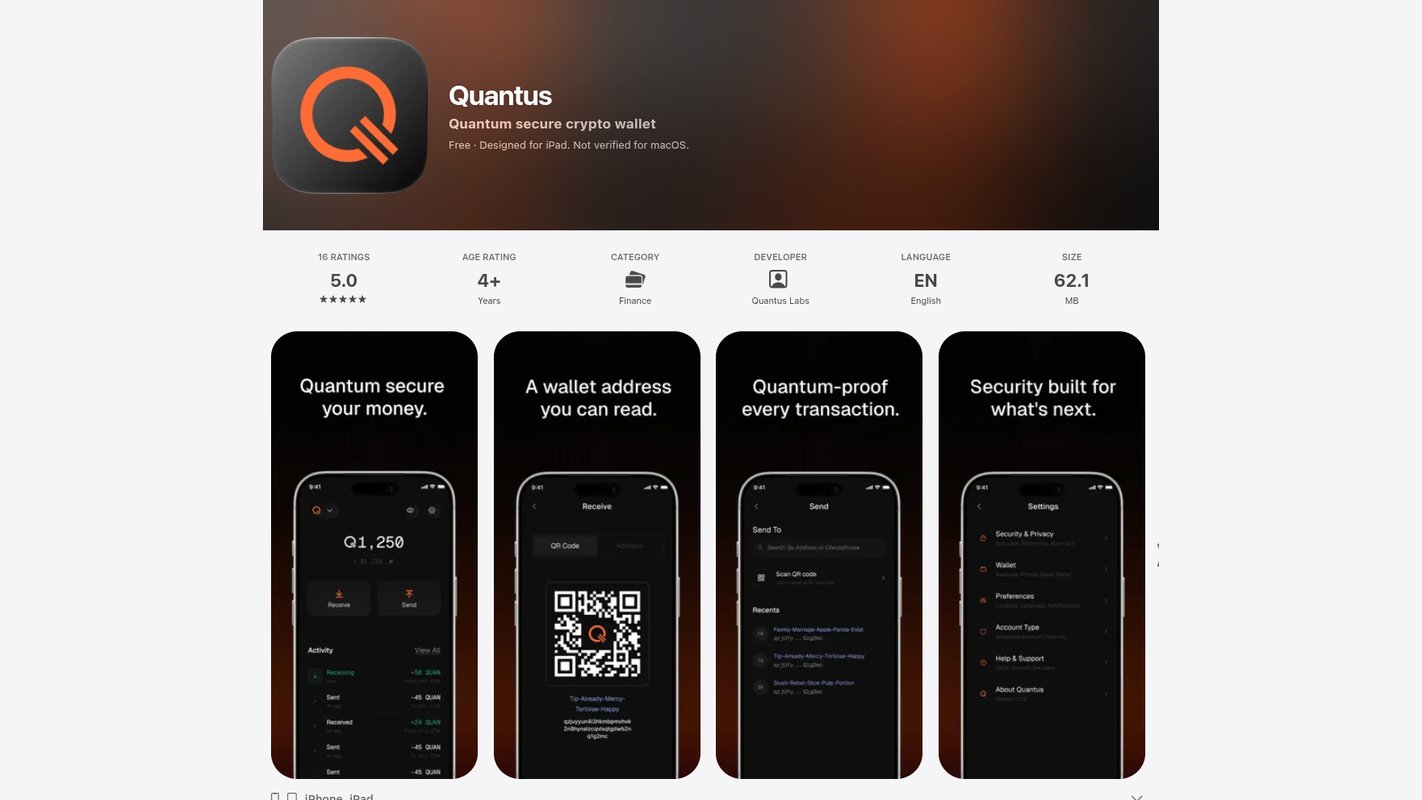
You need a Quantus address before you start. All Quantus mainnet addresses start with qz, for example: qzk5WTch4rYS1AqFuvH53MUsngCSbBzb2gpNxAnyMnMRyTrqd.
- Quantus Wallet: the official mobile app for iOS and Android, currently in public beta. Recommended for most miners.
- Quantus Cold Wallet: an Android app that turns an offline phone into an air-gapped signer. Keystone 3 is supported through Quantus firmware.
- Exchange address: SafeTrade lists Quantus under the ticker QUANTUS. Check the minimum deposit and the network before you point a miner at an exchange address.
To create an address in the official app:
- Install Quantus Wallet and choose Create New Wallet.
- Write down the 24-word recovery phrase and keep it offline. Anyone with these words controls your coins.
- Tap Receive and copy your qz… address.
How to Mine Quantus on 2Miners
2Miners recommends SRBMiner-MULTI for NVIDIA, AMD and Intel GPUs. Quantus support was added in version 3.6.4; the current developer fee for the quantus algorithm is 2%. Use the latest release.
Quantus Pool (PPLNS)
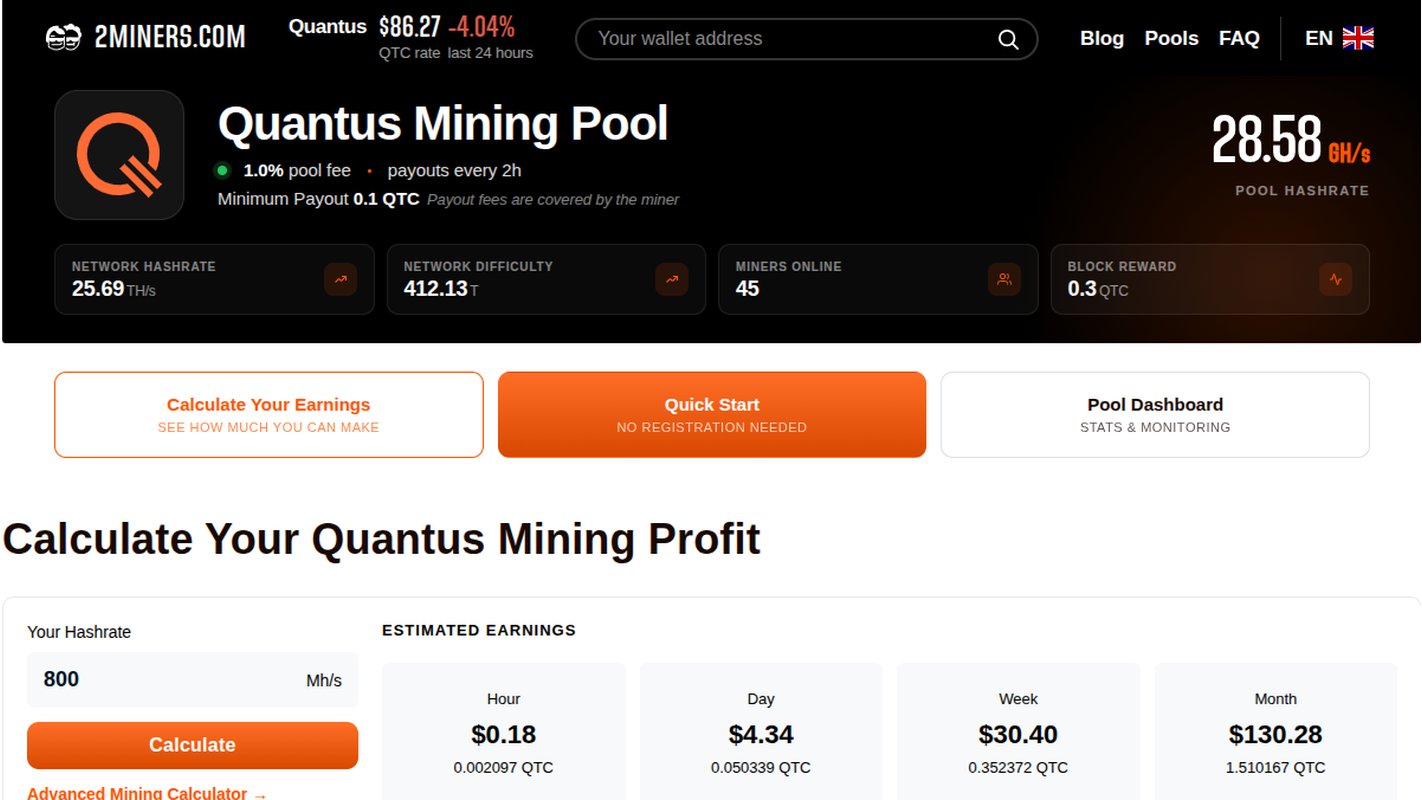
Steady payouts proportional to your shares. Fee: 1%. Minimum payout: 0.1 QTC. Payouts run automatically every 2 hours.
- Europe: qtc.2miners.com:3636
- USA: us-qtc.2miners.com:3636
- Asia: asia-qtc.2miners.com:3636
- SSL port: 13636
- Worker: YOUR_QTC_ADDRESS.RIG_ID
- Password: x
Pool dashboard: 2miners.com/qtc-mining-pool. Setup guide: qtc.2miners.com/help.
Quantus SOLO Pool
You receive the full block reward for every block your rigs find. Fee: 1.5%. Same payout schedule and minimum.
- Europe: solo-qtc.2miners.com:7676
- USA: us-solo-qtc.2miners.com:7676
- Asia: asia-solo-qtc.2miners.com:7676
- SSL port: 17676
- Worker: YOUR_QTC_ADDRESS.RIG_ID
- Password: x
Pool dashboard: 2miners.com/solo-qtc-mining-pool. Setup guide: solo-qtc.2miners.com/help.
SRBMiner-MULTI on Windows
Download SRBMiner-MULTI, unpack it, create a .bat file in the miner folder and paste one line (PPLNS, Europe):
SRBMiner-MULTI.exe –algorithm quantus –pool qtc.2miners.com:3636 –wallet YOUR_QTC_ADDRESS.RIG_ID –password x
Replace YOUR_QTC_ADDRESS with your qz address. RIG_ID is optional: up to 32 characters, letters, numbers, “-” and “_”. For SOLO, change the pool to solo-qtc.2miners.com:7676. For SSL, use port 13636 (or 17676 for SOLO) and add –tls true.
HiveOS
HiveOS has no built-in Quantus miner yet, so use a custom miner:
- Create a wallet in HiveOS with your qz address and coin QTC.
- In a new flight sheet choose Custom miner and paste the installation URL of the latest srbminer_custom archive from the SRBMiner-MULTI releases page.
- Hash algorithm: quantus. Wallet and worker template: %WAL%.%WORKER_NAME%. Pool URL: qtc.2miners.com:3636. Password: x.
- Extra config arguments: –algorithm quantus –disable-cpu.
PPLNS or SOLO: Which to Choose
- PPLNS pays you a share of every block the pool finds. Smaller, regular payouts with low variance.
- SOLO pays the whole block reward, but only for blocks your own hashrate finds.
With the network at around 28 TH/s, a rig with about 1 GH/s (one RTX 4090) finds a block about once every five days on average, and the real gaps can be much longer. For one rig or a few GPUs, PPLNS is the practical choice. SOLO makes sense for large farms.
One more reason to pick your pool deliberately: in October 2026 a single address mined more than half of recent Quantus blocks. Spreading hashrate across pools keeps the network healthy.
Quantus Mining Profitability
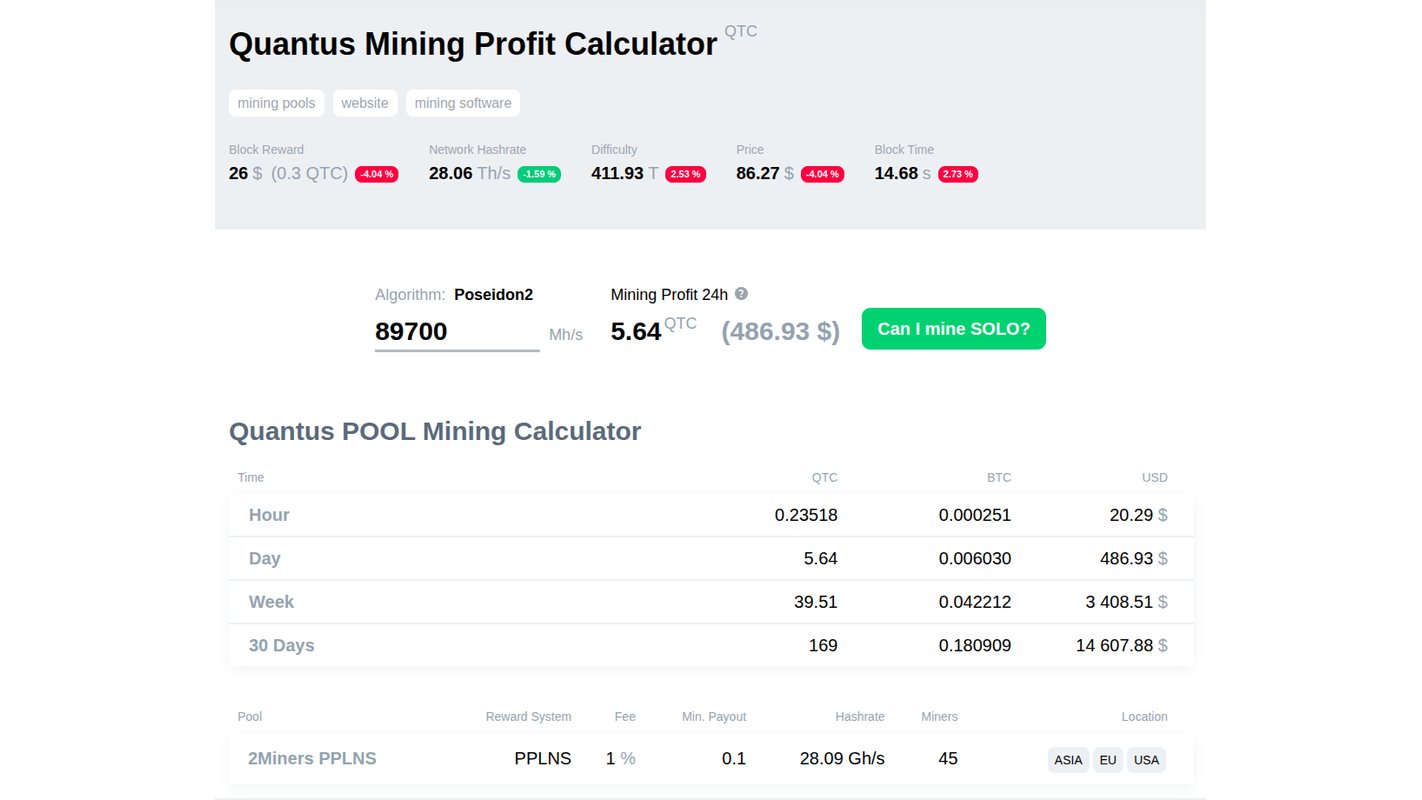
Quantus is supported in 2CryptoCalc. Enter your hashrate and electricity price to see expected daily earnings in QTC and USD for PPLNS and SOLO. The calculator uses live difficulty and price data. Price data: CoinMarketCap.
Where to Sell QTC
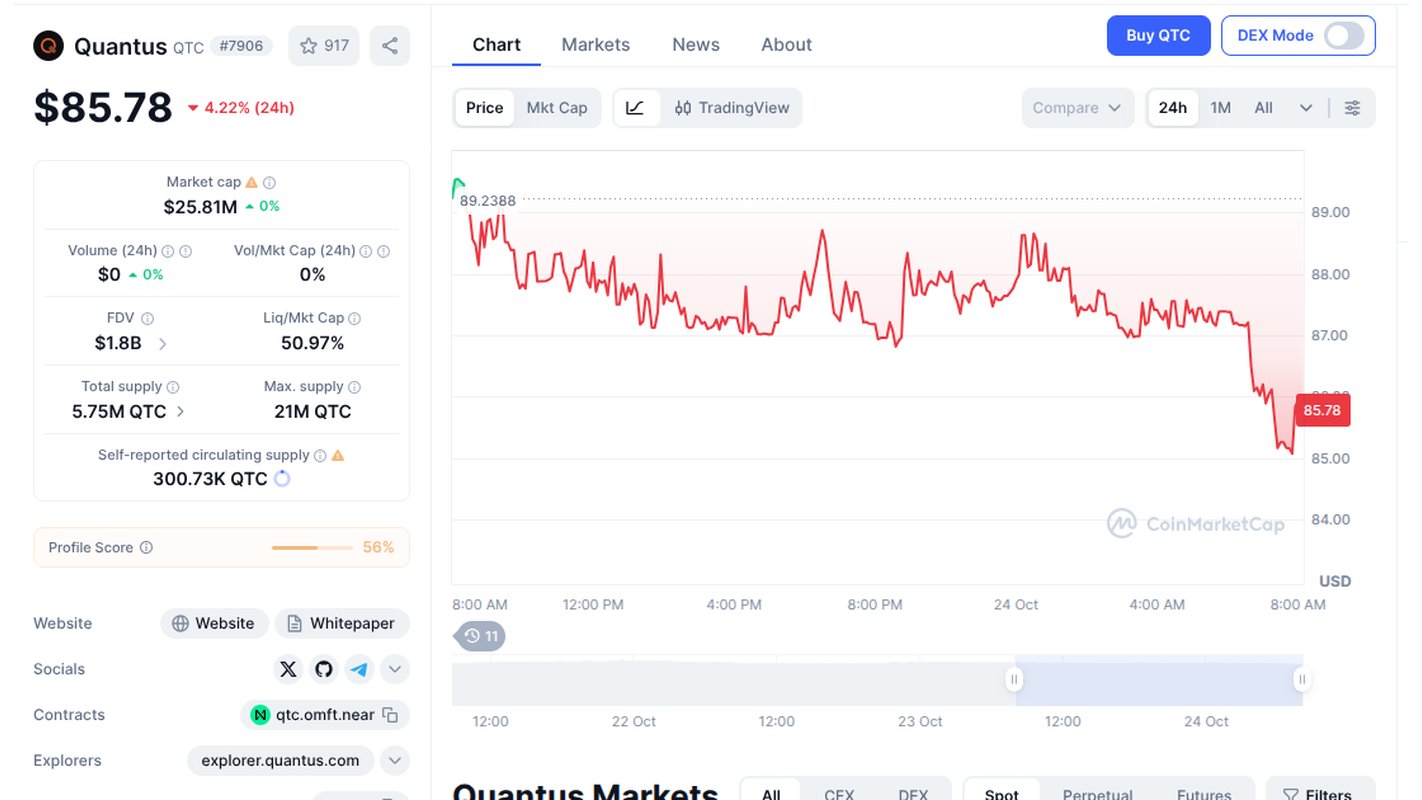
- SafeTrade: listed since mainnet launch under the ticker QUANTUS.
- BigONE: QTC/USDT pair since October 5, 2026.
- NEAR Intents (near.com): swaps between QTC and assets on other chains since October 6, 2026.
Liquidity is still thin, so check the order book before selling large amounts.
Quantus Mining FAQ
Is Quantus (QTC) the same as Qubitcoin (QTC)?
No. They are different coins with different algorithms that happen to share a ticker. 2Miners mines Quantus Network on Poseidon2.
Can I mine Quantus with a CPU?
Technically yes, with the official Quantus miner, but a desktop CPU earns a tiny fraction of what a single mid-range GPU does. SRBMiner-MULTI does not support CPU mining for this algorithm.
Is there a Quantus ASIC?
Not today. Poseidon2 was not designed to resist specialized hardware, so this may change.
Why does the explorer show 0.30 and 0.31 QTC rewards?
The protocol rounds each payout and carries the remainder forward, so the displayed reward alternates. The underlying reward is about 0.305 QTC and decreases slowly.
Stay Updated
Follow us on X (Twitter) and join our Telegram chat to stay informed about new developments, miner alerts, and network upgrades.